During training, an engineer observes that the derivative of the loss function with respect to a particular weight has reached exactly zero at the current point. Which statement correctly interprets what this means on its own?
Select an answer to reveal the explanation.
Short Explanation and Infographic
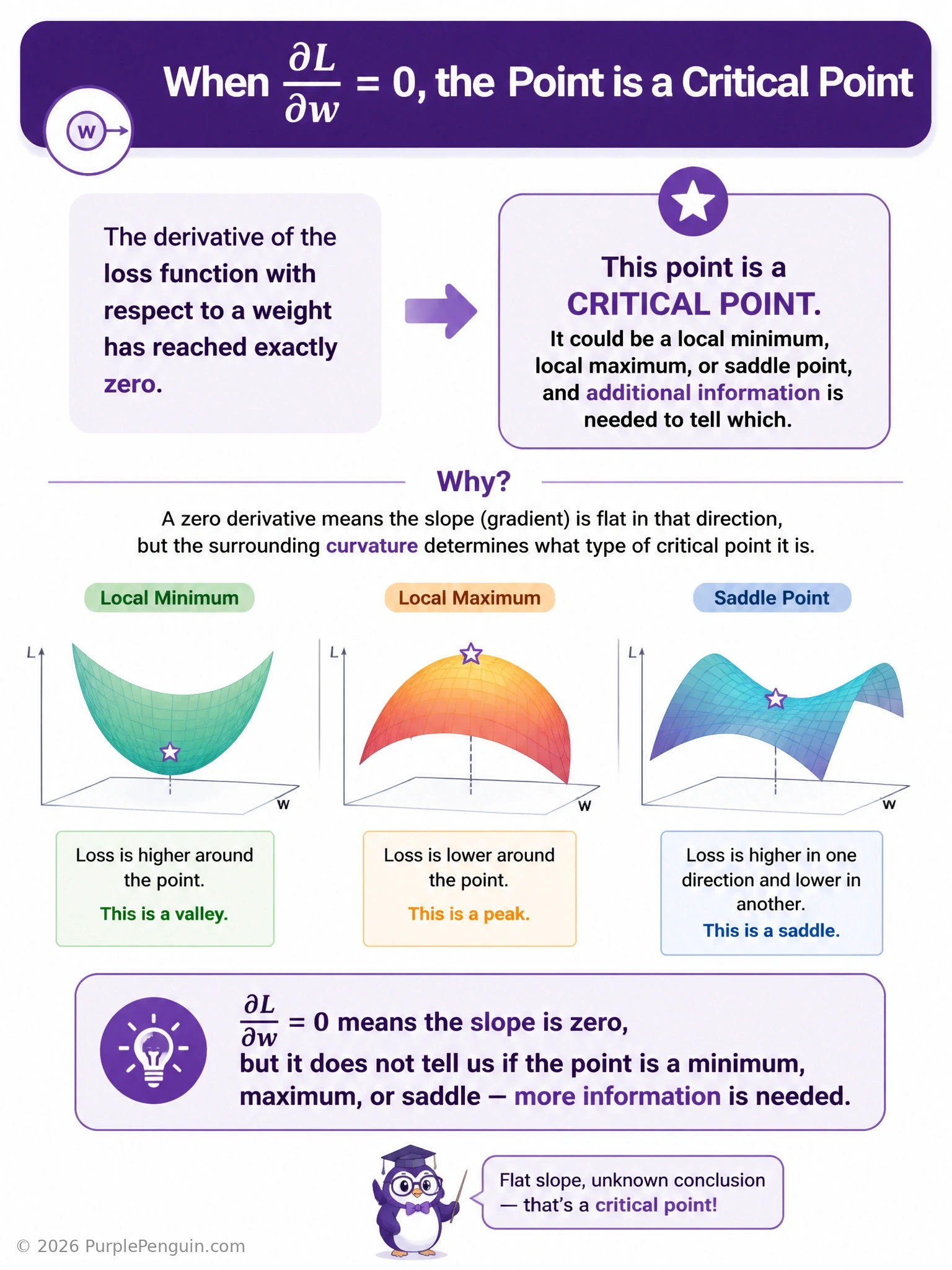
A derivative of zero just tells you the slope is flat right there — that's it, that's all it guarantees. It's what we call a critical point, but flat could mean you're sitting in a nice valley (local min), on top of a hill (local max), or on a saddle where it curves up one way and down another. You need more evidence, typically the second derivative or, in higher dimensions, the Hessian matrix, to tell those apart. So no, zero gradient doesn't hand you a global minimum on a silver platter, and it definitely doesn't mean training has broken — in fact it's often exactly where you want to land. It just means: stop and check the curvature before celebrating.
Full explanation below image
Full Explanation
When the derivative (or, in multivariable settings, the gradient) of a loss function equals zero at a given point, that point is classified as a critical point (also called a stationary point). This condition alone is necessary but not sufficient to determine the nature of that point — it could be a local minimum (loss curves upward in every direction from that point), a local maximum (loss curves downward in every direction), or a saddle point (loss curves upward in some directions and downward in others, which is common in the high-dimensional loss landscapes of deep neural networks). To distinguish between these cases, you need additional information: in one dimension, the sign of the second derivative (positive implies local minimum, negative implies local maximum, zero is inconclusive and requires further tests); in multiple dimensions, the eigenvalues of the Hessian matrix (all positive implies local minimum, all negative implies local maximum, mixed signs imply a saddle point). 'Guaranteed to be the global minimum' is incorrect because a zero derivative only certifies local flatness; there could be other points elsewhere in the loss landscape with even lower loss, and without convexity guarantees (which deep neural network loss surfaces generally lack), there is no way to conclude global optimality from a zero gradient alone. 'Guaranteed to be a local minimum' is incorrect for the same underlying reason applied locally — a zero derivative is equally consistent with a local maximum or a saddle point, and in fact saddle points are extremely common in the high-dimensional, non-convex loss surfaces typical of deep learning, arguably more common than true local minima. 'Training has definitely diverged' is incorrect and actually inverts the intended meaning: a zero gradient during training is frequently a sign of convergence (the optimizer has settled near a critical point, ideally a good local minimum), not divergence; divergence typically manifests as exploding, oscillating, or NaN-valued losses and gradients, which is the opposite behavior from a vanishing gradient. The core principle worth remembering: 'zero derivative' answers the question 'is the slope flat here?' but says nothing about the shape of the curvature around that flat point — that distinction requires second-order information, which is exactly why optimizers and analysis tools examine the Hessian (or approximations to it) when precise characterization of a critical point matters.