Standard RNNs struggle to learn dependencies across long sequences because gradients shrink to near zero as they're propagated back through many time steps. Which component of an LSTM (Long Short-Term Memory) unit is primarily responsible for mitigating this vanishing gradient problem?
Select an answer to reveal the explanation.
Short Explanation and Infographic
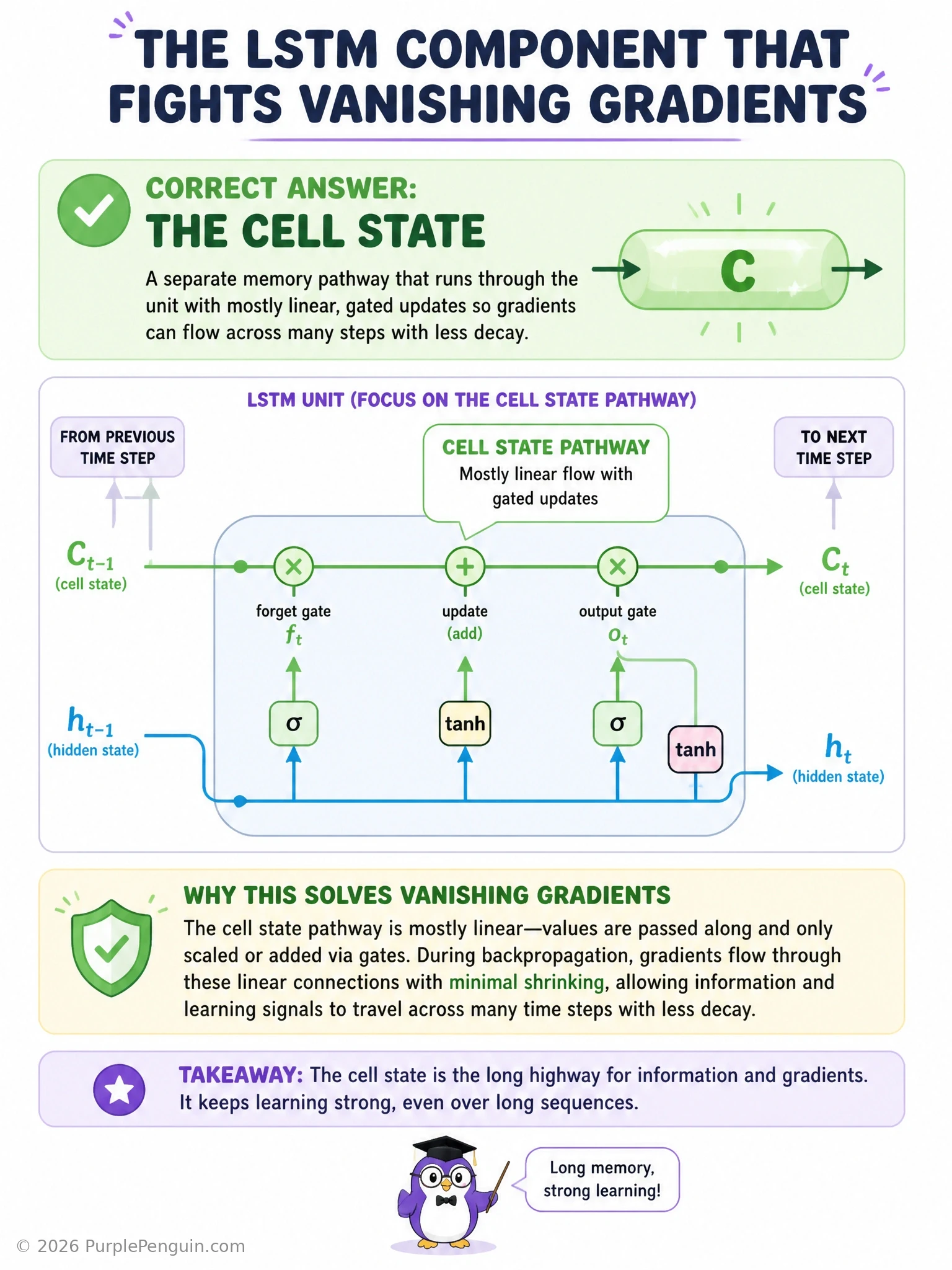
The hero here is the cell state. Picture it as a conveyor belt running straight through the LSTM unit, mostly untouched except for a few gated additions and removals, rather than getting squashed through a nonlinearity at every single step the way a plain RNN's hidden state does. Because the cell state's updates are mostly additive and controlled by gates (forget, input) rather than repeated multiplicative squashing, gradients can flow backward across many time steps without shrinking to nothing. The output gate is important too, but it just decides how much of that cell state gets exposed as the visible hidden state at each step — it's not the mechanism preventing gradient decay. The embedding layer only converts tokens into vectors before any recurrence happens, and softmax just turns final scores into probabilities — neither has anything to do with gradients flowing backward through time.
Full explanation below image
Full Explanation
The correct answer is the cell state, which functions as a dedicated memory highway running through the LSTM unit largely in parallel to the more heavily transformed hidden state. In a vanilla RNN, the hidden state is repeatedly passed through a nonlinearity (like tanh) and multiplied by weight matrices at every time step, and during backpropagation through time the chain rule repeatedly multiplies gradients by these same small derivative and weight terms, so gradients shrink exponentially the further back they travel — the vanishing gradient problem. The LSTM's cell state sidesteps this with mostly additive, gated updates: the forget gate decides what fraction of the existing cell state to keep, and the input gate decides what new information to add, but the cell state is not forced through a squashing nonlinearity at every step in the same repeated multiplicative way; this near-linear pathway lets gradients flow backward across many time steps with far less decay, which is why LSTMs learn dependencies spanning dozens or even hundreds of steps where plain RNNs fail. The first distractor, the output gate, does play an important role, but its job is to control how much of the cell state's information is exposed as the hidden state at the current step — it shapes what the rest of the network sees, but isn't the structural reason gradients survive long backward passes; that credit belongs to the cell state pathway itself. The second distractor, the input embedding layer, operates entirely outside the recurrent mechanism, converting token IDs into dense vectors before the sequence ever enters the recurrent computation — it has no role in how gradients propagate backward through time. The third distractor, the softmax output layer, converts raw output scores into a probability distribution over classes or vocabulary items, a task entirely disconnected from how gradients flow backward through the recurrent memory pathway across time steps; softmax operates at a single time step's output, not across the temporal depth of the sequence. A useful memory aid: picture the cell state as an uninterrupted conveyor belt of memory with a few valves (gates) controlling what gets added or dropped, exactly the kind of near-linear pathway that lets gradient signal travel far without vanishing.