A team is choosing an architecture to classify tens of thousands of product photos into categories like 'shoes,' 'bags,' and 'watches.' Which type of network is generally the best default choice for this kind of image classification task?
Select an answer to reveal the explanation.
Short Explanation and Infographic
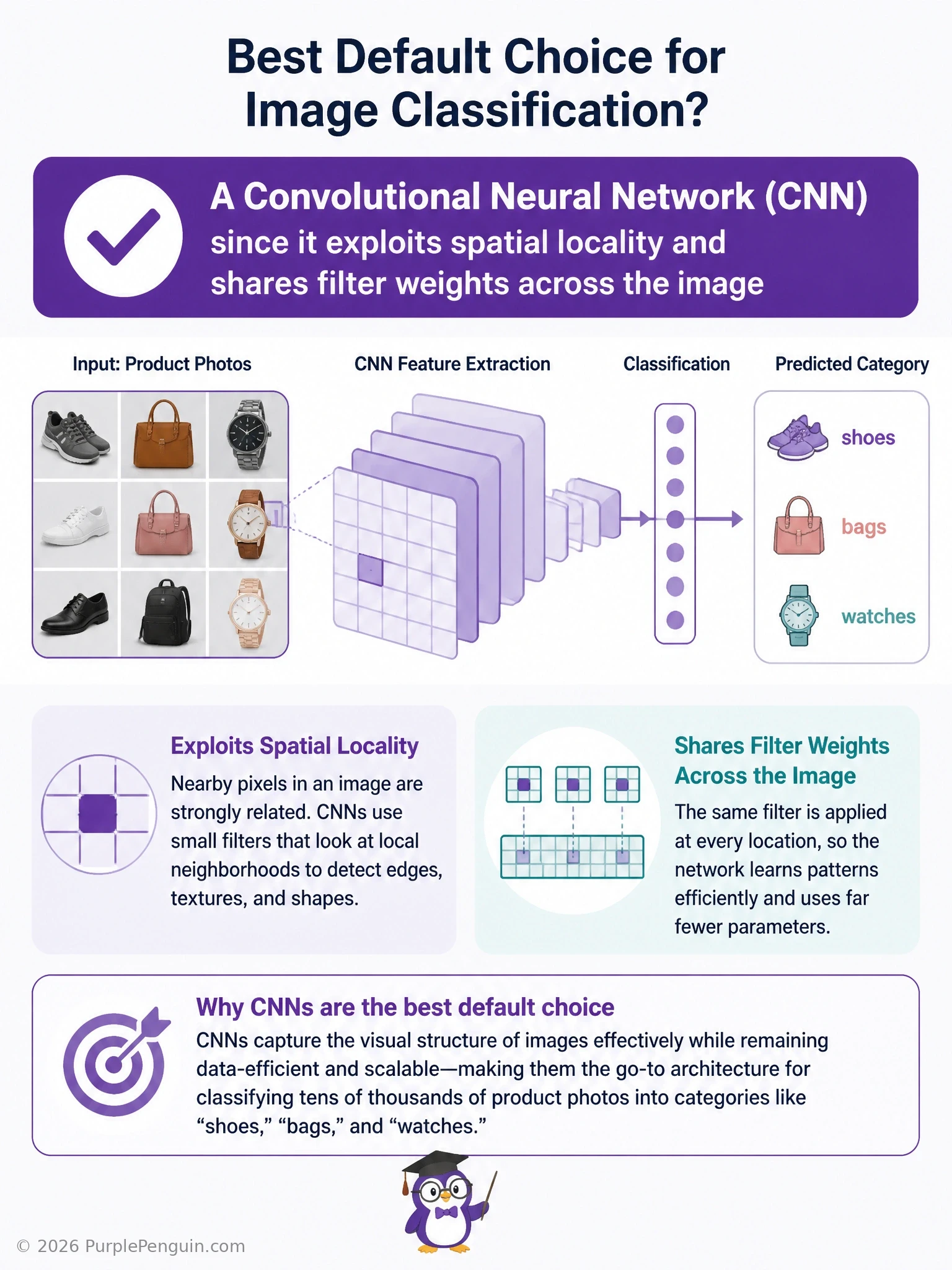
For image classification, CNNs are the default for a reason: they use small filters that slide across the image looking for local patterns — edges, corners, textures — and because those filters are shared across every position, the network doesn't need a separate weight for every single pixel combination. That keeps the parameter count sane and lets the network build up from simple local patterns in early layers to whole-object recognition in deeper layers, which is exactly the structure a photo has. A plain fully connected network ignores that spatial structure entirely and would need an enormous, wasteful number of weights. RNNs are built for sequences that unfold over time or order, like sentences or audio, not static grids of pixels. And decision tree ensembles struggle badly with raw high-dimensional pixel data since they can't learn the hierarchical spatial features a CNN builds naturally.
Full explanation below image
Full Explanation
The correct answer is the Convolutional Neural Network, because CNNs are architecturally designed around two properties that match image data perfectly: local connectivity and weight sharing. A convolutional filter only looks at a small neighborhood of pixels at a time (local connectivity), and that same filter is applied across every position in the image (weight sharing), which means the network can detect a pattern like a diagonal edge regardless of where it appears in the frame, while keeping the number of learnable parameters dramatically smaller than a fully connected alternative. Stacking convolutional layers lets the network build a feature hierarchy: early layers detect simple edges and colors, middle layers combine those into textures and parts, and deeper layers assemble those parts into whole-object representations like a shoe or a watch face — exactly the representational structure needed for classifying product photos. The first distractor, a plain fully connected feedforward network, technically could be applied to flattened pixel vectors, but it discards all spatial relationships between neighboring pixels and requires a separate weight for every input-to-neuron connection, leading to an explosion of parameters, severe overfitting risk, and no built-in translation invariance — a shoe in the top-left corner and the same shoe in the bottom-right corner would look like entirely different inputs to the network. The second distractor, recurrent neural networks, are built to model sequential or temporal dependencies, where the order of inputs matters and information needs to persist across time steps, such as in language or time-series data — a static product photo has no temporal ordering to exploit, so RNNs bring no architectural advantage here and are rarely used for standard image classification. The third distractor, decision tree ensembles like random forests or gradient boosting, can be effective on structured tabular data with a modest number of engineered features, but raw pixel arrays are extremely high-dimensional and lack the kind of discrete, independently meaningful features that tree splits work well on; trees also cannot learn translation-invariant spatial hierarchies the way convolutional filters do, so they perform poorly on raw image classification without heavy manual feature engineering. The core memory aid: CNNs win at images because convolution mirrors how visual patterns repeat across a scene, letting one learned filter generalize everywhere in the frame.