A small startup has only 2,000 labeled medical images, nowhere near enough to train a deep CNN from scratch. Instead, they start from a network already trained on millions of general-purpose photos, then fine-tune its later layers on their small medical dataset. What is this strategy called?
Select an answer to reveal the explanation.
Short Explanation and Infographic
That's transfer learning in a nutshell — you take a network that already learned a ton of useful, general visual features from a giant dataset (edges, textures, shapes, and so on) and instead of starting from random weights, you use those learned features as your starting point, then fine-tune the later layers for your specific, much smaller task. It's why 2,000 medical images can actually work: the network isn't learning to see from zero, it's just adapting existing vision skills to a new domain. Data augmentation is a different idea entirely — it's about stretching, flipping, or cropping images to make your existing dataset act bigger, not about reusing another model. Ensemble learning is about combining several models' votes, and federated learning is about training across distributed devices without moving the data — neither matches what's being described here.
Full explanation below image
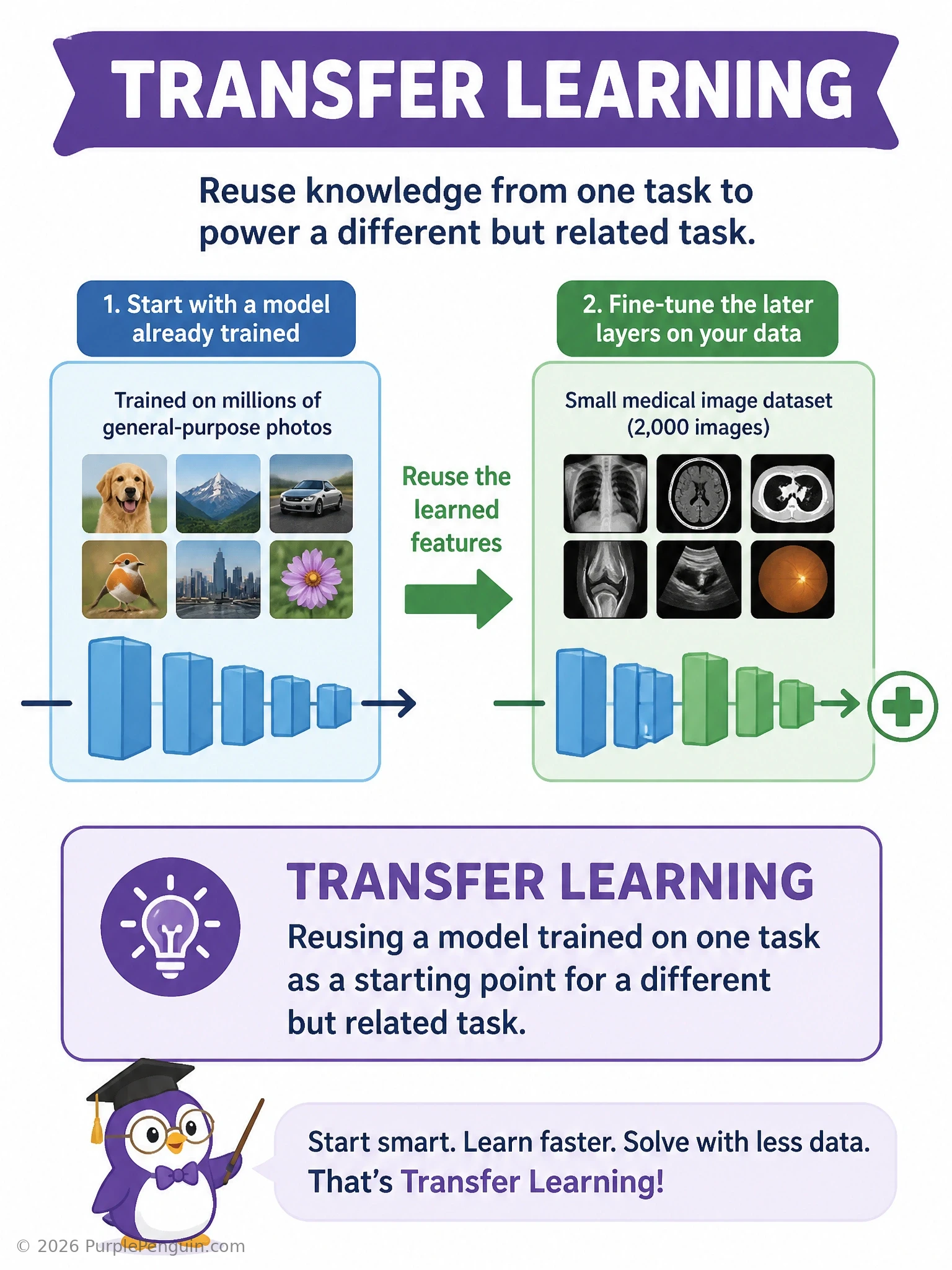
Full Explanation
The correct answer is transfer learning, which is defined as taking a model already trained on one task — often on a large, general dataset — and reusing its learned weights, either frozen or fine-tuned, as the starting point for a different but related task. In the scenario, a CNN pretrained on millions of general photographs has already learned a hierarchy of visual features in its early and middle layers, such as edge detectors, textures, and shape patterns, which transfer remarkably well to a new domain like medical imaging even though the original training data looked nothing like X-rays or scans. By reusing those weights and only fine-tuning the later, more task-specific layers on the small labeled dataset, the startup can achieve strong performance despite having far too little data to train a comparable network from scratch. The first distractor, data augmentation, is a legitimate technique for combating small datasets, but it works by artificially multiplying the existing training examples through transformations like rotation, flipping, cropping, or color jitter — it does not involve reusing any other model's learned parameters, so it does not match the scenario's core mechanism of starting from a pretrained network. The second distractor, ensemble learning, refers to combining the outputs of multiple separately trained models, typically through voting or averaging, to improve robustness and accuracy — it says nothing about reusing knowledge from a model trained on a different task, and the scenario describes only a single model being adapted, not multiple models being combined. The third distractor, federated learning, addresses a completely different problem: training a single global model collaboratively across many decentralized devices or servers while keeping raw data local for privacy reasons — there is no decentralized training or data-locality concern in the scenario, only the reuse of pretrained weights on a centralized small dataset. A good way to remember transfer learning's value: it lets you 'borrow' the expensive, data-hungry part of learning general features from someone else's large-scale training run, and spend your limited data budget only on the fine-tuning needed for your specific problem.