A model achieves very high accuracy on training data but performs noticeably worse on new, unseen data. Which of the following is a common technique to address this problem?
Select an answer to reveal the explanation.
Short Explanation and Infographic
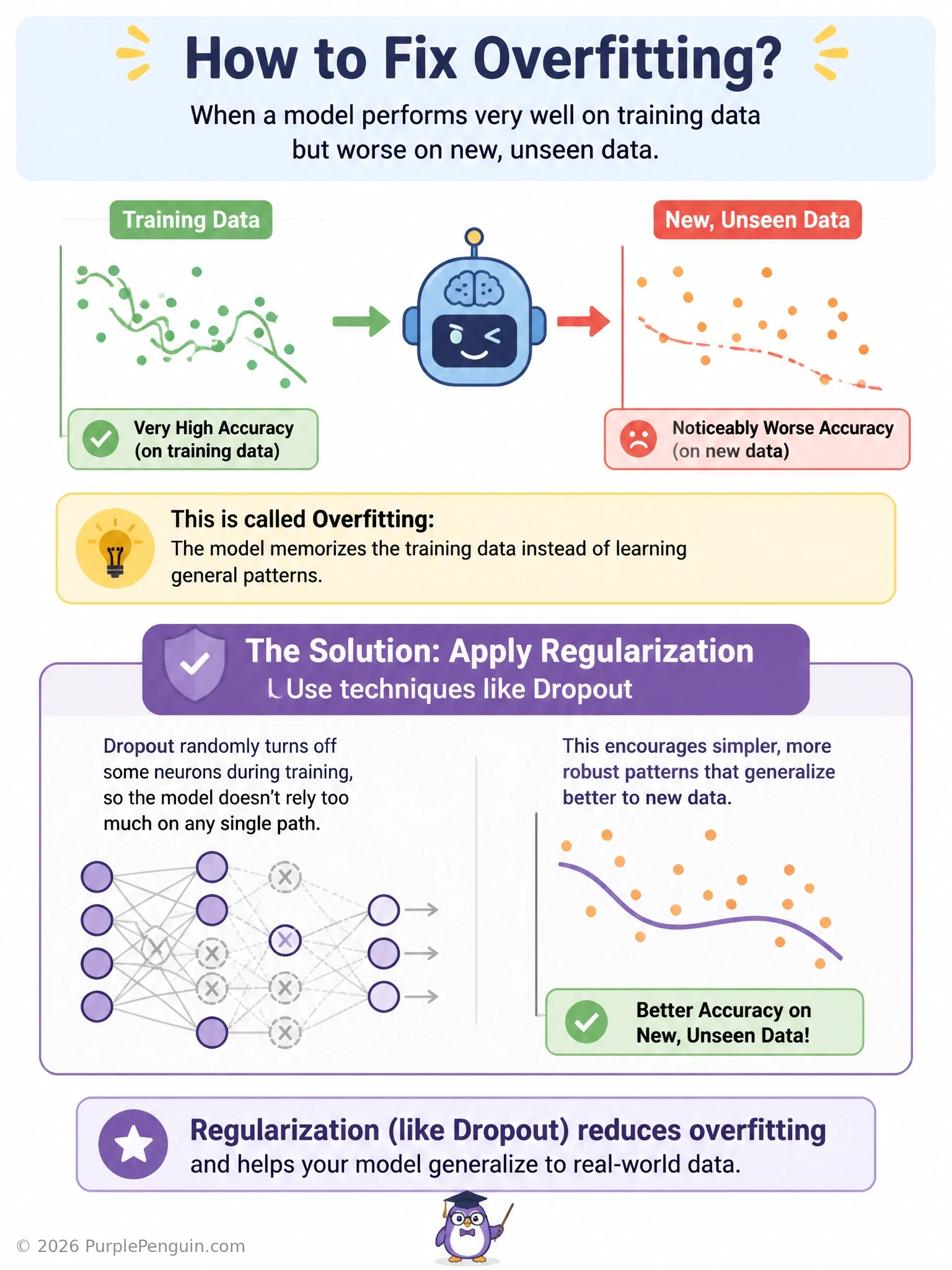
What you're describing is textbook overfitting — the model has memorized the training set instead of learning patterns that generalize. One go-to fix is regularization, and Dropout is a favorite: during training, it randomly zeroes out a chunk of neurons on each pass, forcing the network to not rely too heavily on any single neuron or path, which pushes it toward more robust features. That's answer C. Cranking up the learning rate until training loss hits zero makes things worse — it just encourages the model to fit the training data even more precisely. Removing your validation set removes your ability to even detect overfitting, the opposite of helpful. And blindly increasing epochs without watching validation performance is exactly how you drive a model further into overfitting. Dropout, along with weight decay and data augmentation, is the right direction here.
Full explanation below image
Full Explanation
The scenario described — high training accuracy paired with poor performance on unseen data — is the classic signature of overfitting, where a model has learned patterns specific to the training set (including noise) rather than generalizable underlying structure. Regularization techniques are specifically designed to combat this. Dropout is one of the most widely used: during training, it randomly deactivates (zeros out) a specified fraction of neurons in a layer on each forward pass, which prevents the network from becoming overly reliant on any particular neuron or co-adapted group of neurons. This forces the network to learn more redundant, distributed, and robust representations, which tend to generalize better to new data. Other common regularization approaches include L1/L2 weight decay, data augmentation, and early stopping, all aimed at the same underlying goal of narrowing the gap between training and validation/test performance.
The first distractor is counterproductive: increasing the learning rate specifically to drive training loss to zero encourages the model to fit the training set even more exactly, which typically worsens overfitting rather than resolving it, and can also destabilize training entirely if the rate becomes too aggressive. The second distractor is directly harmful to diagnosing and controlling overfitting: the validation set exists precisely to monitor how well the model generalizes to data it wasn't trained on, and removing it eliminates the team's ability to detect overfitting at all, let alone address it, while also not meaningfully changing the model's tendency to memorize training data. The third distractor compounds the problem: continuing to train for more epochs without monitoring validation performance typically allows the model to keep memorizing training-set idiosyncrasies well past the point where validation performance has started to degrade, which is the opposite of a corrective action — this is why early stopping (halting training when validation performance stops improving) is itself a standard regularization strategy.
A useful memory aid: overfitting means the model has 'crammed for a specific test' rather than 'genuinely learned the subject,' and dropout is like randomly forcing the model to study without relying on any one 'favorite' fact, pushing it to build broader, more transferable understanding.