What is the main objective of using the Adam optimizer during neural network training?
Select an answer to reveal the explanation.
Short Explanation and Infographic
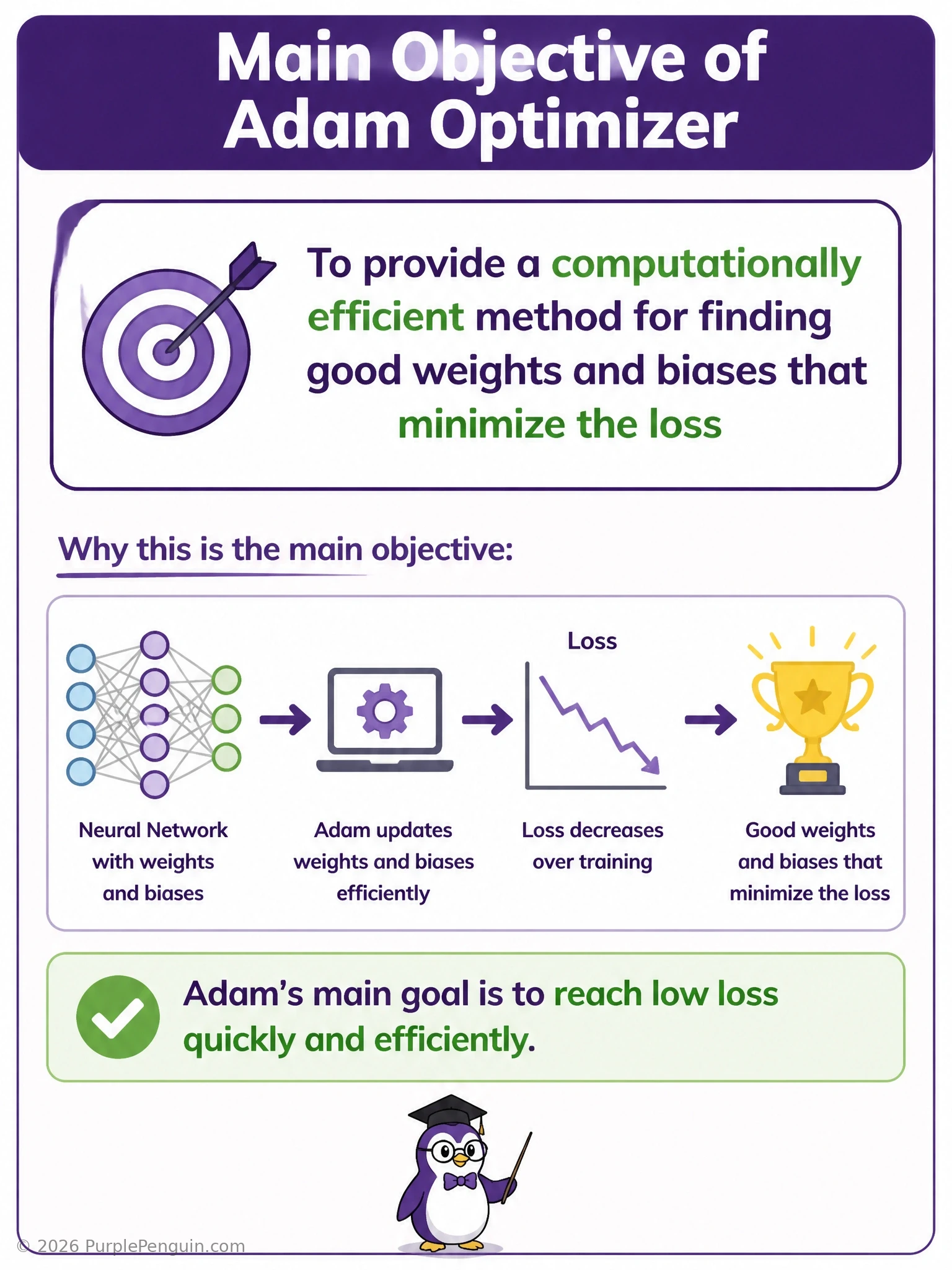
Adam is one of the most popular optimizers out there because it's a smart, efficient way to actually find good weights and biases as the model trains. It combines ideas from momentum and adaptive learning rates, keeping a running memory of past gradients so it can adjust its step size per parameter on the fly. Practically speaking, that usually means faster, more stable convergence than plain gradient descent, without a ton of manual tuning. That's answer D. Adam doesn't get rid of the loss function — it actually needs the loss function's gradient to work at all. It also doesn't guarantee finding the global minimum; deep learning loss surfaces are complicated and full of local minima and saddle points, and no optimizer promises a perfect global solution. And it has nothing to do with growing your dataset — that's data collection or augmentation, an entirely separate concern. Adam is about efficiently updating weights, full stop.
Full explanation below image
Full Explanation
Adam (Adaptive Moment Estimation) is an optimization algorithm that combines the benefits of momentum-based gradient descent with adaptive, per-parameter learning rates. It maintains running estimates of both the first moment (the mean of past gradients, similar to momentum) and the second moment (the uncentered variance of past gradients) for each parameter, and uses these estimates to scale each parameter's update individually. This allows Adam to take larger, more confident steps for parameters with small or consistent gradients and more cautious steps for parameters with noisy or large gradients, generally leading to faster and more stable convergence in practice than plain stochastic gradient descent, while requiring comparatively little manual tuning of the learning rate.
The first distractor is incorrect because Adam, like all gradient-based optimizers, fundamentally depends on the loss function; it uses the gradients of the loss with respect to the weights to compute its updates, so removing the loss function would leave the optimizer with nothing to optimize against. The second distractor is incorrect because no practical optimizer, Adam included, can guarantee finding the global minimum of a neural network's loss surface; these loss landscapes are typically highly non-convex, riddled with local minima, saddle points, and plateaus, and optimizers like Adam are designed to efficiently navigate toward a good (often local) minimum, not to provide any theoretical guarantee of global optimality. The third distractor is incorrect because dataset size is controlled by data collection, curation, and augmentation strategies, which are entirely separate from the choice of optimizer; Adam operates purely on whatever batches of data it is given during training and has no mechanism for expanding the dataset itself.
A helpful memory aid: think of Adam as a smart, self-adjusting hiker who remembers recent terrain (gradient history) to decide how big and in what direction each step should be, making the descent toward lower loss faster and more stable, but still just a hiker navigating an unknown landscape, not one with a guaranteed map to the absolute lowest point.