What is the primary role of a generative model, such as a GAN?
Select an answer to reveal the explanation.
Short Explanation and Infographic
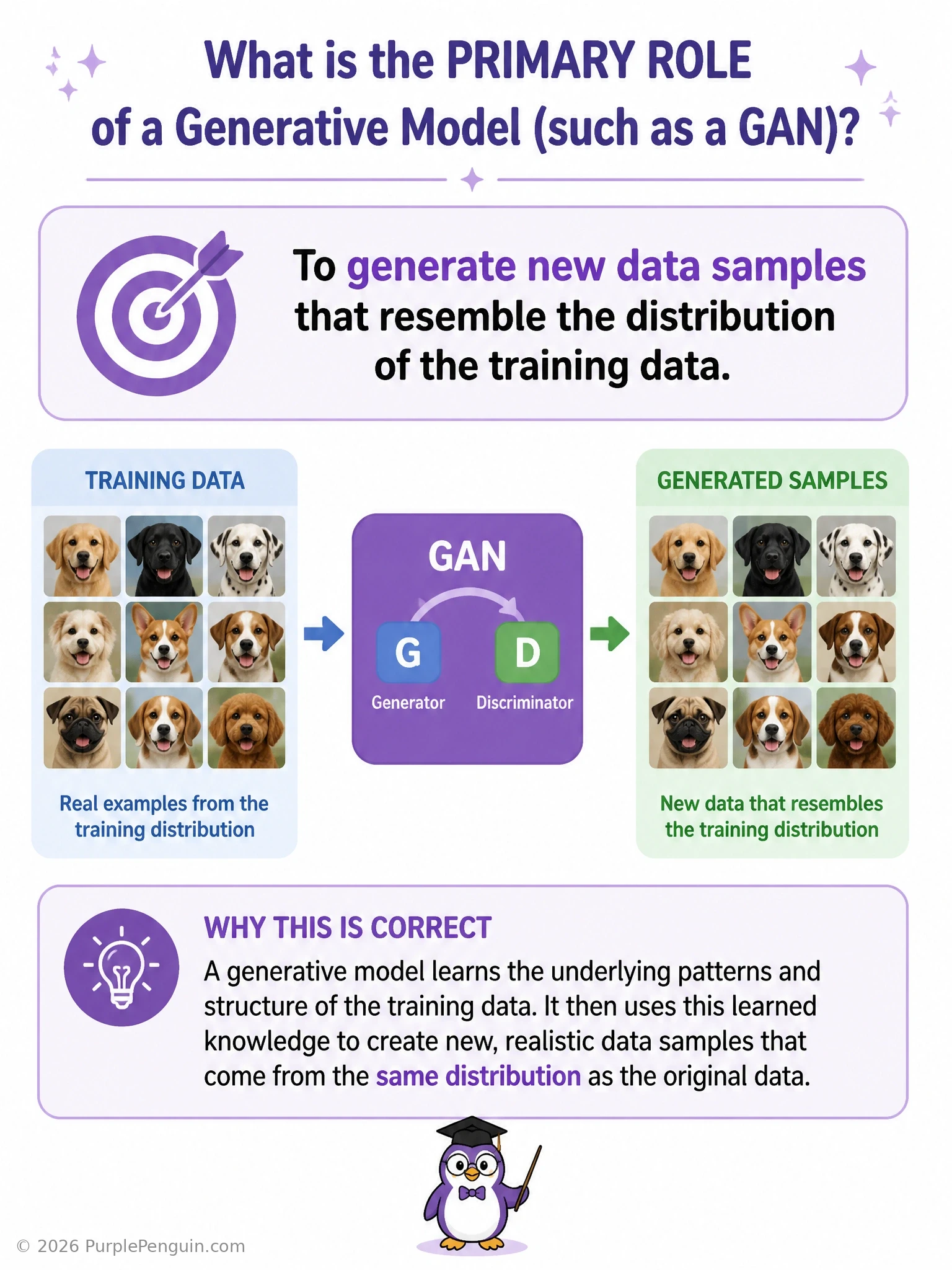
A generative model's whole purpose in life is to create — it studies the patterns in a training dataset and then produces brand-new samples that look like they could've come from that same dataset. Think of a GAN generating a realistic-looking face that never actually belonged to a real person. That's the first option here, and it's the defining job of generative models. Assigning inputs to predefined class labels is what a classifier does, a completely different family of models focused on discrimination, not generation. Reducing dimensionality purely for visualization is describing something like PCA or t-SNE used as a plotting tool, not what a generative model is built for, even though some generative models like autoencoders do involve compression along the way. And detecting anomalies via a fixed rule-based threshold is describing a simple rules engine, not a learned generative model at all. Generation of new, realistic data is the core identity of models like GANs.
Full explanation below image
Full Explanation
A generative model is designed to learn the underlying distribution of a training dataset well enough that it can produce entirely new samples that plausibly could have come from that same distribution. A generative adversarial network (GAN) accomplishes this through a two-network adversarial setup: a generator that attempts to produce realistic synthetic samples from random noise, and a discriminator that attempts to distinguish real training samples from the generator's fakes. As the two networks are trained together, the generator progressively improves at producing samples realistic enough to fool the discriminator, eventually learning to generate highly convincing new data, such as photorealistic images, synthetic text, or artificial audio, that were not present in the original training set.
The first distractor describes a discriminative classification model, whose job is to map an input to one of a set of predefined labels (for example, identifying whether an image contains a cat or a dog); this is fundamentally different from generation, since a classifier learns a decision boundary between classes rather than learning to produce new samples from a data distribution. The second distractor describes dimensionality reduction techniques used strictly for visualization, such as PCA or t-SNE, which project high-dimensional data into two or three dimensions purely so it can be plotted and inspected visually; while some generative architectures like autoencoders do involve a compressed latent representation, generative models are not restricted to, or primarily used for, visualization. The third distractor describes a simple rule-based anomaly detection system relying on fixed thresholds, which is a hand-engineered heuristic approach rather than a learned generative model; genuine generative-model-based anomaly detection (for example, using an autoencoder's reconstruction error) is possible, but it still relies on the model having learned a data distribution, not on a fixed rule.
A helpful memory aid: discriminative models answer 'what is this?' by drawing boundaries between categories, while generative models answer 'can you make me something new like this?' by learning to sample from the underlying data distribution itself.