
Which retraining trigger strategy is most appropriate when a model's input feature distribution is known to shift significantly every 90 days?
Select an answer to reveal the explanation.
Short Explanation and Infographic
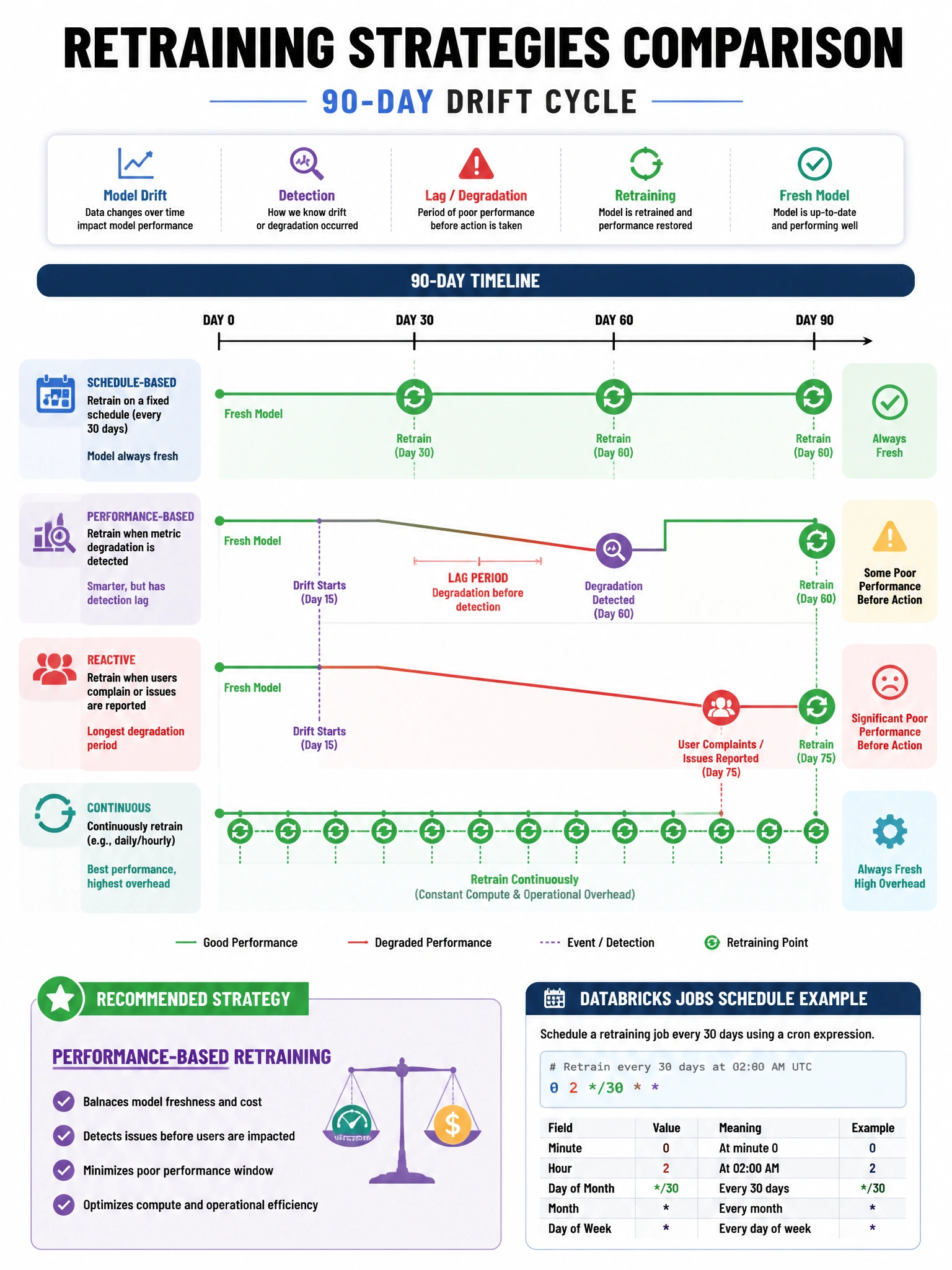
When you know drift happens on a predictable schedule, get ahead of it with scheduled retraining — waiting for performance to drop means serving bad predictions for days before you catch it.
Full explanation below image
Full Explanation
Retraining trigger strategies: 1) Schedule-based (recommended here): retrain every X days/weeks regardless of performance. Appropriate when drift patterns are predictable and regular. Simple to implement with Databricks Jobs on cron schedule. Proactive — prevents degraded performance. 2) Performance-based: retrain when a monitored metric (accuracy, AUC) drops below a threshold. Requires ground truth labels to measure production accuracy (which may lag by weeks in some domains). Reactive — some bad predictions before catching. 3) Data drift-based: retrain when feature distribution diverges significantly (KS-test, PSI). Can be proactive even without labels. 4) Continuous: retrain on every new batch (online learning). Computationally expensive, may cause instability. For this scenario: 90-day drift cycle → retrain every 30-60 days to ensure the model never goes more than one cycle without updating. Performance-based alone is risky if ground truth labels are delayed.