
In Unity Catalog, how is a model registered using the three-level namespace?
Select an answer to reveal the explanation.
Short Explanation and Infographic
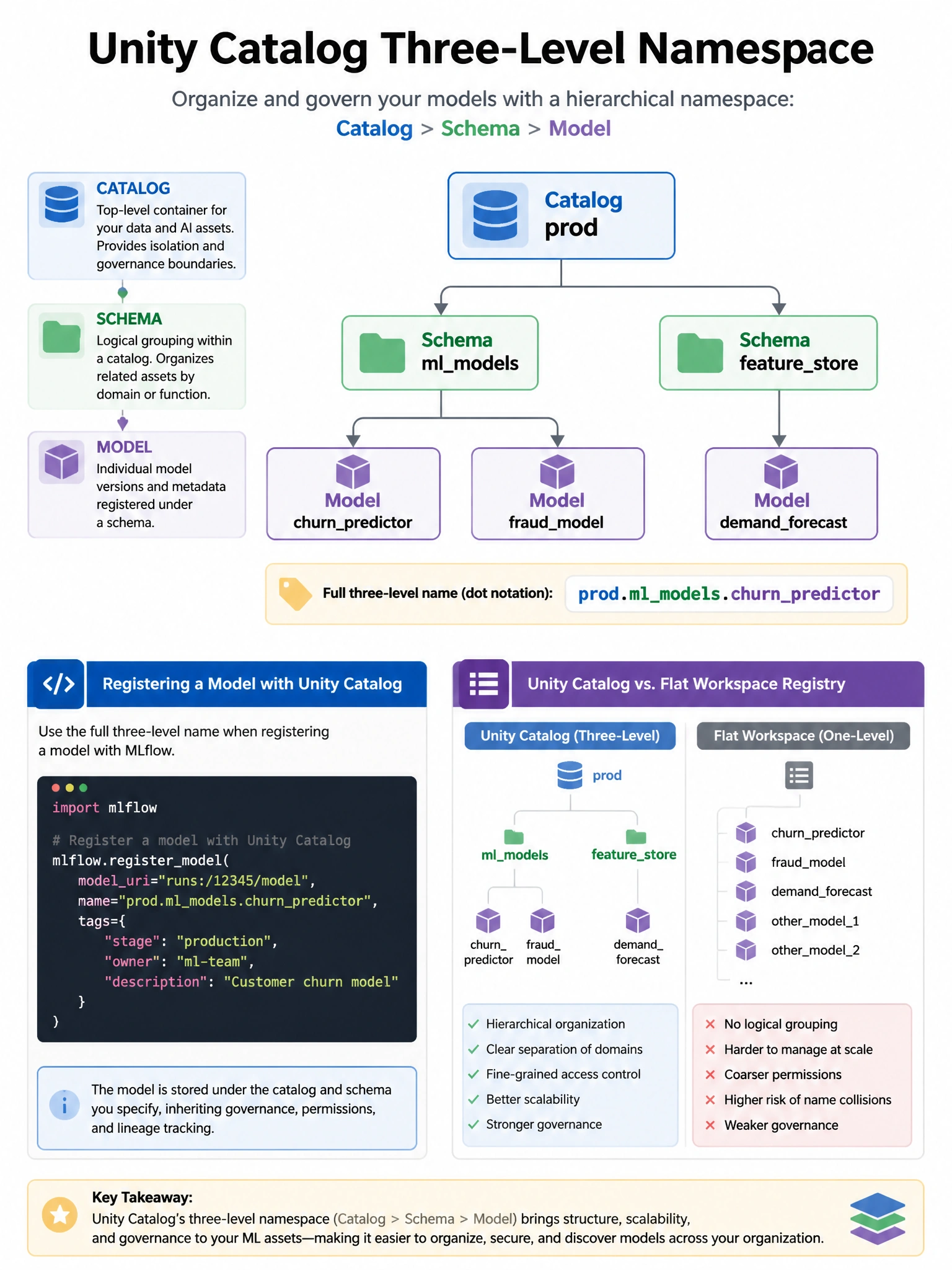
Unity Catalog uses a three-part dot-notation name — catalog.schema.model — just like tables. Registering 'prod.ml_models.churn_v2' puts the model in the prod catalog, ml_models schema, under the name churn_v2.
Full explanation below image
Full Explanation
Unity Catalog uses a three-level namespace: catalog.schema.object_name. For ML models: catalog (top-level namespace, e.g., 'prod', 'dev', 'sandbox'), schema (database within catalog, e.g., 'ml_models', 'feature_store'), model_name (e.g., 'churn_predictor'). To register: mlflow.register_model('runs:/run_id/model', 'prod.ml_models.churn_predictor'). To reference aliases: models:/prod.ml_models.churn_predictor@champion. To load: mlflow.pyfunc.load_model('models:/prod.ml_models.churn_predictor/5'). Key advantages: access control at catalog/schema/model level, cross-workspace sharing, lineage tracking. The workspace-level registry uses a flat namespace (just model_name). Unity Catalog does NOT use keyword parameters in register_model; the name is always a positional string argument.