
How does Delta Lake's ACID transaction support benefit ML batch inference pipelines?
Select an answer to reveal the explanation.
Short Explanation and Infographic
ACID atomicity means your batch inference job either fully commits its predictions or rolls back entirely — no downstream system ever reads half a day's predictions mixed with yesterday's stale results.
Full explanation below image
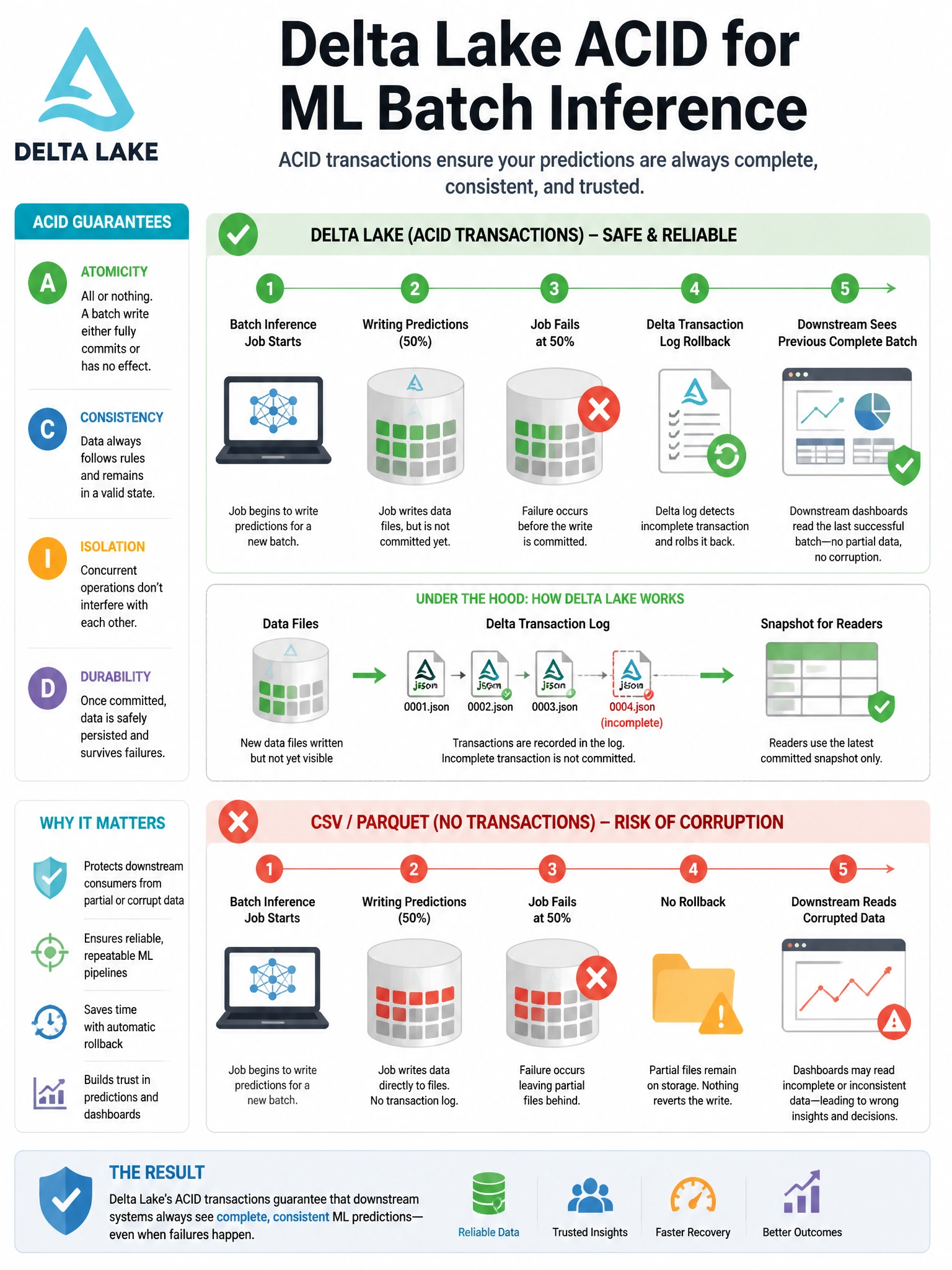
Full Explanation
Delta Lake provides ACID (Atomicity, Consistency, Isolation, Durability) transactions for batch ML inference: Atomicity — a batch inference job that writes 1M predictions either succeeds completely (all 1M rows committed) or fails cleanly (zero rows written). No partial writes. Isolation — concurrent readers see a consistent snapshot; they don't observe the write mid-progress. This is critical when downstream systems or dashboards read the predictions table while a new batch is being written. Consistency — schema enforcement prevents writing malformed predictions. Durability — committed results survive cluster failures. Practical benefit: if a batch inference job fails midway (e.g., cluster OOM), Delta's transaction log ensures the partial writes are rolled back — the downstream system continues reading the previous complete batch, not corrupted partial results. Compression, prediction validation, and encryption are separate features.