
What advantage does Unity Catalog provide for ML models compared to the workspace-level MLflow Model Registry?
Select an answer to reveal the explanation.
Short Explanation and Infographic
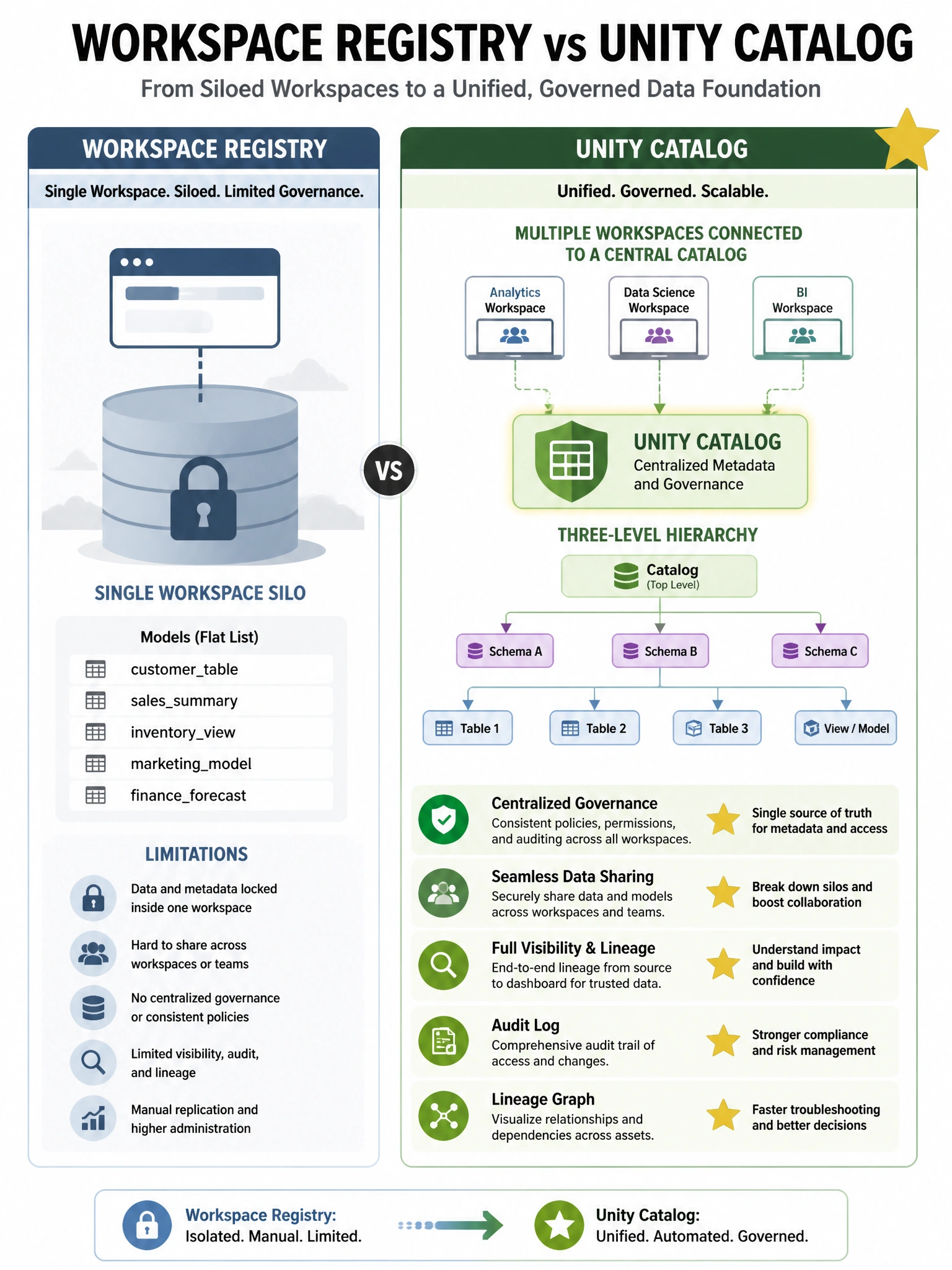
Unity Catalog is like a company-wide file server with permissions and an audit log — versus a local drive that only your team can see.
Full explanation below image
Full Explanation
Unity Catalog (UC) extends the MLflow Model Registry with enterprise governance features: 1) Cross-workspace access — models registered in UC are accessible from any Databricks workspace in the same metastore, unlike workspace-level registries which are siloed. 2) Fine-grained access control — GRANT/REVOKE permissions at catalog.schema.model level. 3) Lineage tracking — UC tracks which tables, notebooks, and jobs produced the model. 4) Audit logging — who accessed, modified, or deployed a model. 5) Three-level namespace (catalog.schema.model_name) replacing the flat namespace of workspace registry. Framework support and inference speed are identical between the two registries — UC doesn't change the underlying model format or serving infrastructure.