
Meridian wants the customs-compliance agent's tool-calling behavior to be auditable after the fact: for any declaration it processed, a compliance officer should be able to see exactly which tools were called, in what order, and what each one returned. What must the chain design account for to make this possible?
Select an answer to reveal the explanation.
Short Explanation
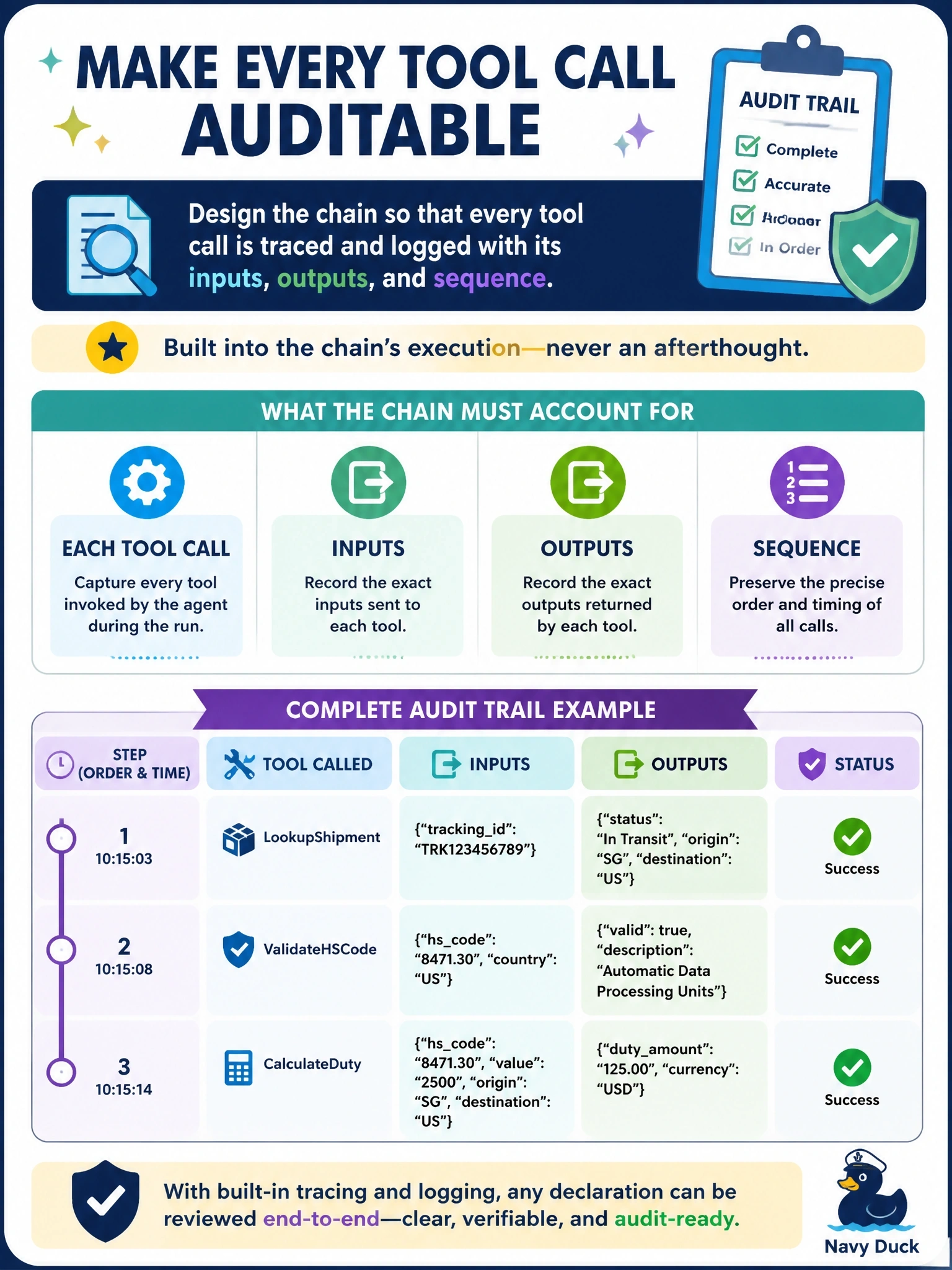
If the officer needs to see the trail later, the chain has to actually write that trail down as it goes - which tool, what went in, what came out, in what order - it doesn't happen automatically just because tools were used.
Full Explanation
The chain design must explicitly account for tracing or logging each tool call - its inputs, its outputs, and the order calls occurred in - as part of how the chain executes, because auditability is not a default, automatic property of tool use; it has to be captured deliberately for a compliance officer to reconstruct what happened after the fact. The claim that tool calls are automatically remembered forever with no configuration is false - without deliberate tracing/logging built into the chain (and typically surfaced via MLflow tracing), there is no persistent record of what a given run actually did once execution finishes. Redesigning the agent to avoid tools altogether is the wrong response to an auditability requirement - it would also remove the live lookups (HS codes, tariff rules) the agent needs to do its job correctly, trading away core functionality to solve a logging problem that has a much more direct fix. Having a human manually retype the agent's actions after each run is unreliable, unscalable, and defeats the purpose of automation - it also depends on a human correctly recalling exactly what the agent did, which the human generally cannot observe directly without the very trace data that's actually needed. This item tests recognizing that observability/traceability is a design-time requirement to build into the chain, not an incidental byproduct of using tools.