
A vessel captain wants a tool where they describe an unusual engine noise in plain conversational language and the assistant asks clarifying follow-up questions before suggesting likely fault categories, rather than requiring a single perfectly-formed query up front. What does this requirement suggest about the chain design?
Select an answer to reveal the explanation.
Short Explanation
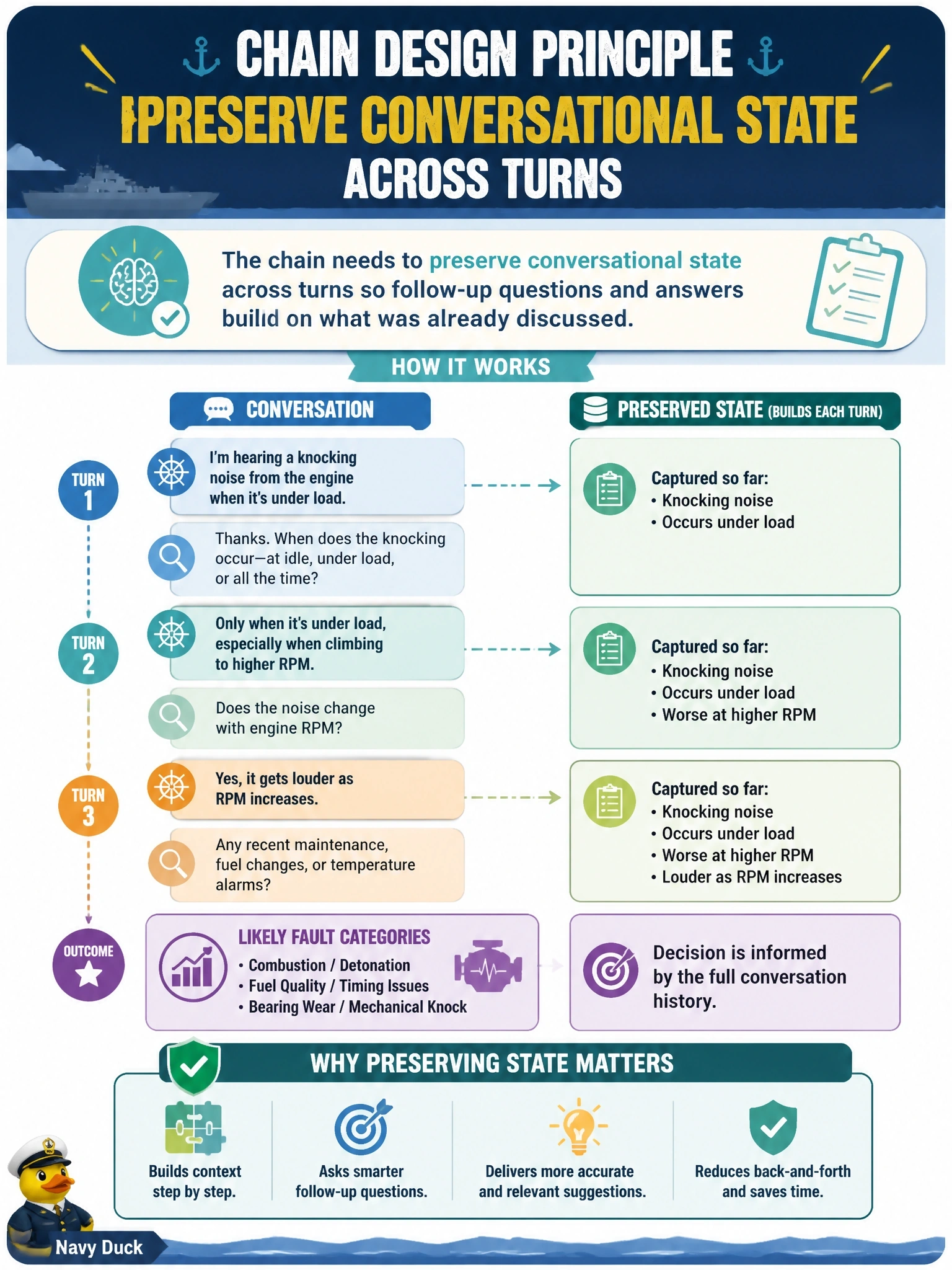
Clarifying questions only work if the assistant remembers what was already said - a chain that forgets everything after each message can't build on 'you mentioned a rattling noise' three turns later, so it needs to carry conversation state along.
Full Explanation
The chain needs to preserve conversational state across turns because the described interaction - ask a follow-up, get an answer, ask another follow-up, then suggest fault categories - inherently depends on later turns being informed by earlier ones; a stateless design would treat each message in isolation and could not meaningfully reference the noise description given two turns earlier. A single-turn stateless design is precisely the pattern that would break this multi-turn clarifying-question flow, since each call would have no memory of what the captain already said, forcing them to repeat everything each time. Rejecting imperfectly structured input contradicts the explicit requirement that the captain speaks in plain conversational language rather than a structured query - the whole point of this design is to accept loose, ambiguous input and refine it through dialogue, not to demand structure up front. Returning a fixed answer regardless of input ignores the requirement entirely; the captain's actual words are supposed to drive both the clarifying questions and the eventual fault-category suggestions. This item tests translating a described multi-turn interaction pattern into the correct architectural implication (state/session management), rather than treating every design item as a single-call prompt-formatting question.