
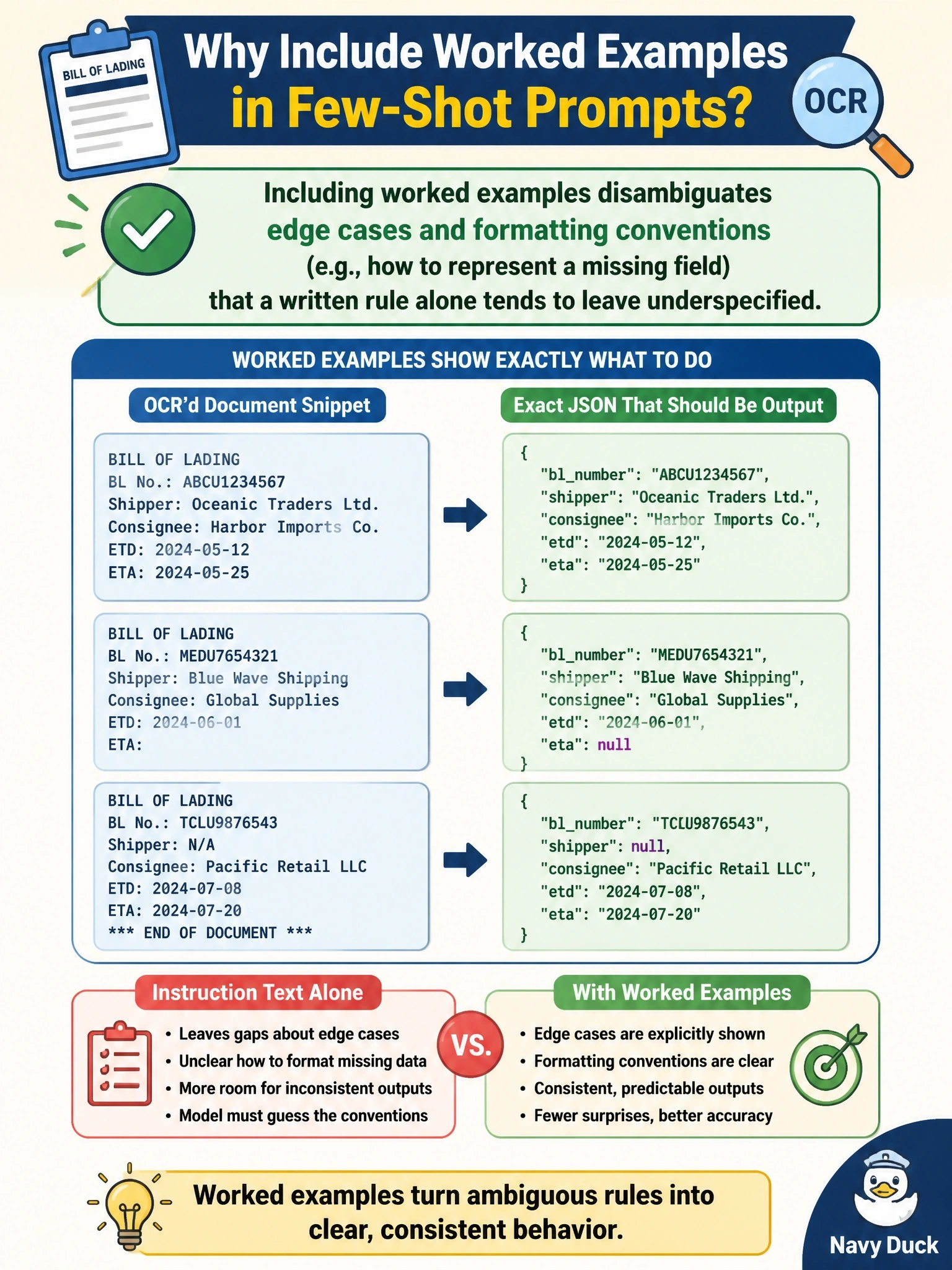
The engineer is designing few-shot examples inside the prompt for extracting fields from bill-of-lading text. Each example shows a sample OCR'd document snippet followed by the exact JSON the model should output for it. What is the primary design benefit of including these worked examples rather than relying on the instruction text alone?
Select an answer to reveal the explanation.
Short Explanation
A written rule can say 'extract these fields,' but it can't anticipate every weird edge case a real scanned document throws at you - showing the model two or three worked examples, including one with a field missing, does what the rule alone can't.
Full Explanation
Few-shot examples earn their place in the prompt because natural-language rules are almost always underspecified at the edges - what to output when a field is illegible, how to format a multi-line address, whether to include units - and a couple of concrete worked examples resolve those ambiguities far more reliably than more prose would. Vector Search index refresh cadence is a completely separate concern governed by the sync mode and the update frequency of source data; few-shot prompt examples have no bearing on it. Whether extracted output ultimately lands in a Unity Catalog table is a downstream data-engineering decision about where results are persisted, and it exists independently of how the extraction prompt itself is designed. Context window size is a fixed property of the chosen model, not something a prompt's contents can expand; adding examples consumes context budget, it does not enlarge it. The exam-relevant point is that few-shot examples are a prompt-design tool for tightening format and edge-case consistency, distinct from indexing cadence, storage architecture, or model capacity.