
Meridian's safety team wants every incoming near-miss report automatically tagged as 'low', 'medium', or 'high' severity so they can be triaged into the right review queue, with no free-text explanation needed at this stage. Which model task fits this requirement best?
Select an answer to reveal the explanation.
Short Explanation
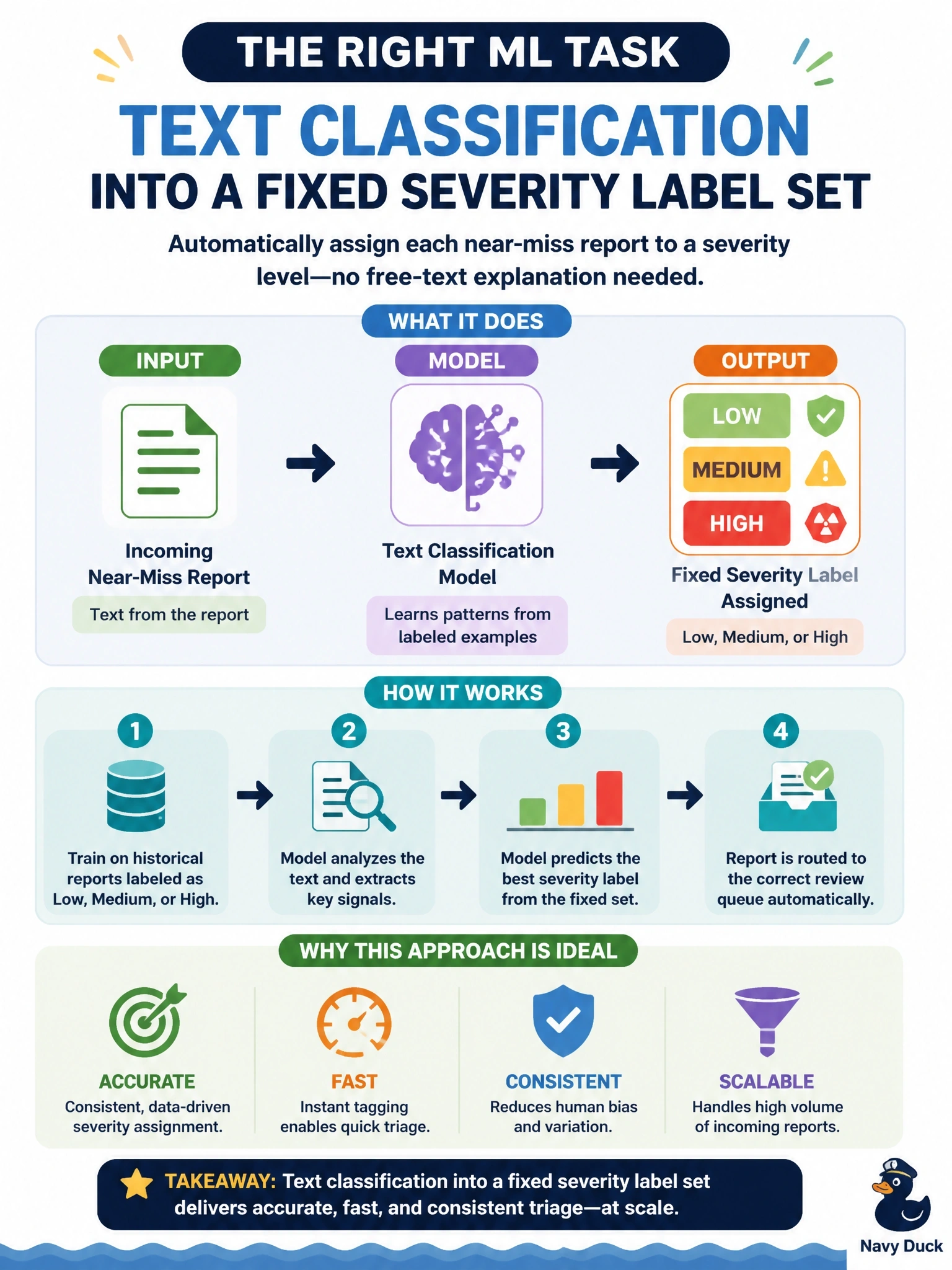
You have three fixed buckets and no need for a written explanation, so text classification fits the job. It gives you the severity label directly, without searching other reports or writing a summary.
Full Explanation
Text classification into a fixed severity label set is correct because each incoming report must be assigned to one of three closed categories—low, medium, or high—and no explanation is requested. This task produces the label needed to route a report to the appropriate review queue. Retrieval-augmented generation over the incident-report corpus is not a fit: the team is not asking a question that requires information retrieved from other reports, but wants each individual report tagged. Abstractive summarization would turn the report into a paragraph, producing free text rather than the required fixed label. Open-ended agentic tool use to search for similar past incidents could support a later investigation or trend-analysis workflow, but searching for precedents is unnecessary for this immediate triage step and adds complexity without meeting the core need more directly. The exam caveat is that text classification assumes the severity categories and their meanings are defined; ambiguous or overlapping criteria can make labels inconsistent even when the model task is appropriate. As a practical check, test the classifier on representative near-miss reports, including borderline cases, and verify that its assigned labels route reports to the intended queues.