
The maintenance-triage agent needs to be able to answer 'what was the most recent service performed on Crane C-14,' not just 'what services have ever been performed on Crane C-14.' What must the data-preparation pipeline write to the Delta table to make that distinction answerable?
Select an answer to reveal the explanation.
Short Explanation
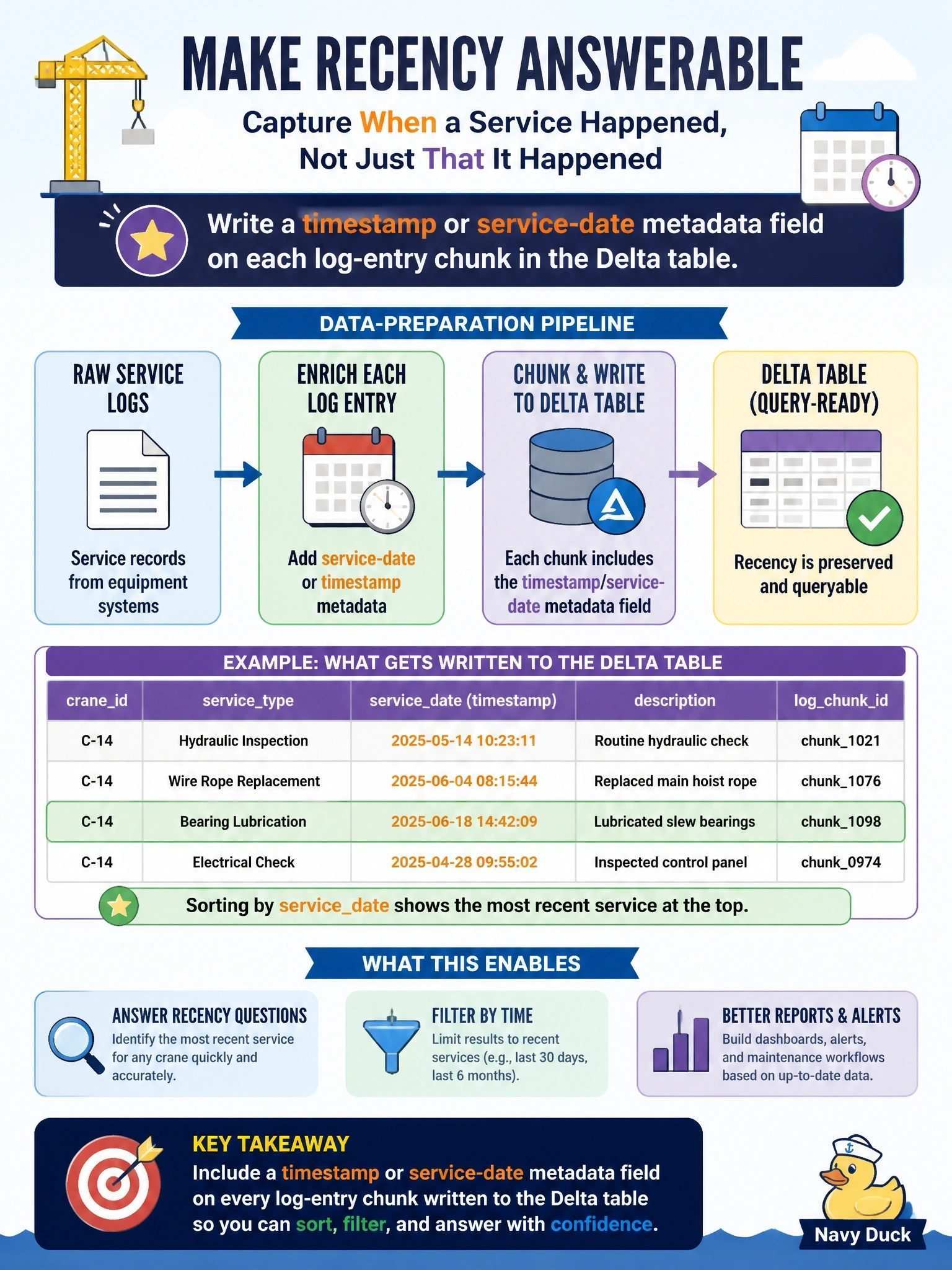
“Most recent” is a recency question, so you need a date field you can sort or filter on—not a larger chunk or an embedding model that might seem to capture time. That gives you a dependable way to distinguish newer service from older service.
Full Explanation
A timestamp or service-date metadata field on each log-entry chunk is correct because “most recent” is fundamentally a recency query. A sortable or filterable date field gives the system a dependable way to distinguish an entry from last week from one three years ago; without it, the system must rely on incidental date text in the free-text log. A larger chunk size so more historical entries fit in one chunk is wrong because combining entries does not identify which one is newest and can make it harder to isolate an entry within the blended chunk. A separate embedding model dedicated only to recent entries is wrong because embeddings represent semantic meaning and have no built-in concept of recency relative to the current date; a different model does not create the date metadata needed for a time-based query. Ingesting chunks in service-log order is wrong because vector-index order is an implementation detail, not a guaranteed reflection of chronological service order, and the index may be rebuilt or reordered. The exam caveat is that incidental date text may appear in a log, but it is not a dependable substitute for structured freshness metadata. In practice, check that every chunk carries its service date and that retrieval can sort or filter on that field before answering which service was most recent.