
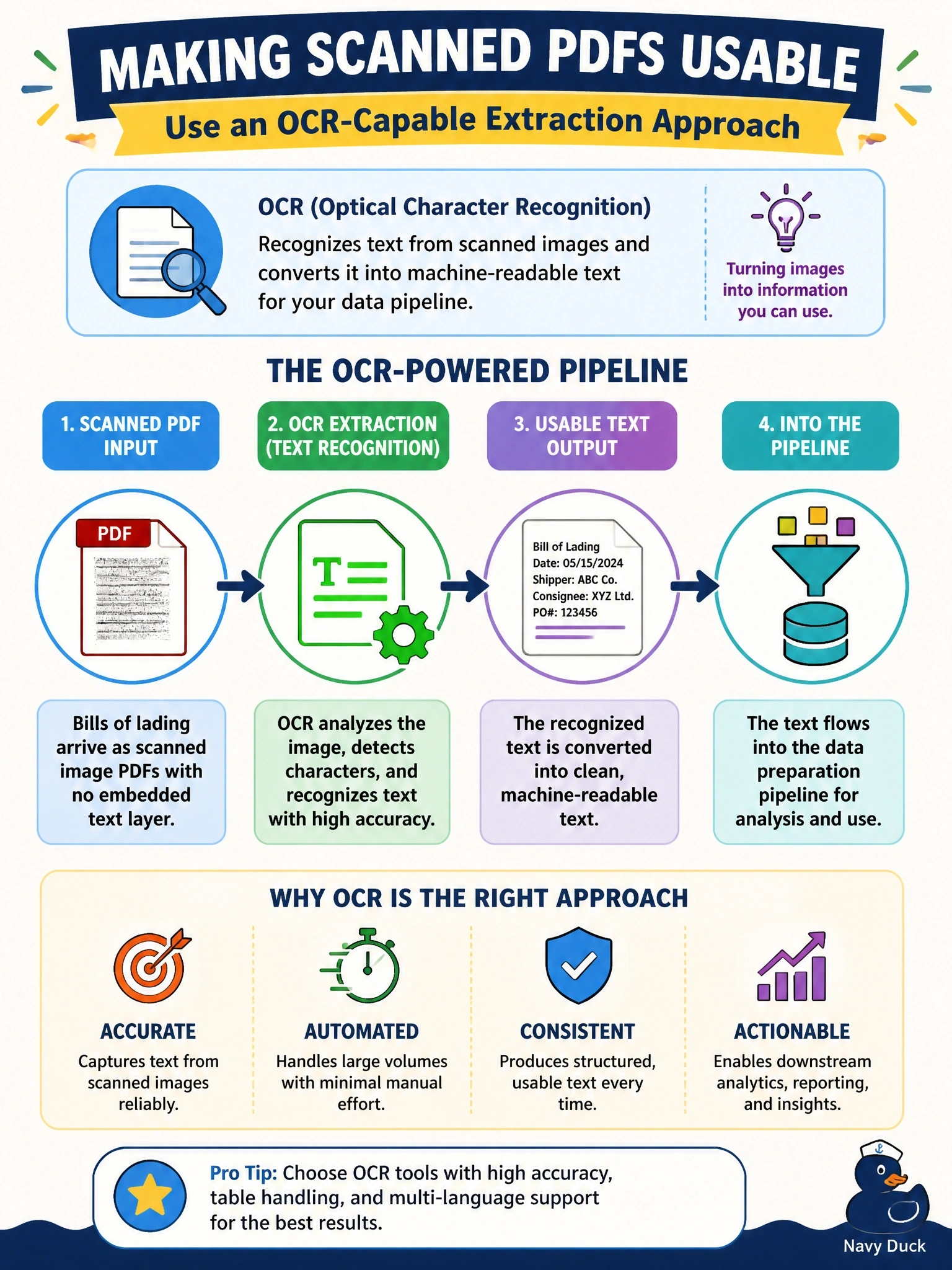
Meridian's bills of lading arrive as scanned image PDFs with no embedded text layer. Which approach should a data engineer use to get usable text into the preparation pipeline?
Select an answer to reveal the explanation.
Short Explanation
No text layer means there's no text to 'extract' in the normal sense - it's a picture of a document - so you need OCR to actually recognize the characters in the image before any chunking or embedding can happen.
Full Explanation
An OCR-capable extraction approach is correct because a scanned image PDF has no embedded text layer to read - the file is fundamentally a picture of a page, and OCR is the technique that recognizes characters from image data and converts them into usable text. A native PDF text-extraction library is the wrong tool here specifically because those libraries work by reading an existing embedded text layer; when that layer does not exist, as stated in the scenario, such a library returns nothing or garbage, not because the library is bad but because there is no text object for it to find. A CSV parser is wrong because the source file is an image-based PDF, not a comma-separated or otherwise delimited plain-text file - the fact that the document's content is logically tabular does not mean it is stored as parseable tabular text; that structure still has to be recovered from the image first. An HTML parser is wrong for the same reason as the CSV parser: the file is a scanned PDF image, not markup, so there is no HTML document object model to traverse. The exam-relevant skill is matching the extraction technique to what the source file actually contains - embedded text, an image needing recognition, structured markup, or delimited data - rather than assuming one tool works for every PDF.