
A newly promoted version of the maintenance-triage agent, now serving 100% of traffic after a successful staged rollout, starts producing noticeably worse triage recommendations following an upstream data change. Meridian Line needs to get back to the previous known-good behavior immediately. What is the fastest correct action?
Select an answer to reveal the explanation.
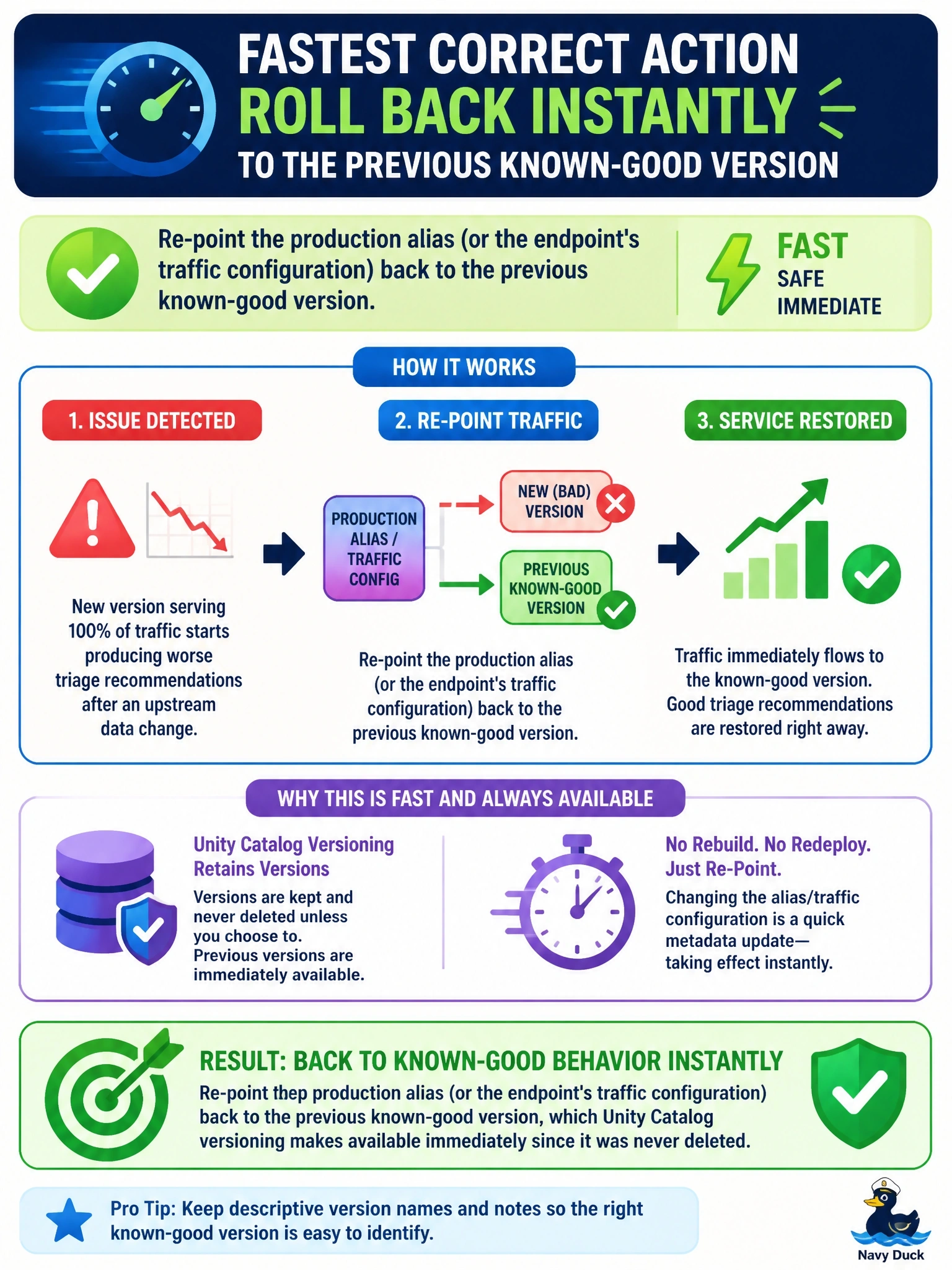
Short Explanation
Nothing about promoting a new version erases the old one. The previous version is still sitting there, still registered — moving the pointer back to it is a rollback, not a rebuild.
Full Explanation
Because Unity Catalog model registry versions are immutable and additive — promoting a new version doesn't delete or overwrite the previous one — the fastest rollback is simply re-pointing the production alias (or adjusting the endpoint's served-entity configuration) back to the previously known-good version, which is still fully registered and available. This is the direct benefit of using aliases for promotion in the first place: rollback is the same lightweight pointer move as promotion was, just in reverse. Deleting the new version is unnecessarily destructive, slower than just moving a pointer, and doesn't 'automatically' fall back to anything — an endpoint with no served entity configured serves nothing, it doesn't intelligently guess a fallback version. Waiting for a future retraining cycle ignores that a known-good version already exists right now and leaves degraded triage recommendations in production for however long that cycle takes — an avoidable and unnecessary risk. Re-logging and re-registering the old code as if it were new treats the previous version as gone when it isn't; that previous version's artifact is exactly what's still sitting in the registry, so rebuilding it from source is redundant, slower, and risks introducing drift from the original that a straight rollback wouldn't have. Exam framing: this is the payoff of the alias-based promotion pattern — safe rollout and fast rollback are the same underlying mechanism.