
Meridian Line is assembling the deployed system for its port-operations copilot: a retrieval step over the circulars Vector Search index, a summarization step, and a separate charter-desk assistant that has nothing to do with circulars. Should these be deployed behind one shared Model Serving endpoint or separate endpoints, and why?
Select an answer to reveal the explanation.
Short Explanation
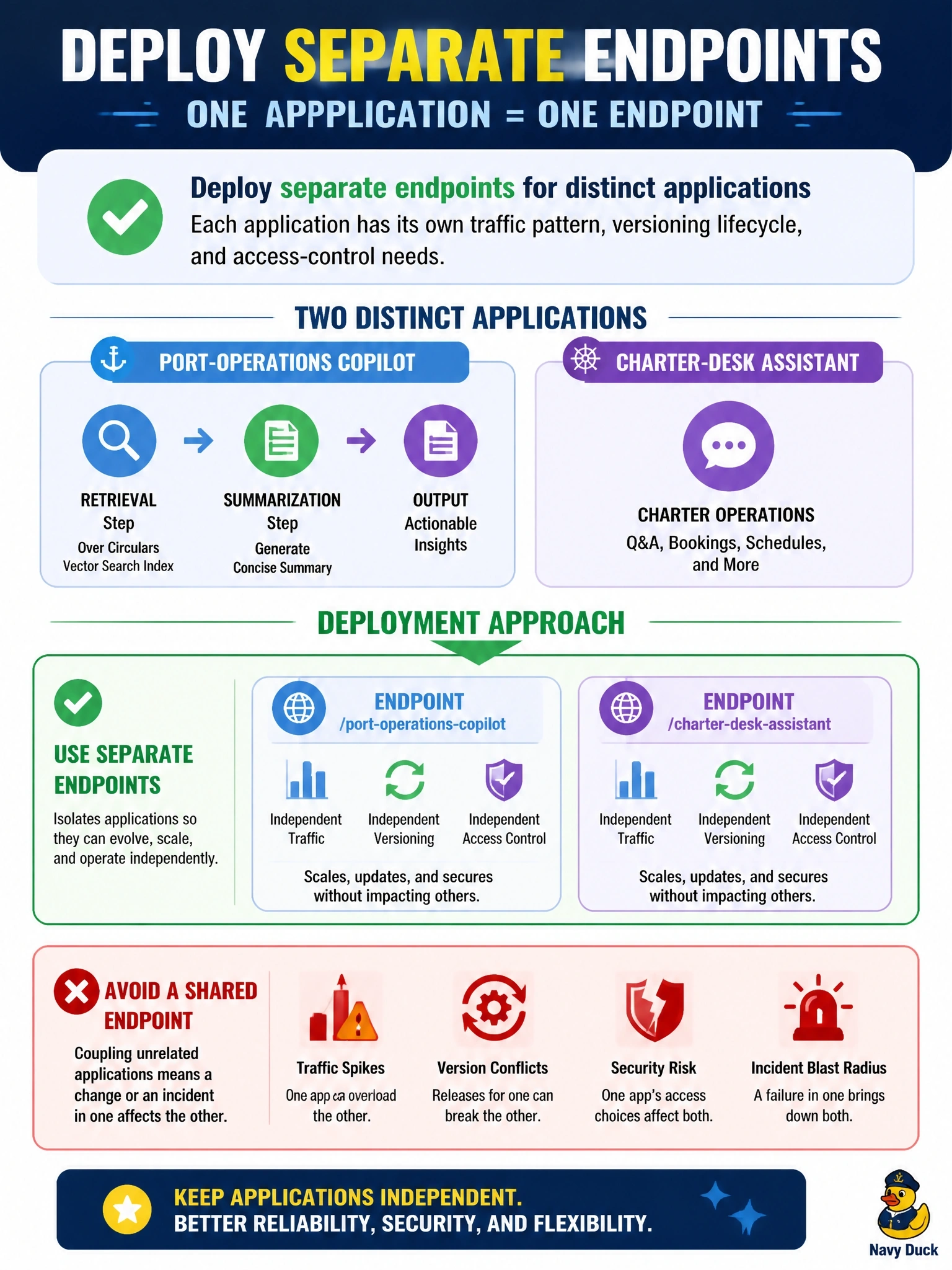
The charter-desk assistant and the port-operations copilot don't share a traffic pattern, a release schedule, or an audience. Bolting them onto one endpoint means a bad deploy on one takes down the other for no reason — separate endpoints keep their blast radii apart.
Full Explanation
Deploying genuinely distinct applications — different traffic patterns, independent release/versioning cadences, and different access-control requirements — behind separate Model Serving endpoints is the appropriate architecture, because it isolates blast radius: promoting a new version, hitting a rate limit, or debugging an incident on the charter-desk assistant has no effect on the port-operations copilot's endpoint, and vice versa. Independent endpoints also let each application be scaled, monitored, and governed (Unity Catalog permissions) according to its own needs rather than a shared compromise. Claiming one shared endpoint is 'always cheaper' ignores that cost depends on the actual capacity/traffic profile of each workload — coupling unrelated workloads for a hypothetical cost saving trades away isolation for a benefit that isn't guaranteed and often isn't real once contention and blast-radius incidents are counted. There's no platform limit of one Model Serving endpoint per Unity Catalog catalog — endpoints and catalogs aren't related that way, and this constraint is fabricated. The claim that Vector Search results and a generated summary can't coexist behind one endpoint response is also fabricated — a chain or agent can retrieve and then generate within a single served model's response, which is exactly how RAG applications are typically composed; that's not the actual reason to separate these two, unrelated, applications. Exam framing: architecture-level endpoint separation is part of sequencing a real deployment, distinct from the mechanics of any single endpoint's configuration.