
Meridian Line's crane-maintenance triage agent must respond to on-deck technicians within roughly a second, all shift long, every shift, and traffic volume is predictable and continuously high. Which Foundation Model APIs mode is the better production fit, and why?
Select an answer to reveal the explanation.
Short Explanation
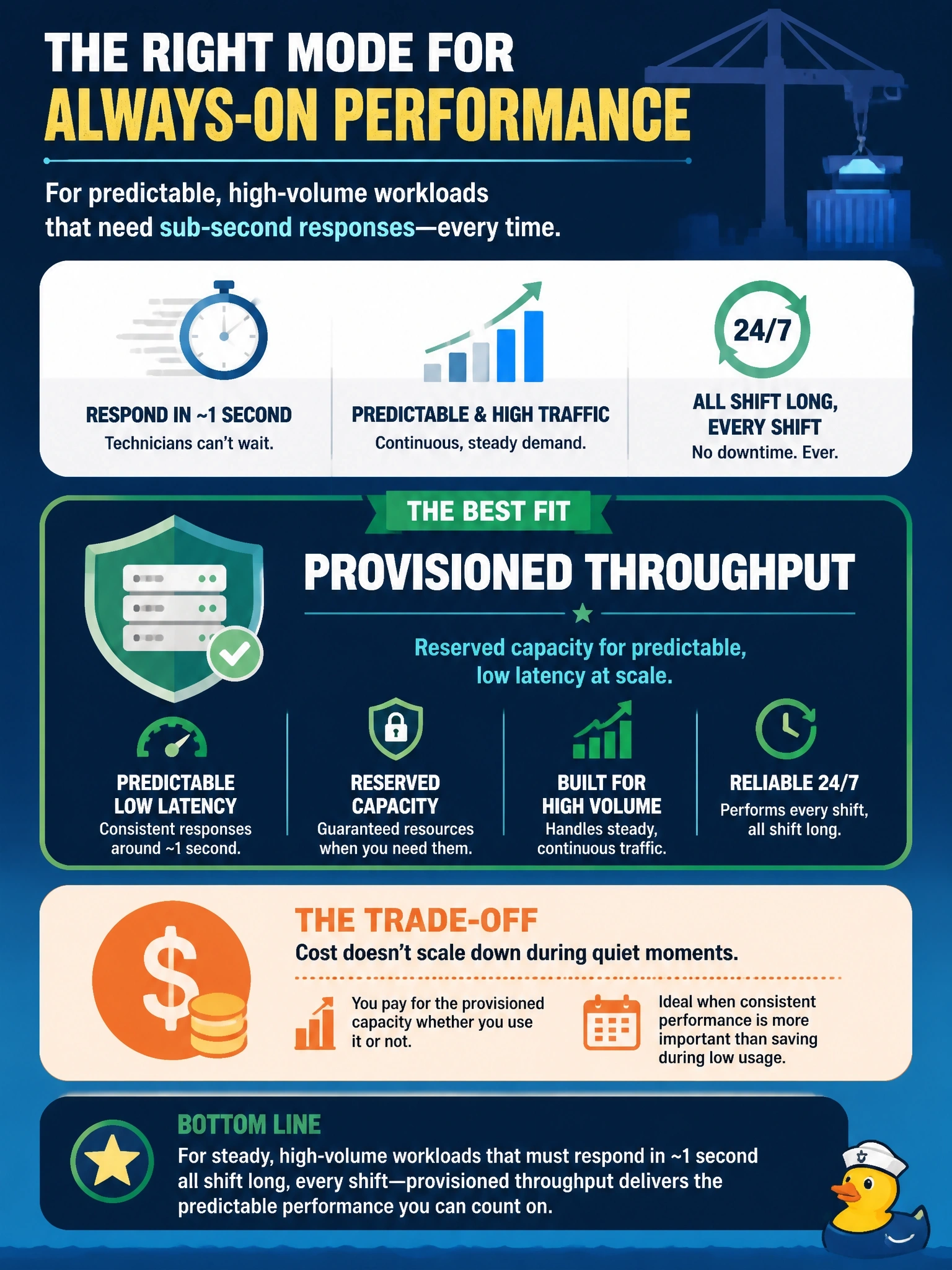
You have steady, high-volume traffic with a tight response-time target, so reserving dedicated capacity gives you more predictable low latency. You pay for that capacity even during quieter moments, but it fits this always-busy workload.
Full Explanation
Provisioned throughput reserves dedicated model-serving capacity, delivering consistent, predictable low latency under steady, high-volume load—exactly the technician-facing, always-busy shift pattern described. The trade-off is that you pay for reserved capacity, not solely for tokens consumed, so costs do not shrink during quieter stretches as usage-based pay-per-token billing does. Pay-per-token is not always cheaper: it often suits low, bursty traffic, but for sustained high volume, accumulated per-token charges can exceed the cost of a comparably sized reservation. Shared, variable load also does not provide the same latency guarantee. The claim that provisioned throughput charges only for generated tokens like pay-per-token while adding a free latency guarantee misstates its defining billing model: you purchase reserved capacity. And pay-per-token does support interactive chat-style requests; it is not limited to batch or offline scoring. Exam caveat: the best fit depends on both traffic pattern and latency needs, not simply on which mode sounds cheaper. As a practical check, compare your sustained forecast with the capacity you would reserve and verify that the reservation meets the response-time target across shifts.