
The maintenance-triage agent's endpoint sits idle most nights when no vessels are in port, then gets a burst of queries each morning. Meridian Line wants to avoid paying for idle compute overnight but accepts a short cold-start delay on the first morning request. Which Model Serving configuration fits, and what is the trade-off?
Select an answer to reveal the explanation.
Short Explanation
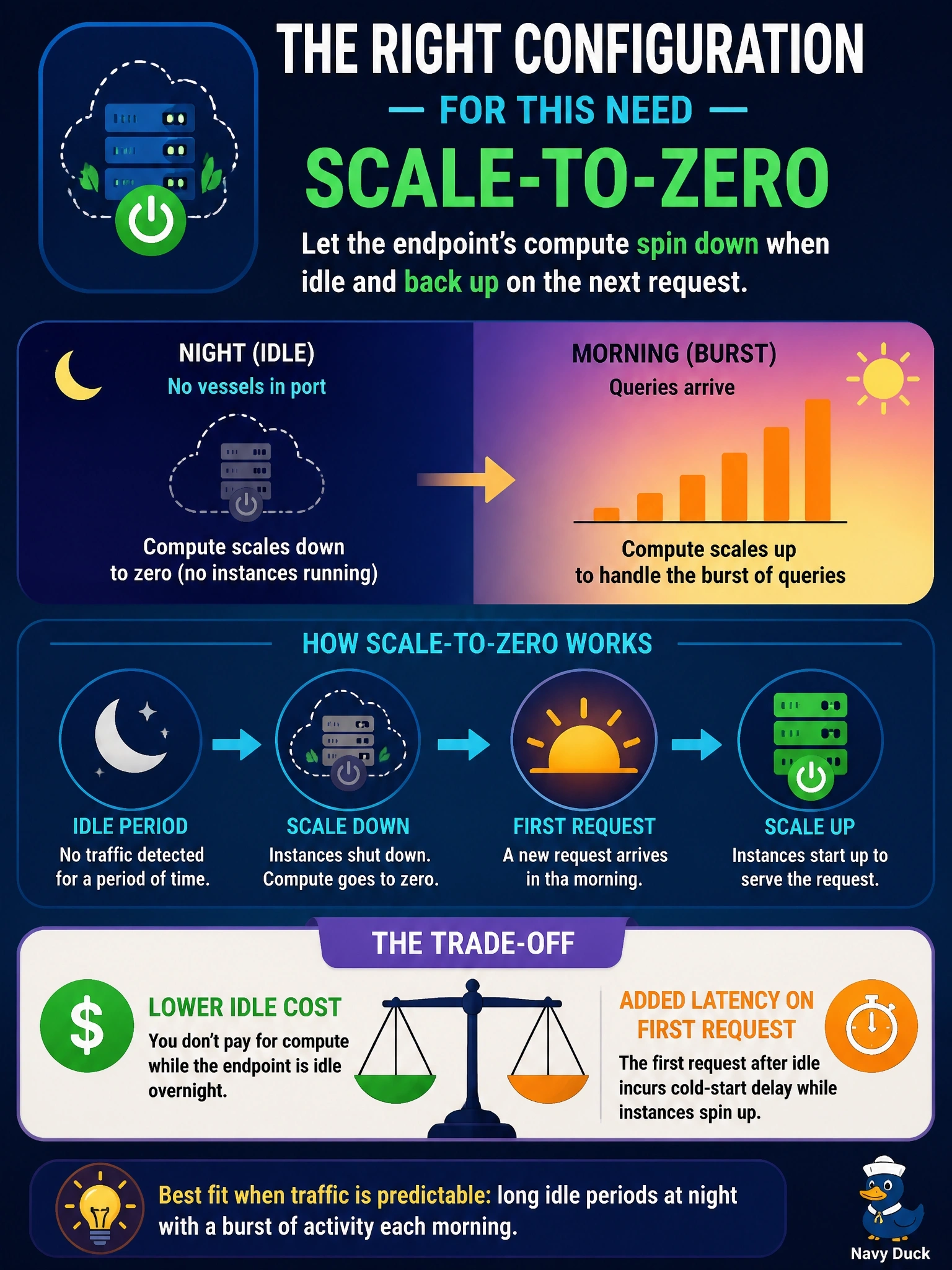
Scale-to-zero is the deliberate cost/latency trade: nothing running (and nothing billed) while it's idle, at the price of a cold-start delay when the first request of the morning wakes it back up.
Full Explanation
Scale-to-zero lets a Model Serving endpoint's underlying compute spin down entirely during idle periods and spin back up when a request arrives, which matches Meridian's overnight-idle, morning-burst pattern and their stated willingness to accept a cold-start delay in exchange for not paying for unused capacity. Provisioned throughput does the opposite of what's needed here: it reserves dedicated capacity continuously specifically to guarantee low, consistent latency, which means it is billed around the clock regardless of idle periods — that's the wrong trade-off for a team trying to avoid overnight cost. Traffic splitting is a routing mechanism between served model versions on one endpoint; setting a percentage to 0% for one version doesn't pause the endpoint's compute or its billing, and there is no such control tied to time-of-day scheduling. Payload logging is an AI Gateway feature for capturing request/response content — it has no relationship to endpoint uptime, scheduling, or compute state, so 'a payload-logging schedule that disables the endpoint' is not a real configuration. Exam framing: scale-to-zero is the specific cost/latency lever for bursty or idle-heavy workloads under endpoint configuration.