
Meridian Line's maintenance-triage agent has been validated in a development notebook. Given these remaining steps — (I) register the model to Unity Catalog, (II) log the chain as an MLflow pyfunc model with a signature and dependencies, (III) create or update a Model Serving endpoint pointing at the registered model version, (IV) run the notebook's chain object interactively to confirm it answers correctly — which ordering gets it into production correctly?
Select an answer to reveal the explanation.
Short Explanation
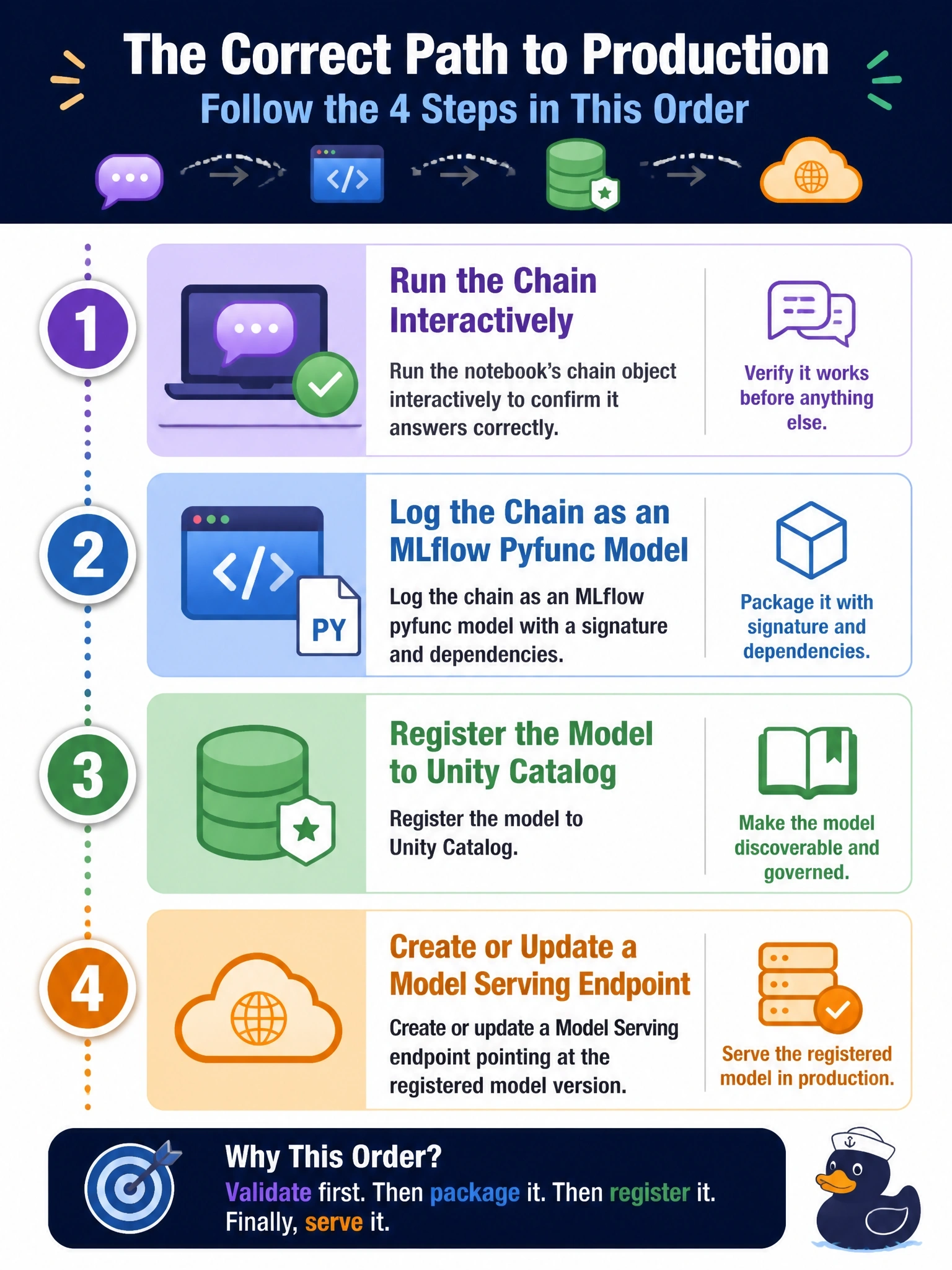
You’ve got the right flow: validate the chain in the notebook, log it, register it, then serve it. Each step needs its prerequisite in place: you can’t register an unlogged model or serve a version that hasn’t been registered.
Full Explanation
The production sequence is to confirm the chain answers correctly in the notebook (IV), log it to MLflow as a pyfunc model with a signature and captured dependencies (II), register the logged model to Unity Catalog under a three-level name to create a governed, versioned model (I), and create or update a Model Serving endpoint that points at that registered version (III). The order matters: registration operates on a logged model, and serving requires a registered version rather than a bare experiment-run artifact. Creating serving before registering leaves the endpoint with no registered model version to serve. Registering before logging attempts to register a model that has not been logged with MLflow, so the required model version does not exist. Logging before checking the chain can capture a broken chain in the artifact; validating first is a cheap way to catch problems before they are packaged. Exam caveat: distinguish the notebook’s interactive check from deployment—the chain working in the notebook does not itself create a logged, registered model or serving endpoint. Practical check: verify the logged model includes its signature and dependencies, confirm its Unity Catalog version, and ensure the endpoint targets that version. This validate, log, register, serve flow is the end-to-end deployment sequence tested for a RAG or agent application.