
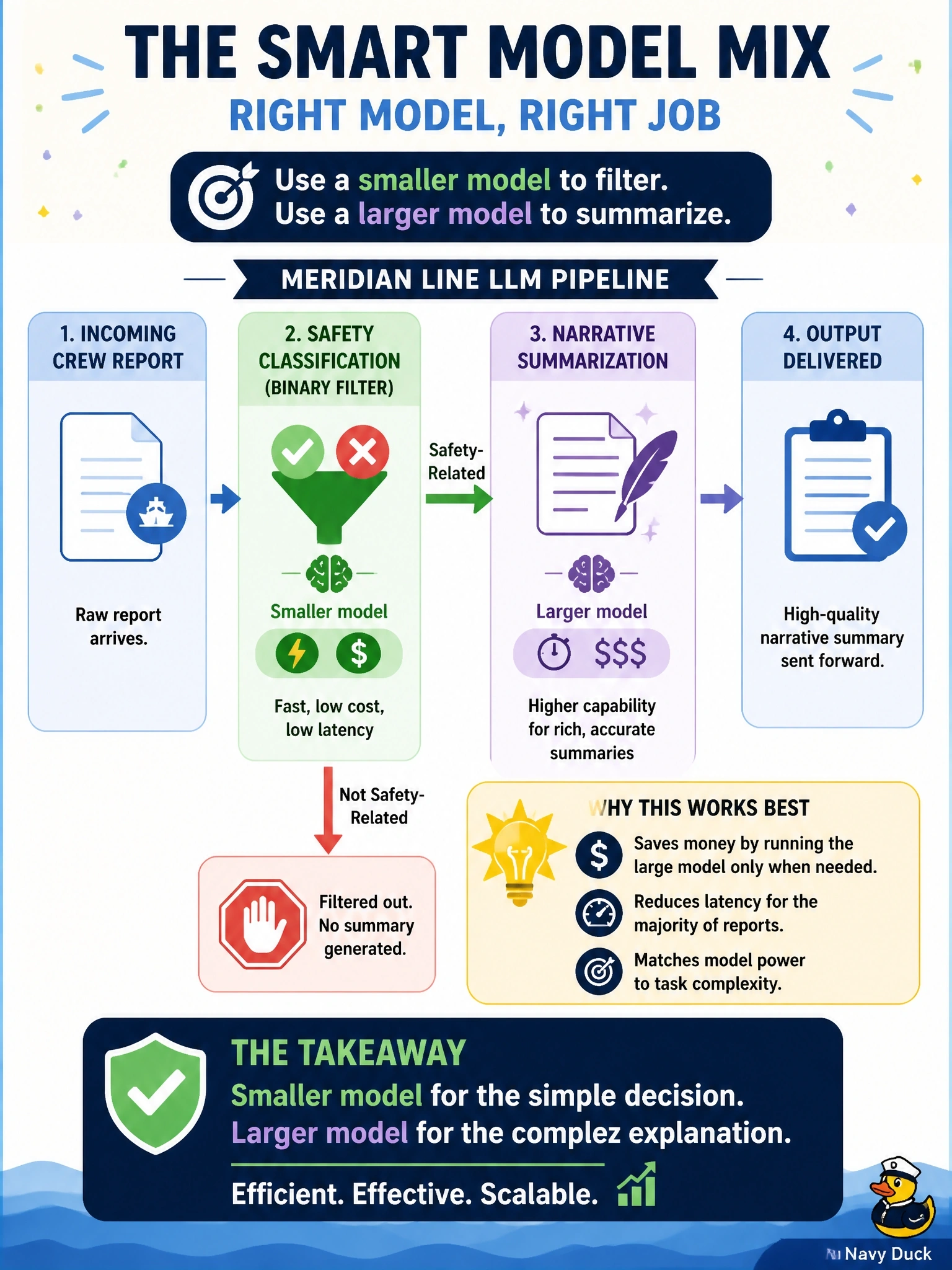
Meridian Line runs two separate LLM calls in its pipeline: one classifies whether an incoming crew report is safety-related at all, and a second drafts a full narrative summary only for reports that pass that filter. Which model-sizing approach is most defensible?
Select an answer to reveal the explanation.
Short Explanation
Match the horsepower to the job. Deciding yes-or-no on 'is this safety related' is a light lift a small, fast model handles fine; writing a coherent narrative summary asks more of a model. Spend your latency and cost budget where the task actually needs it.
Full Explanation
Matching model capability to task difficulty is a core cost/latency optimization: a binary or low-cardinality classification task like 'is this report safety-related' is well within the ability of a smaller, faster, cheaper model, while open-ended narrative generation genuinely benefits from a more capable model's stronger language and reasoning ability, so routing the lighter task to the lighter model and the harder task to the stronger model reduces overall cost and latency without sacrificing quality where it matters. Using the large model for both steps is simple but wastes cost and latency on the classification step, where the extra capability buys little to nothing. Reversing the assignment -- a large model for classification and a small model for summarization -- gets the sizing backwards: classification is the lower-difficulty task here regardless of the cost of a wrong call, and summarization is precisely the harder generative task that benefits most from a stronger model, so a small model would likely produce weaker narrative summaries. Using the smallest model for both because inputs are short conflates input length with task difficulty; a short input can still require strong generative or reasoning capability. Exam framing: selecting a model per task by weighing cost, latency, and quality is explicit in the Section 3 objectives, and pipelines with multiple LLM calls are exactly where per-step model choice pays off.