
The port-operations copilot serves a steady, predictable volume of terminal-planner queries around the clock, and Meridian Line wants to lock in a fixed, guaranteed throughput at a stable cost rather than pay per token during traffic spikes. Which Foundation Model APIs mode fits?
Select an answer to reveal the explanation.
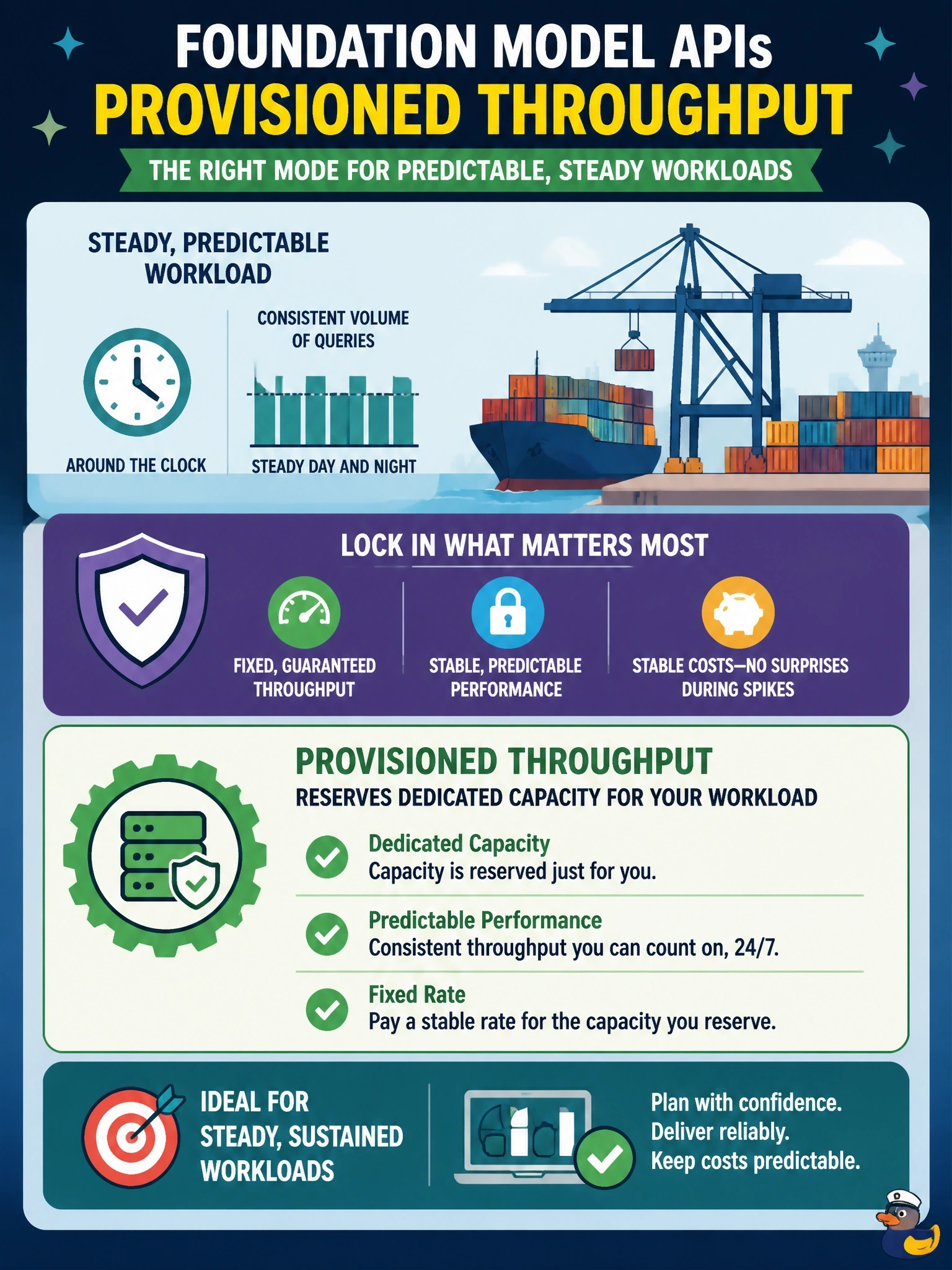
Short Explanation
Pay-per-token is a taxi meter -- great for spiky, unpredictable traffic. Provisioned throughput is a leased car -- you commit to steady capacity and know your bill in advance. Steady round-the-clock traffic is the provisioned-throughput case.
Full Explanation
Foundation Model APIs offers pay-per-token serving, priced per input and output token with capacity that scales automatically, and provisioned throughput, which reserves a fixed amount of model capacity for a predictable rate and cost -- the choice is a workload-shape decision, and a steady, always-on query volume with a desire for guaranteed throughput and stable pricing is the case provisioned throughput is built for. Pay-per-token is the better fit for bursty or unpredictable traffic where paying only for what is used matters more than a fixed guarantee, which is the opposite of what is described here. An External Model is a different axis entirely -- it is a Model Serving endpoint that proxies to a model hosted outside Databricks (through a supported provider) rather than a choice between billing models for a Databricks-hosted foundation model, so it does not address the throughput-guarantee requirement at all. A Vector Search index has nothing to do with model-serving billing; it is a retrieval component, not an LLM invocation mode, so it is a category error as an answer here. Exam framing: selecting an appropriate model and serving mode on cost, latency and workload grounds is explicitly a Section 3 objective, and pay-per-token versus provisioned throughput is the core Foundation Model APIs decision to know.