
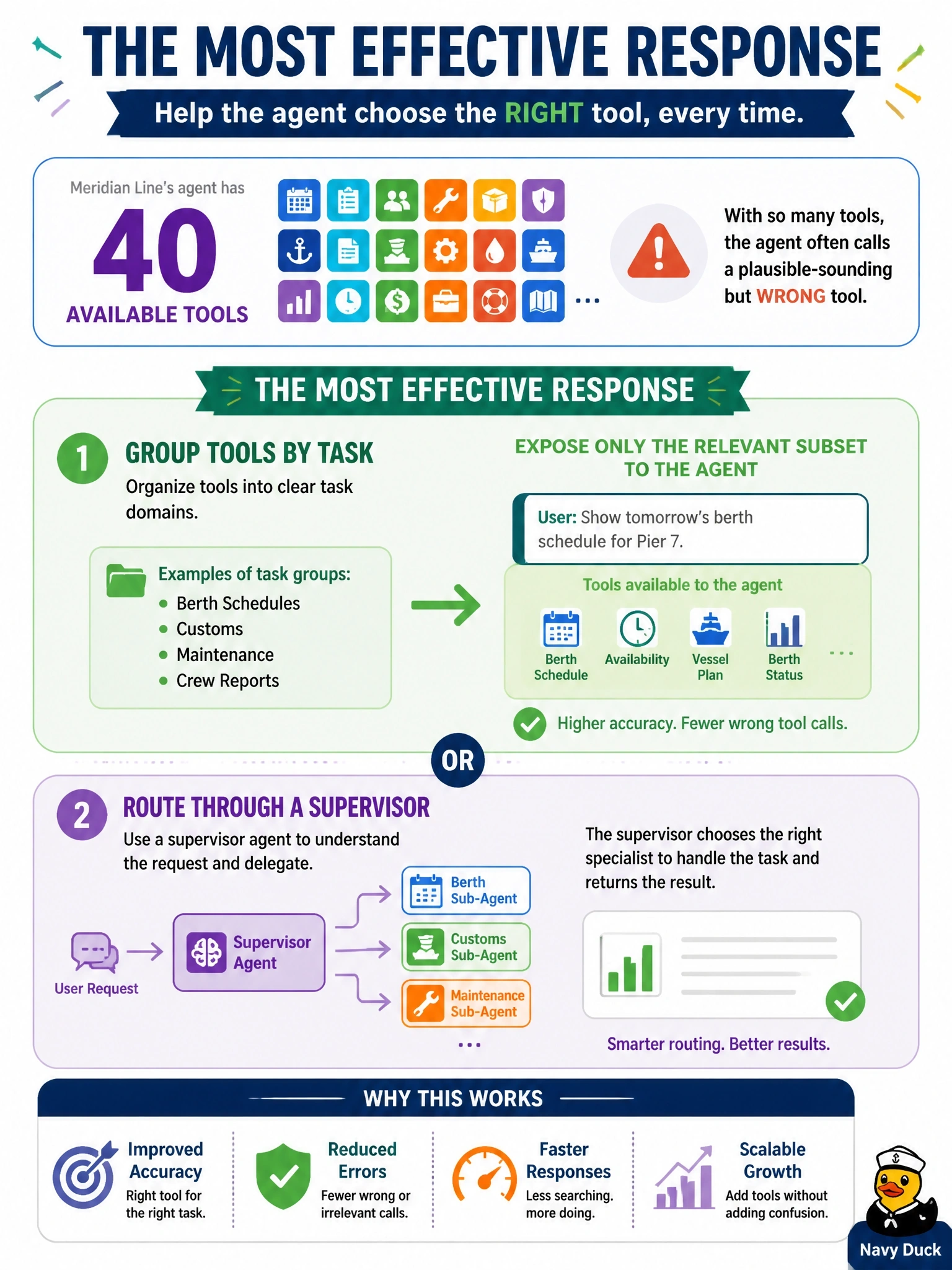
Meridian Line's port-operations agent has grown to 40 available tools spanning berth schedules, customs, maintenance, and crew reports, and it now frequently calls a plausible-sounding but wrong tool. What is the most effective response?
Select an answer to reveal the explanation.
Short Explanation
A model choosing among 40 look-alike tools is like a new hire handed the entire company directory and told to just know who to call. Narrow the set -- by task, or by handing sub-agents their own smaller toolbox -- and the wrong-tool problem mostly goes away.
Full Explanation
Tool selection accuracy degrades as the number of available tools grows, because the model must discriminate among many descriptions that can overlap or resemble each other; the practical fix is to reduce the choice set the model sees at any one time, either by scoping tools to the active task or workflow stage, or by decomposing the single agent into a supervisor that routes a query to a narrower sub-agent equipped with only the tools relevant to that domain -- this is exactly the problem the Multi-Agent Supervisor pattern is built to address. A longer system prompt asking the model to 'think carefully' does not change what information it has to discriminate with, and prompt-level pleading is a weak substitute for actually reducing ambiguity in the tool surface. Renaming tools with numeric prefixes changes sort order, not semantic distinguishability, and does nothing for a model reasoning over descriptions. Allowing more tool calls per turn lets the agent try more things after a wrong choice but does not reduce the rate of wrong choices, and it increases latency and cost. Exam framing: defining and ordering tools for multi-stage reasoning includes managing tool-set size and scope, a design decision distinct from writing any single tool's description well.