
A Meridian Line engineer gives the customs-compliance agent a tool literally named 'lookup' with no description, and the agent frequently calls it for questions that have nothing to do with HS codes. What is the most direct fix?
Select an answer to reveal the explanation.
Short Explanation
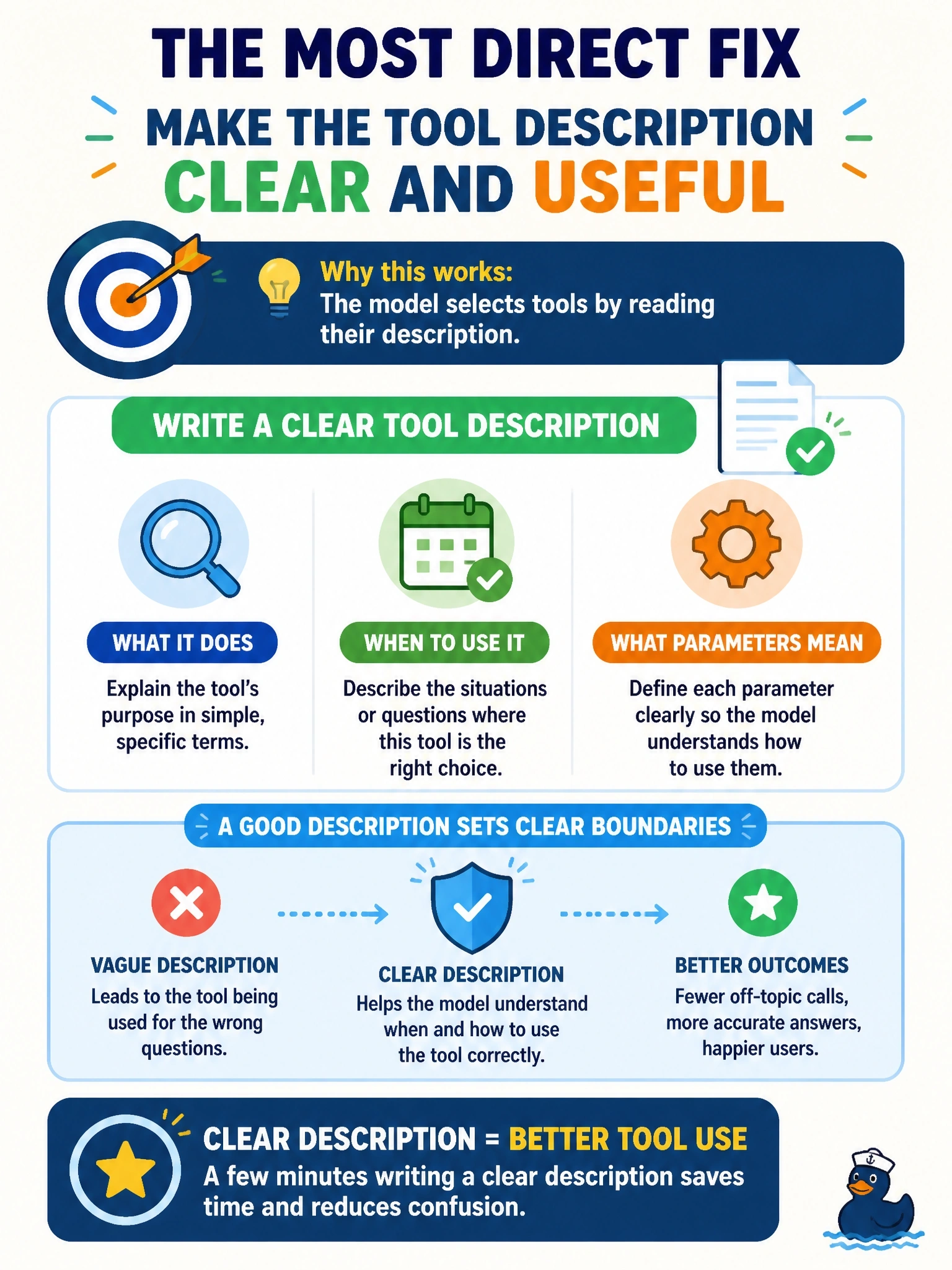
An agent doesn't read your code, it reads the tool's description before deciding to call it. A vague or missing description is the number one reason a model calls the wrong tool or the right tool at the wrong time -- write the description like you're briefing a new hire, not naming a variable.
Full Explanation
Tool-calling models decide whether and when to invoke a tool almost entirely from its name, description, and parameter documentation, because that description is what actually gets placed in the model's context at inference time. A tool named 'lookup' with no description gives the model nothing to reason about, so it either calls it indiscriminately or ignores it; writing a specific description of the tool's purpose, its expected inputs, and the situations where it applies directly fixes the selection problem. Renaming the tool to something shorter addresses nothing about disambiguation and is a distraction, not a fix. Moving the logic into the system prompt as prose abandons tool calling for description-only reasoning, which loses the structured invocation and argument validation that make tools reliable in the first place, and it does not scale as more tools are added. Raising temperature increases randomness in generation but does not give the model better grounds for choosing among tools -- if anything it makes selection less predictable, not more accurate. Exam framing: developing tools an agent calls is explicitly about the tool's interface -- name, description, and parameters -- since that interface is the only signal the model has for deciding when to reach for it.