
A Meridian Line demurrage-calculation assistant reasons through laytime arithmetic more accurately when asked to work step by step, but brokers complain that the raw reasoning now clutters the answer and occasionally exposes an abandoned wrong calculation. What is the appropriate way to keep the accuracy without the clutter?
Select an answer to reveal the explanation.
Short Explanation
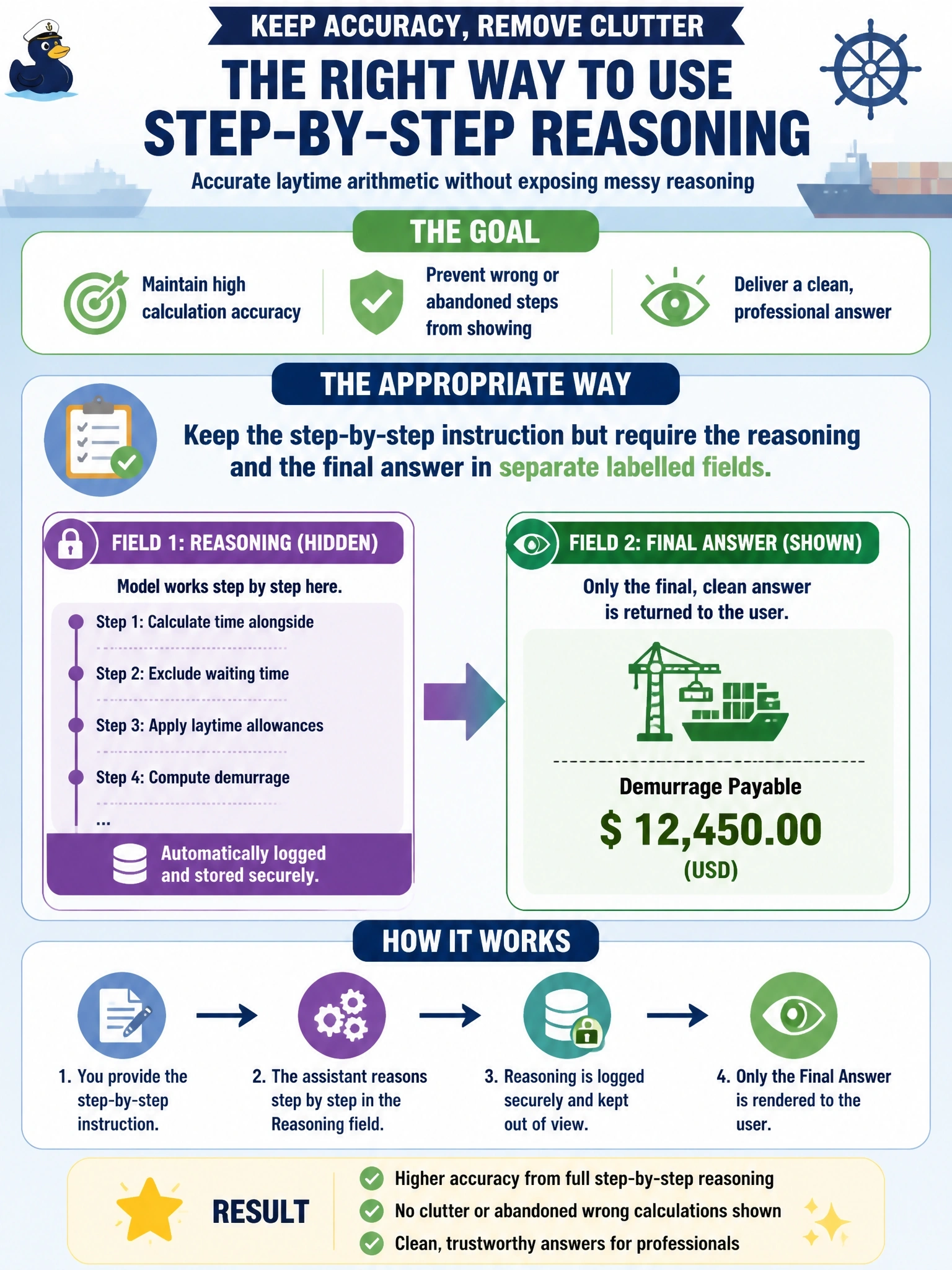
You want the thinking and you do not want to publish it. Ask for both parts in labelled fields, show the answer, log the reasoning. That way you keep the accuracy gain and you still have the trace when someone disputes a demurrage number.
Full Explanation
Step-by-step prompting improves multi-step numerical accuracy because the intermediate tokens are where the computation actually happens, so removing the instruction removes the benefit. The workable pattern is to keep the reasoning but structure it: require a response with a reasoning field and a separate final-answer field, render only the final answer to brokers, and persist the reasoning to logs or the MLflow trace where it becomes valuable evidence when a demurrage figure is challenged. The fourth option is the closest trap and the one most people pick, because 'think silently and answer only' sounds equivalent — but a model that produces no intermediate tokens has not done the intermediate reasoning, so this quietly reverts to the lower-accuracy behaviour while appearing to keep the instruction. Capping max_tokens does not suppress reasoning selectively; it truncates whatever is being generated, which most often cuts the final answer off the end. Abandoning the instruction trades away an accuracy gain that a presentation-layer fix can preserve at no cost. Exam framing: separating internal reasoning from the user-visible response is a prompt-and-output-contract decision, and the reasoning that gets logged is also the material an evaluation or judge step can inspect later.