
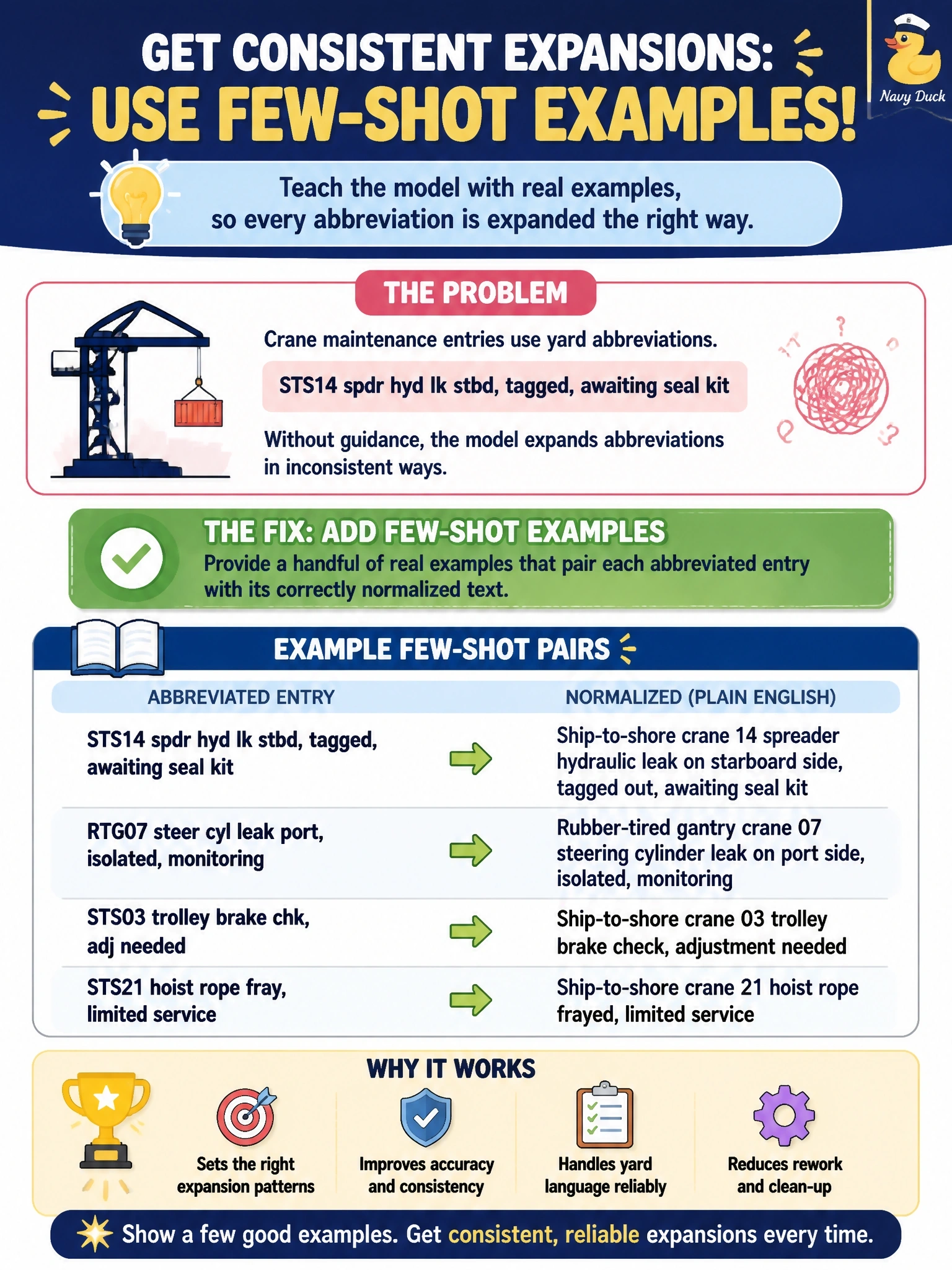
Crane maintenance entries at Meridian Line read like 'STS14 spdr hyd lk stbd, tagged, awaiting seal kit'. A prompt asking the model to normalize each entry into plain English produces reasonable but inconsistent expansions of the yard abbreviations. Which prompt technique fixes this most directly?
Select an answer to reveal the explanation.
Short Explanation
The model does not know your yard's shorthand — nobody wrote it down. Show it four or five real before-and-after pairs and it will pattern-match the house dialect. Few-shot examples are how you teach a convention you cannot define in a rule.
Full Explanation
Few-shot prompting exists for exactly this situation: a task whose correct behaviour is easier to demonstrate than to specify. Domain shorthand is arbitrary and local — 'spdr' for spreader, 'stbd' for starboard, 'lk' for leak — so no amount of instruction text conveys the convention as efficiently as several input-output pairs drawn from the real corpus. The examples both fix vocabulary and pin the output style. Raising the temperature moves in exactly the wrong direction; the complaint is inconsistency, and higher temperature increases sampling variance. Step-by-step reasoning helps on multi-step inference problems where the model must derive something, but expanding an abbreviation is a lookup, not a derivation, and the reasoning trace mostly adds tokens and latency. Retrieving similar entries is the closest trap because it superficially resembles few-shot prompting, but similar entries are more unlabelled shorthand — they show the model more of the problem, not the answer, and would only help if the corpus already contained normalized pairs. For the exam, keep the distinction sharp: few-shot examples teach form and convention, retrieval supplies facts the model does not have, and step-by-step prompting supports reasoning depth.