
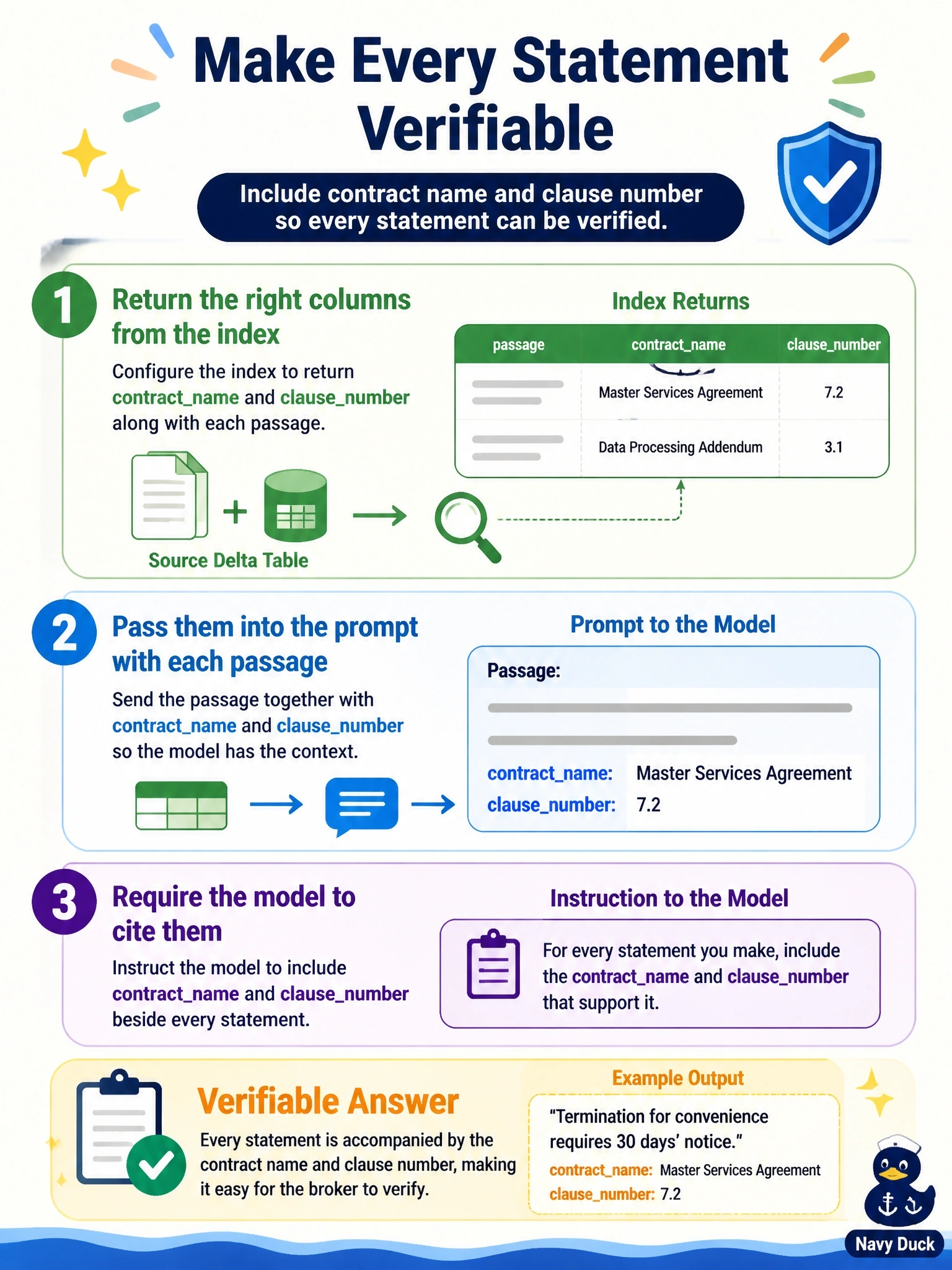
The charter-desk assistant must show the contract name and clause number beside every statement it makes so a broker can verify it. The chunks carry contract_name and clause_number columns in the source Delta table. What must the application do for those values to appear in the answer?
Select an answer to reveal the explanation.
Short Explanation
Citations are plumbing, not intuition. If the contract name and clause number are not carried out of the index and put in front of the model, it has nothing to cite and will make something up. Return the columns, label each passage, and require the format.
Full Explanation
Grounded citation is an end-to-end data-flow requirement: the identifying metadata must be synced into the index, requested among the returned columns at query time, rendered into the prompt attached to its passage, and demanded by the output format instruction. Break any link in that chain and the model either omits citations or invents them, which in a contract-review workflow is worse than no citation at all. Expecting the model to infer the identifiers from the clause text is the closest trap because clause text often does contain a clause number, but it is unreliable — many chunks will not include it, and nothing in the text names the contract the chunk came from. Concatenating citation strings into the embedded text is a real technique for improving retrieval on titled documents, but it changes what gets matched and does not guarantee clean, parseable metadata in the output; you would still want the structured column. Post-hoc matching of the generated answer back to the corpus is the anti-pattern that produces the most convincing wrong citations, because it attaches a source that resembles the claim rather than the source the claim came from. Exam framing: verifiable citation is designed at index-creation time, not bolted on afterwards.