
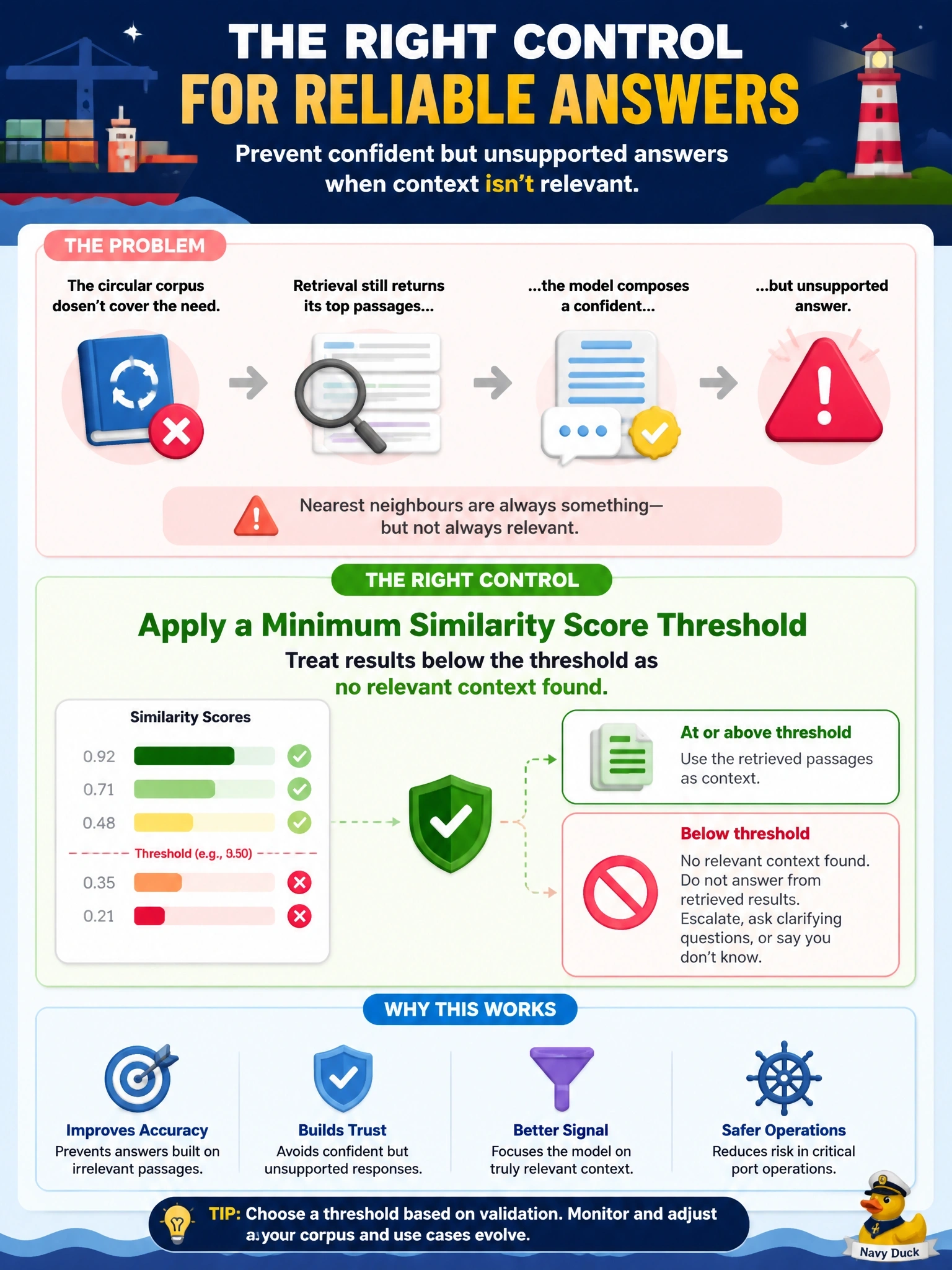
When a planner asks the port-operations copilot something the circular corpus simply does not cover, retrieval still returns its top passages — the nearest neighbours are always something — and the model composes a confident but unsupported answer. Which control most directly prevents this?
Select an answer to reveal the explanation.
Short Explanation
Nearest neighbour does not mean near. Vector search will always hand you something, even when the answer is not in the corpus at all. Put a score floor on it: below the line, the honest output is 'I don't have a circular covering that.'
Full Explanation
A similarity search has no concept of absence — it returns the closest vectors in the index whether or not any of them are actually relevant, so an out-of-corpus question yields low-scoring but non-empty results that look identical to good results by the time they reach the prompt. Thresholding on the similarity score converts that into an explicit signal the application can act on: below the floor, skip generation or route to a refusal template that says no covering circular was found. This is the standard handling of the low-relevance retrieval failure mode, and it pairs with an explicit grounding instruction in the prompt. Telling the model to hedge is the closest trap because it improves tone without improving truth — a hedged fabrication is still a fabrication, and the planner may act on it. Retrieving a single result does not reduce hallucination; it removes the corroborating passages while still supplying one weak passage as apparent evidence. A larger context window addresses over-long input, an unrelated failure mode, and does nothing about relevance. Exam framing: the three named retrieval failure modes — empty results, low-relevance results, and over-long context — each have their own control, and score thresholding plus a refusal path is the answer to the middle one.