
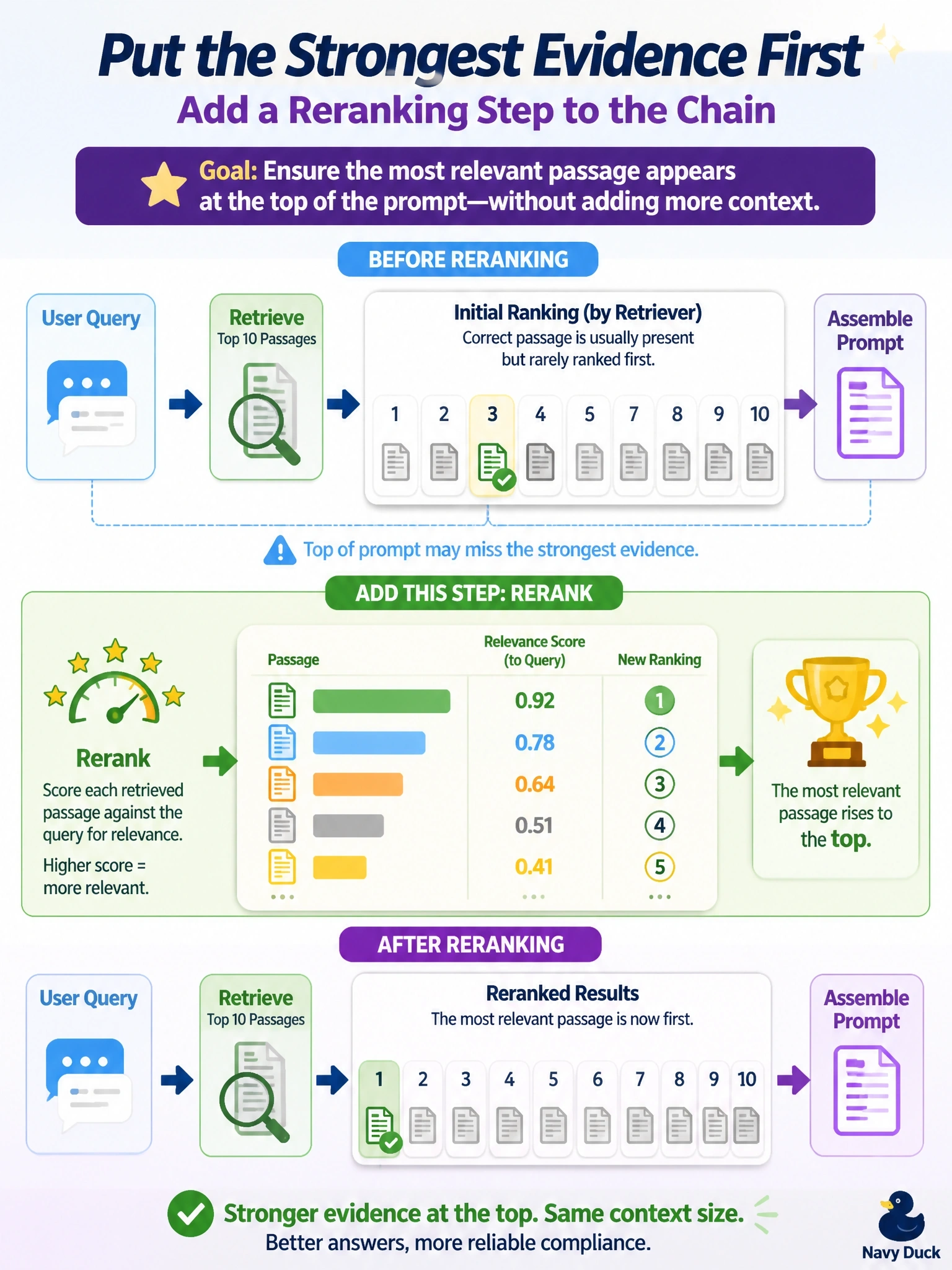
Retrieval for the customs-compliance assistant returns ten candidate passages, and evaluation shows the genuinely correct passage is usually present but rarely ranked first. The team wants the strongest evidence at the top of the prompt without enlarging the context. What should they add to the chain?
Select an answer to reveal the explanation.
Short Explanation
Vector search is a fast first pass — it is good at 'these ten are in the neighbourhood' and mediocre at 'this one is best'. A reranker is the slow, careful second pass over just those ten. Cheap to add, and it is exactly the failure you described.
Full Explanation
The symptom described — correct passage present but poorly ranked — is the textbook case for a two-stage retrieve-then-rerank pipeline. The vector search stage optimizes for recall over millions of chunks with a single cheap similarity computation; a reranker then scores each of the small candidate set against the query with a more expensive model that examines query and passage together, producing much better ordering at negligible cost because it runs over ten items rather than two million. Ordering matters because models attend unevenly across a long context, so putting the best evidence first materially improves answers. Increasing k is the closest-looking distractor and it addresses the wrong half of the problem: recall is already adequate, since the correct passage is usually retrieved — the defect is ordering, and a larger k makes ordering worse. A second index with another embedding model is a real technique for improving recall, but it doubles indexing cost and again targets recall, not rank. Summarizing all ten passages destroys the citation trail the compliance use case needs and risks the summarizer discarding the one detail that mattered. For the exam: name the stage that fails before choosing the remedy — recall failures and ranking failures have different fixes.