
Meridian Line chunks charterparty contracts into small passages so that retrieval is precise, but answers now lack the surrounding clause context needed to be correct — a retrieved sentence about laytime makes no sense without the clause it sits in. Which retrieval design resolves this without abandoning small chunks?
Select an answer to reveal the explanation.
Short Explanation
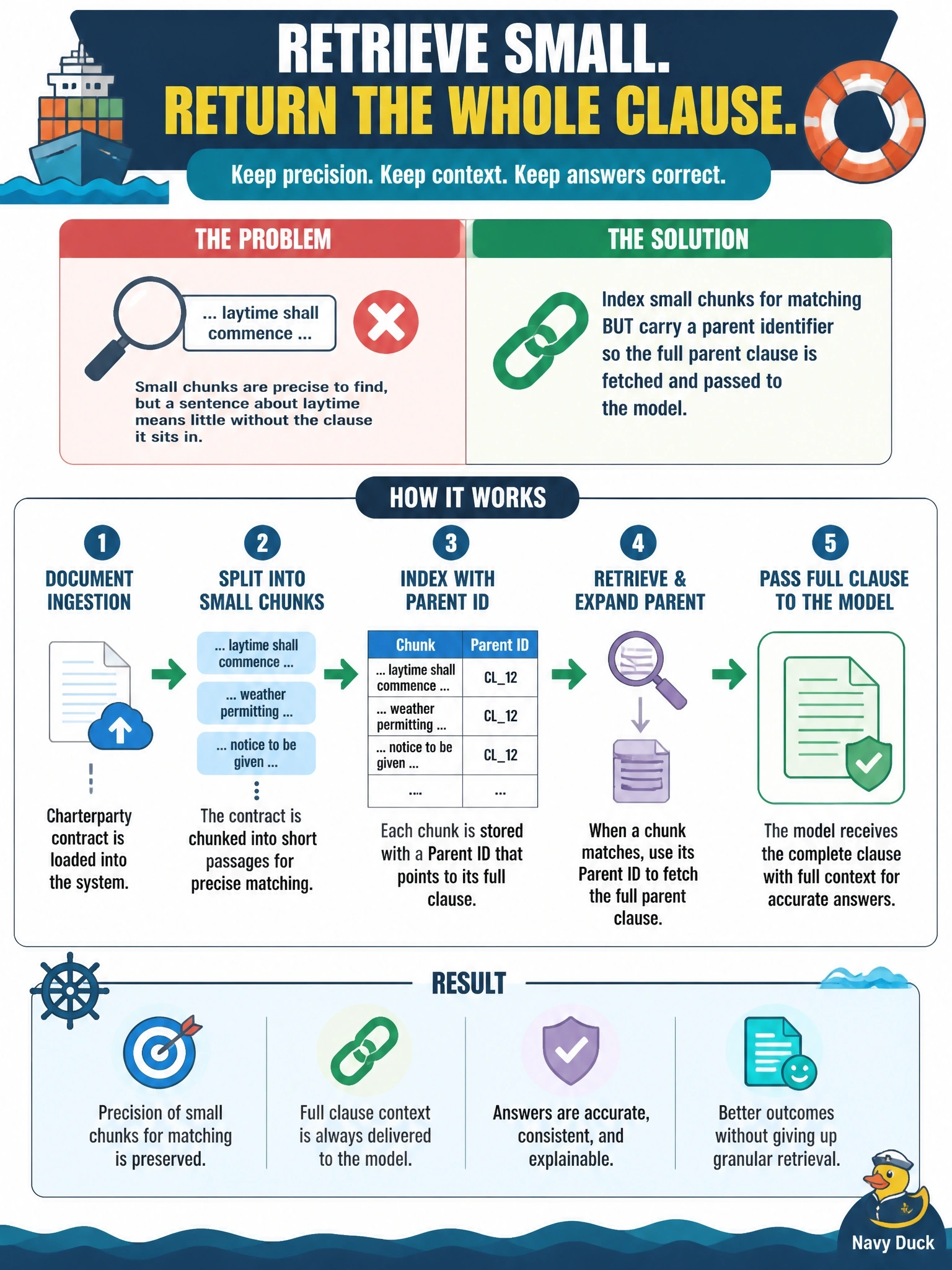
Search small, read big: you match on the tight passage where precision lives, then give the model the whole clause it came from so the answer makes sense. A parent identifier in your metadata makes that handoff possible. This keeps retrieval precise without stripping away the context needed to interpret the clause.
Full Explanation
This is the small-to-big, or parent-document, retrieval pattern: the chunk size that maximizes retrieval precision is often smaller than the span a model needs to answer correctly. At indexing time, each small child chunk carries a parent identifier; retrieval ranks the children, and the application fetches the full parent clause to pass to the model. Retrieving matching chunks and nearby passages can help in flat prose, but positional proximity does not reliably follow clause structure: a nearby passage may belong to another clause, and the retrieved text is not guaranteed to form a complete clause. Increasing overlap adds index size and duplicated text, blurs distinctions between chunks, and still cannot guarantee that a whole clause appears in one chunk. Indexing whole contracts instead sacrifices retrieval precision because one embedding cannot represent a fifty-page document well. The exam caveat is that chunking is not a single-size choice: distinguish the unit you match on from the unit you provide for generation. As a practical check, confirm that each retrieved child points to the intended complete clause and that the application passes that clause—not merely the child or its neighbours—to the model. For charterparties, split on clause boundaries and preserve parent identifiers.