
During a routine equipment compliance check, a dental assistant inspects an intraoral digital X-ray unit rated to operate at 75 kVp. According to NCRP and dental radiography textbooks, what is the minimum total aluminum-equivalent filtration required for this unit?
Select an answer to reveal the explanation.
Short Explanation
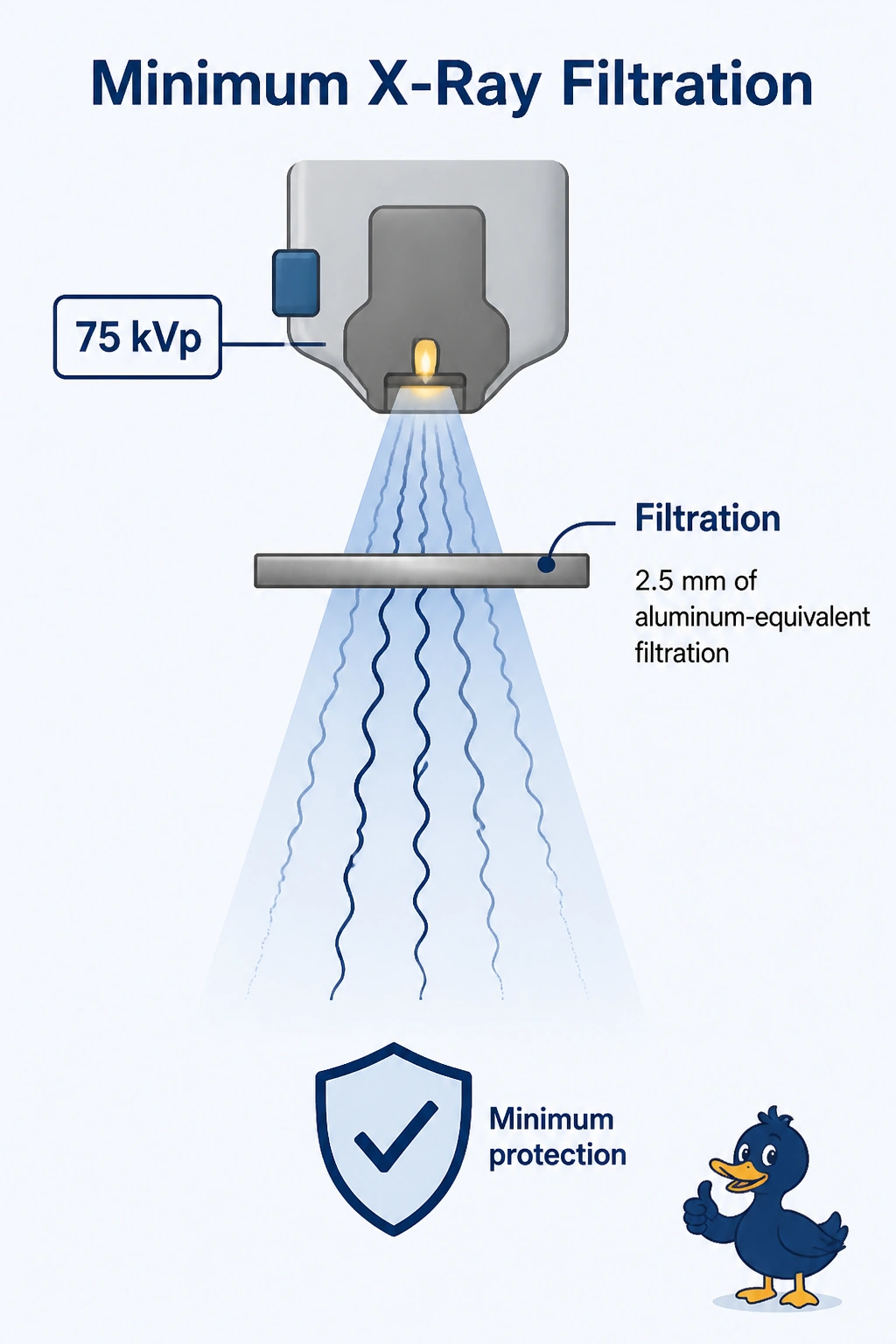
Think of X-ray filtration like a bouncer at a door, turning away weak, low-energy photons before they ever reach your patient's skin. According to NCRP and dental radiography textbooks, you need at least 2.5 mm of aluminum-equivalent total filtration for this unit above 70 kVp; the common trap is recalling the 1.5 mm minimum meant for lower-kVp units.
Full Explanation
According to NCRP and dental radiography textbooks, intraoral dental X-ray systems designed to operate above 70 kVp must have at least 2.5 mm of aluminum-equivalent filtration combining inherent tube components and added aluminum disks. FDA 21 CFR 1020.30 Table 1 is minimum HVL (specified dental: 2.1 mm Al at 71 kVp), not total-filtration thickness. This total filtration selectively absorbs low-energy photons that lack sufficient energy to reach the digital receptor and would otherwise be absorbed by the patient's superficial tissues. Selecting 1.5 mm of aluminum-equivalent filtration applies to units operating in the 50 to 70 kVp range, which leaves too many soft X-rays in a higher-energy 75 kVp beam. Choosing 0.5 mm of aluminum-equivalent total thickness reflects the lower threshold for systems operating below 50 kVp and provides inadequate skin protection for standard intraoral radiography. Specifying 3.5 mm of aluminum-equivalent total filtration overstates the textbook minimum and, if added unnecessarily, would attenuate useful diagnostic photons and force longer exposure times. Total filtration includes both inherent filtration from the glass envelope and insulating oil plus any added aluminum disk, not just the external disk alone. Verify the manufacturer's tubehead specification label and annual half-value layer (HVL) report to confirm compliance before clinical use.
Prefer to study offline? Printable PDF study book + test engine ($7.50, unofficial). These questions stay free here.