
Before the primary X-ray beam reaches the added aluminum disk in an intraoral dental X-ray unit, several structural components already absorb some of the lowest-energy photons. Which combination of components provides this inherent filtration?
Select an answer to reveal the explanation.
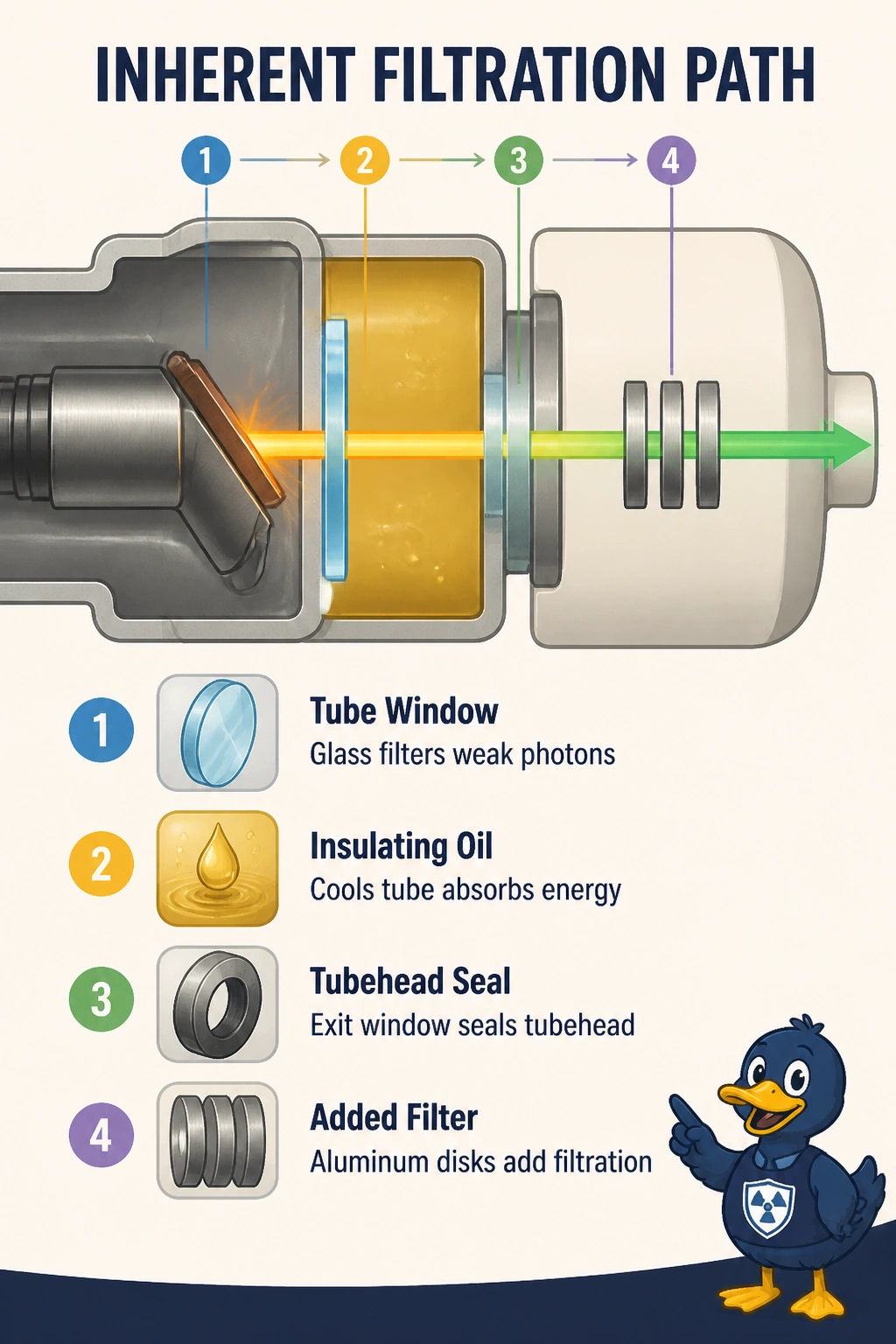
Short Explanation
Even before the X-ray beam meets the aluminum filter, it has to push through the tubehead's own layers, much like sunlight filtering through window glass before reaching your sunglasses. Those built-in layers create inherent filtration, and the trap is confusing them with the added collimator or internal electrical parts outside the beam path.
Full Explanation
Inherent filtration is produced by The glass window of the x-ray tube, the insulating oil, and the tubehead seal, which lie directly in the path of the emerging primary beam. As X-ray photons exit the anode target, they pass through the glass wall of the X-ray tube, the surrounding cooling oil, and the exit window seal, which selectively attenuate the weakest, longest-wavelength photons before they ever reach the added aluminum filter. By contrast, The step-up transformer, the autotransformer, and the timer wire regulate voltage and exposure duration inside the housing and do not intercept the exit beam. Likewise, The copper anode stem, the tungsten target, and the focusing cup generate and direct electrons to produce X-rays rather than filtering the exiting beam. Finally, The lead collimator, the aluminum disk, and the open PID sit beyond the tubehead window and do not provide inherent filtration: only the aluminum disk provides added filtration, while the lead collimator and the open PID restrict beam size rather than filtering. As a radiation-protection caveat, inherent filtration alone is insufficient to meet federal total-filtration requirements for diagnostic beams, so manufacturers combine it with added aluminum filtration. During routine preventive maintenance, verify that the tubehead exit window is intact and free of oil leaks, which can alter beam attenuation.
Prefer to study offline? Printable PDF study book + test engine ($7.50, unofficial). These questions stay free here.