
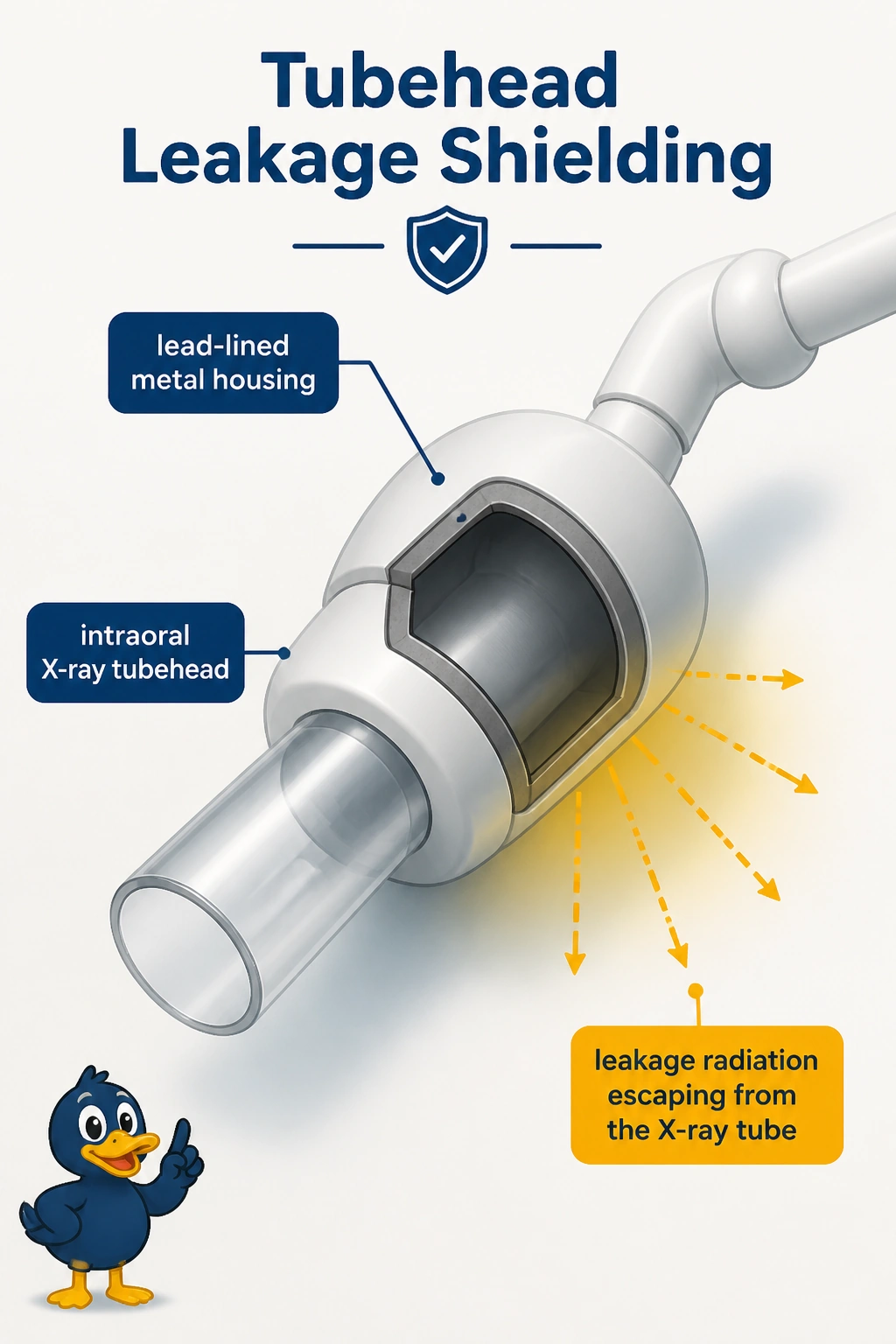
During a radiation protection review, a dental assistant asks how the protective lead-lined metal housing of an intraoral X-ray tubehead controls unwanted radiation. Which type of radiation is this lead shielding specifically designed to block?
Select an answer to reveal the explanation.
Short Explanation
Inside the tubehead, X-rays fire off in every direction, and only the beam aimed down the PID should ever leave the box. The trap is confusing tubehead leakage with scatter radiation bouncing off your patient. Remember that lead lining around the housing traps stray photons before they ever reach the room.
Full Explanation
Inside the glass X-ray tube, electrons striking the tungsten target emit X-ray photons isotropically in all directions, not solely toward the patient. Leakage radiation escaping from the X-ray tube refers to any photons that attempt to exit through the tubehead walls rather than the collimator port, and the dense lead-lined metal housing absorbs them to protect both patient and operator. Scatter radiation deflected outward from the patient's facial tissues occurs after the useful beam strikes the patient, so tubehead shielding cannot block it; operator distance, proper standing angle, and structural barriers handle patient scatter. Primary beam photons exiting through the open-ended PID represent the intentional diagnostic beam that passes through the collimator and filtration to expose the digital receptor. Secondary photons produced inside the dental operatory walls arise from interactions outside the tubehead and are managed by room shielding rather than housing lead. As a safety caveat, a dropped or cracked tubehead can compromise internal lead shielding and cause abnormal leakage. If a tubehead experiences impact damage, take the unit out of service until a qualified inspector verifies acceptable leakage limits.
Prefer to study offline? Printable PDF study book + test engine ($7.50, unofficial). These questions stay free here.