
Inside a dental X-ray tube, high-speed electrons travel from the cathode and strike the tungsten target at the anode. Which physical interaction generates the majority of the X-ray photons in the primary diagnostic beam?
Select an answer to reveal the explanation.
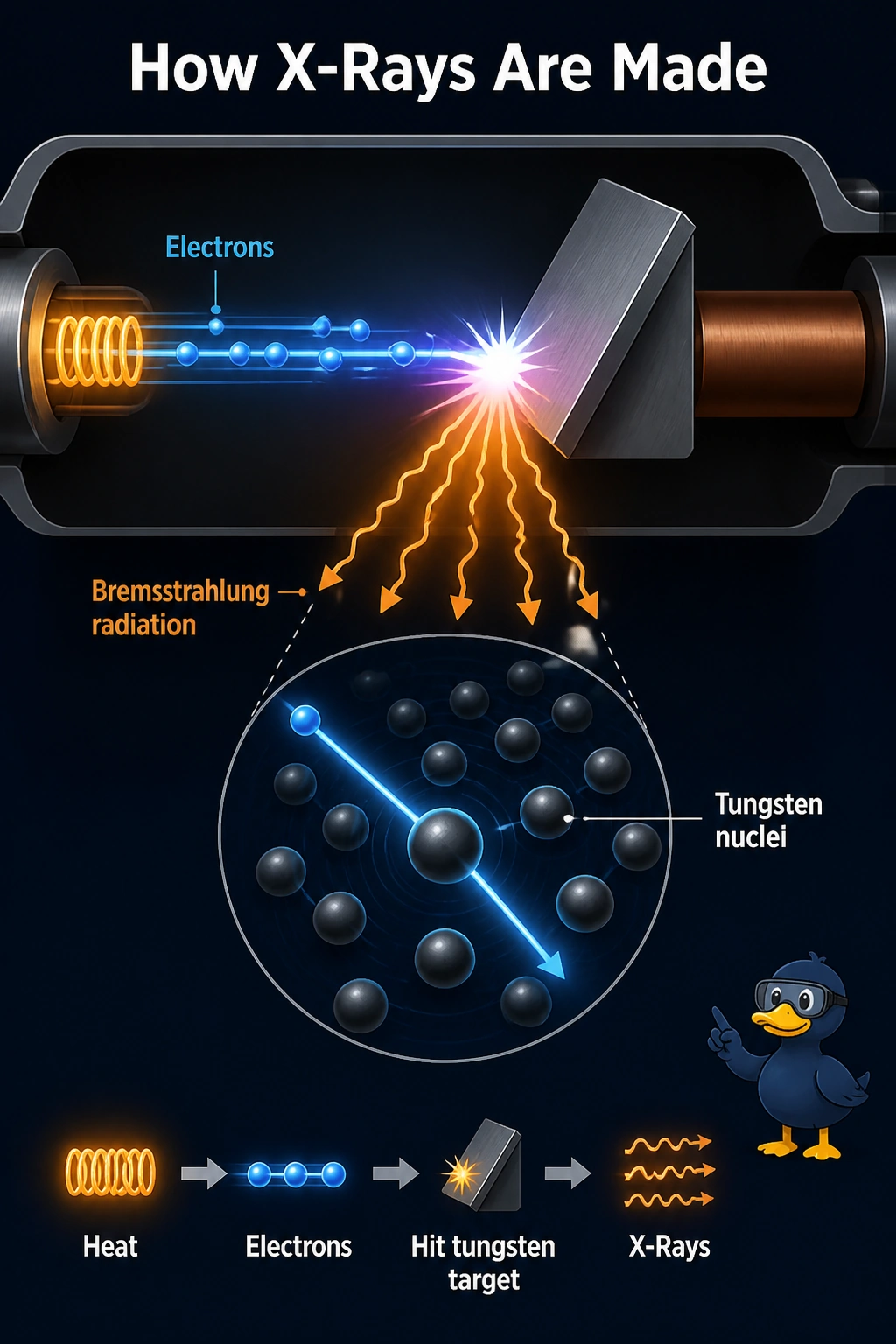
Short Explanation
You can picture the fast electrons braking near tungsten nuclei, with some of their motion becoming X-ray photons; this Bremsstrahlung radiation makes most of the primary beam. Thermionic emission of electrons from the heated tungsten target is a tempting mix-up, but thermionic emission releases electrons at the cathode before they cross the tube.
Full Explanation
When high voltage accelerates electrons across the dental X-ray tube into the anode, most of their kinetic energy becomes heat, while a small fraction produces X-ray photons. Bremsstrahlung radiation produced when electrons decelerate near tungsten nuclei accounts for most of the primary beam and creates a continuous spectrum of photon energies up to the selected kVp. Thermionic emission of electrons from the heated tungsten target is not the source: thermionic emission releases electrons from the cathode filament before acceleration, not from the anode target. Photoelectric absorption of low-energy electrons by the glass tube envelope is also incorrect because the photoelectric effect describes X-ray photons interacting with matter; it does not generate the primary beam from high-speed electrons. Pair production triggered when electrons collide with outer-shell valence electrons is physically impossible in dental radiography: pair production requires photon energies far above diagnostic dental tube voltages, and the described electron collision is not its mechanism. As an exam caveat, characteristic radiation also occurs at the tungsten target above its binding-energy threshold, but it contributes a smaller share of photons. As a practical check, allow the tubehead to cool adequately between heavy series to protect the tungsten target from overheating.
Prefer to study offline? Printable PDF study book + test engine ($7.50, unofficial). These questions stay free here.