
During a radiation safety review, a dental assistant asks what constitutes the main source of occupational radiation exposure for staff working near a dental operatory during intraoral exposures. Which type of radiation poses this primary risk?
Select an answer to reveal the explanation.
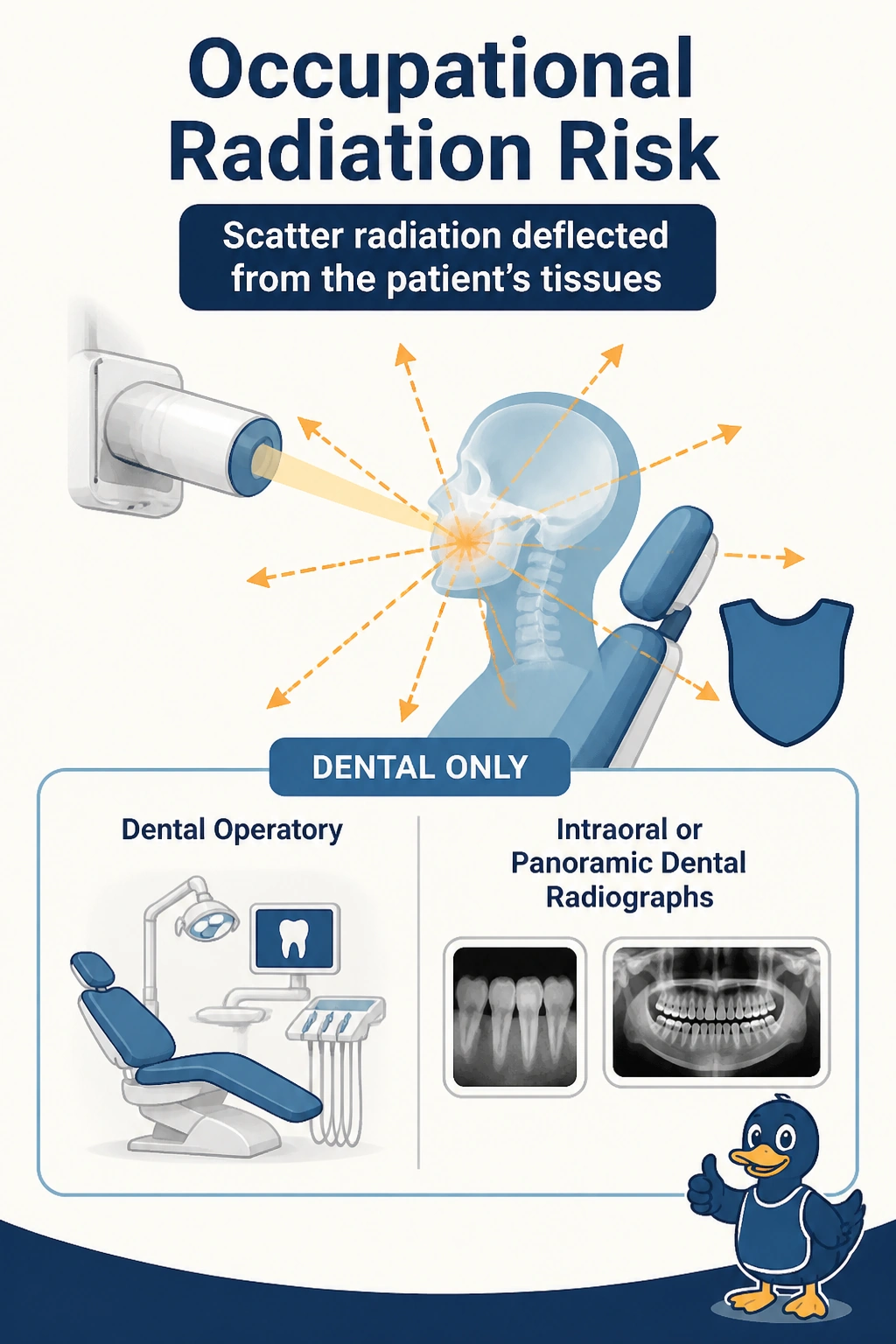
Short Explanation
Once the X-ray beam hits the patient's cheek, photons bounce off in every direction like billiard balls! The trap is thinking tubehead leakage is your biggest worry, when patient scatter actually accounts for most operator exposure. Step back at least six feet at a 90-to-135-degree angle or step behind a barrier.
Full Explanation
During diagnostic dental radiography, the primary X-ray beam enters the patient's tissues, where most low- and medium-energy photons either pass through to the digital sensor or undergo Compton interactions. These Compton interactions deflect photons in all directions, creating Scatter radiation deflected from the patient's tissues, which represents the main source of occupational radiation exposure for the dental team inside or near the operatory. By contrast, Primary radiation exiting the patient's cheek toward the wall is directed along the narrow collimated beam path toward the receptor and wall barrier, where the operator must never stand. Leakage radiation escaping through the back of the tubehead housing is strictly minimized by the lead-lined tubehead casing and represents a negligible fraction compared to patient scatter. Bremsstrahlung radiation generated inside the digital sensor does not occur because braking radiation is produced by high-speed electrons decelerating at the tungsten target inside the X-ray tube, not inside the intraoral receptor. One caveat is that scatter intensity is highest along the path of the primary beam and drops rapidly with distance via the inverse square law. As an operational check, always stand behind a protective barrier or at least six feet away at a 90-to-135-degree angle to the primary beam.
Prefer to study offline? Printable PDF study book + test engine ($7.50, unofficial). These questions stay free here.