
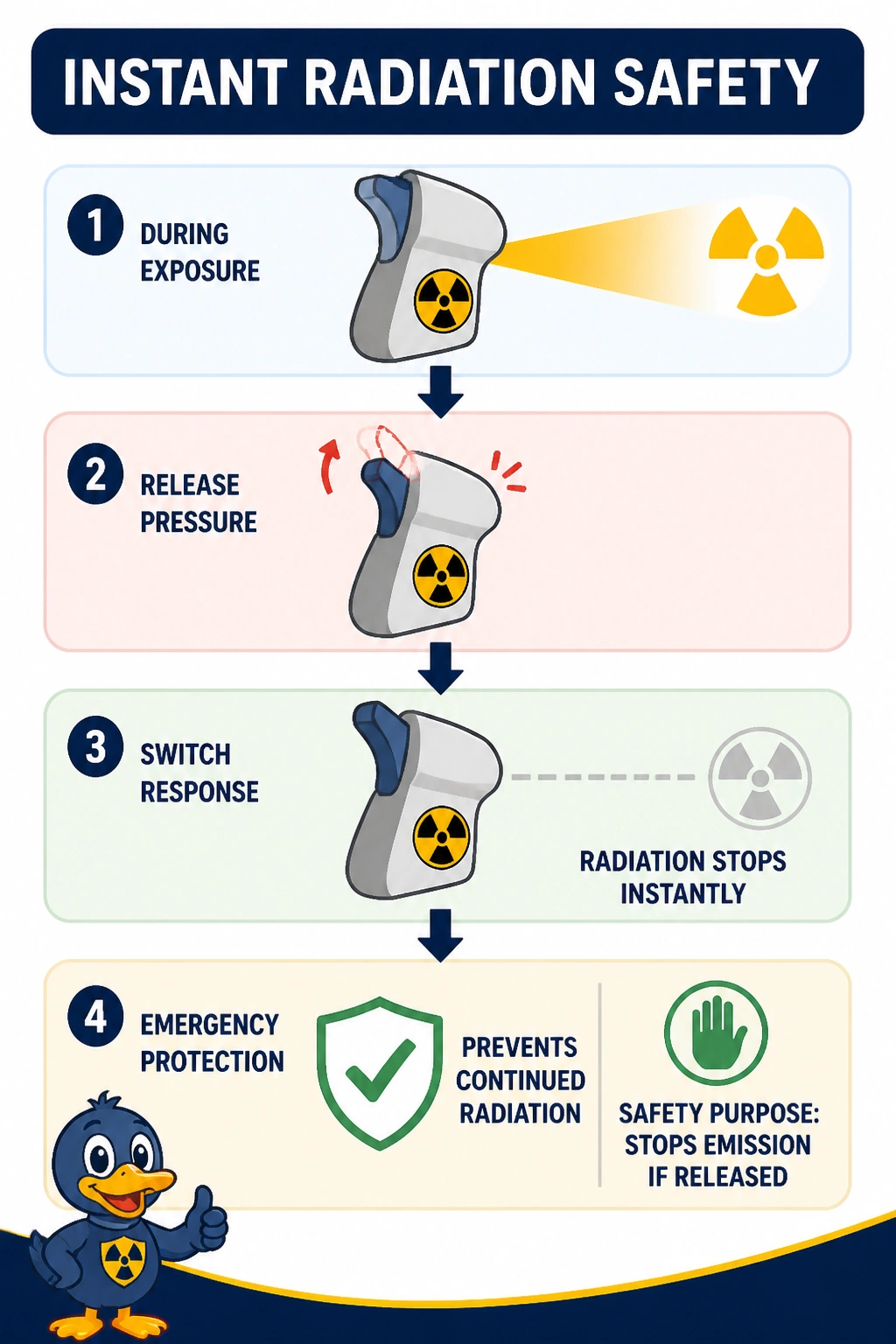
A dental assistant notices that releasing the intraoral X-ray exposure button halfway through the audible tone immediately stops X-ray emission, resulting in a pale, grainy digital image. Why is the exposure switch engineered to behave this way?
Select an answer to reveal the explanation.
Short Explanation
That exposure button works like a lawnmower safety bar—the moment you let go, everything stops! The trap is thinking you can eyeball a shorter exposure by releasing early, which just ruins your image with underexposure. Keep steady pressure until the tone completely finishes.
Full Explanation
Federal performance standards for diagnostic dental X-ray systems require a dead-man type exposure switch. Its purpose is To ensure radiation production stops instantly if the operator releases pressure during an emergency, such as a patient suddenly moving or a child pulling away from the tubehead. Maintaining continuous pressure until the audible tone ends guarantees the full preset exposure time is delivered. Selecting this design is not To allow the assistant to manually shorten exposure time for pediatric patients, because cutting an exposure short by releasing the button produces an underexposed, non-diagnostic image instead of using proper pediatric timer settings. Nor is it To prevent the digital sensor from overcharging during high-kilovoltage exposures, since sensor saturation is controlled by timer and kilovoltage selection rather than manual switch release. Finally, the switch is not designed To calibrate the milliamperage output between consecutive intraoral exposures, as mA regulation is handled internally by the generator circuit. One caveat is that releasing the button a fraction of a second too early can mimic generator failure by producing a pale, grainy image. As an operational check, keep firm pressure on the exposure switch until both the audible tone and indicator light turn off.
Prefer to study offline? Printable PDF study book + test engine ($7.50, unofficial). These questions stay free here.