
A new patient with no dental pain asks why the dentist performs a clinical examination and reviews their dental history before deciding which digital radiographs to order. Which principle from ADA and FDA guidelines explains this sequence?
Select an answer to reveal the explanation.
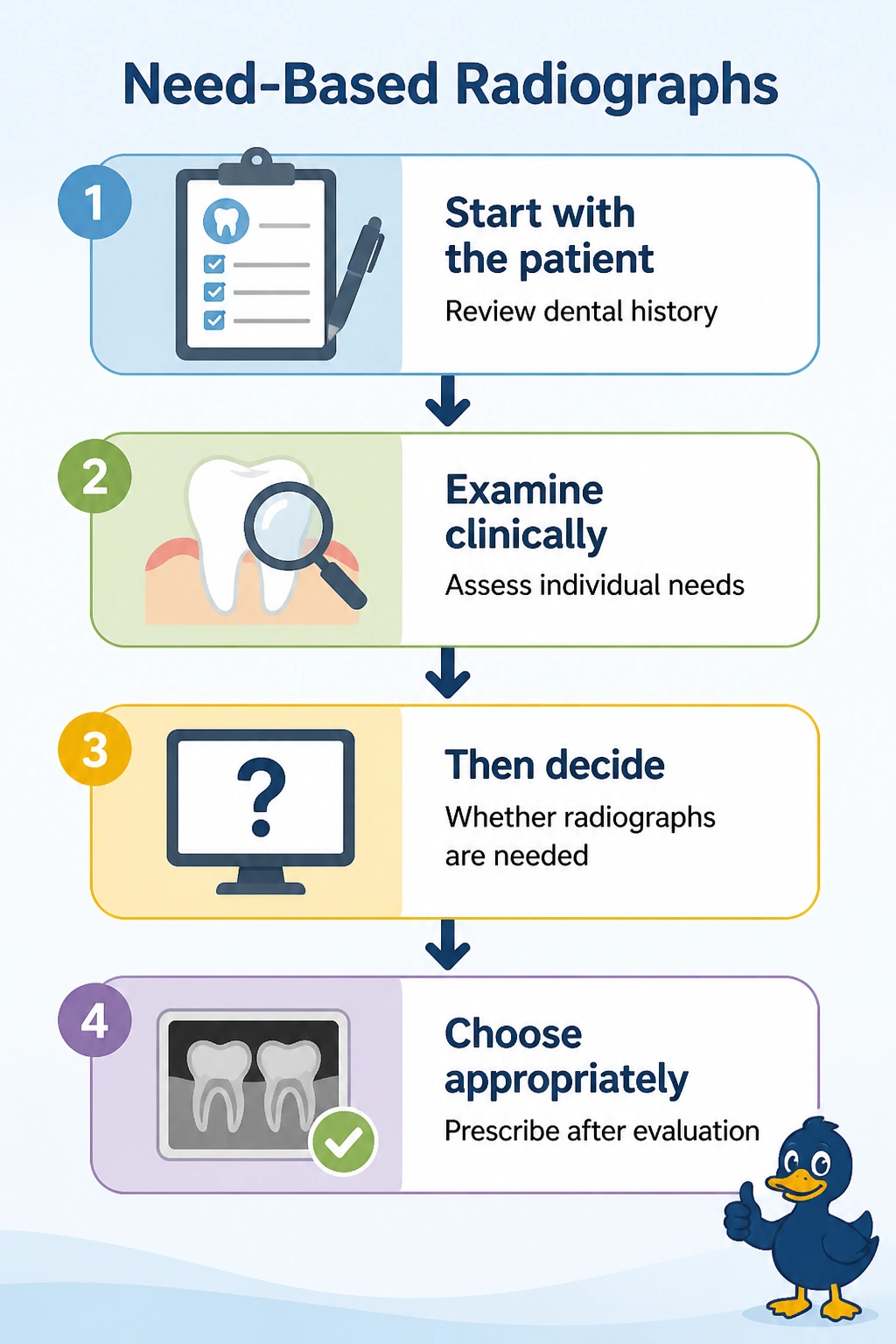
Short Explanation
Think of dental radiographs like a tailored prescription rather than a one-size-fits-all menu: your dentist checks your history and examines you first so each exposure has a clear reason. This individualized approach avoids assuming that every new patient automatically needs a fixed set of images.
Full Explanation
ADA and FDA patient-selection guidelines apply the ALARA principle by requiring each diagnostic dental exposure to be justified by clinical findings. Radiographs are therefore prescribed after clinical evaluation based on individual patient need, so imaging addresses your health history, caries risk, and examination results. A full-mouth series is not mandatory for every new adult patient before any clinical exam: a new patient with recent transferable radiographs or low disease risk may need only selected views or no images. Panoramic imaging does not always replace intraoral radiographs at every initial visit because panoramic images lack the spatial resolution needed to detect early interproximal caries compared with bitewings. Bitewing radiographs are not prohibited unless you report active toothache pain; asymptomatic recall or elevated-risk patients may need bitewings to find hidden interproximal decay before symptoms develop. As an exam caveat, only the dentist prescribes radiographs after evaluating you, not the dental assistant on a standing protocol. As a practical check, verify that a radiographic order is documented in your chart before positioning any digital receptor.
Prefer to study offline? Printable PDF study book + test engine ($7.50, unofficial). These questions stay free here.