
A newly hired dental assistant asks why they must wear a personal radiation dosimeter badge at collar level during clinical shifts. What is the primary function of this dosimeter?
Select an answer to reveal the explanation.
Short Explanation
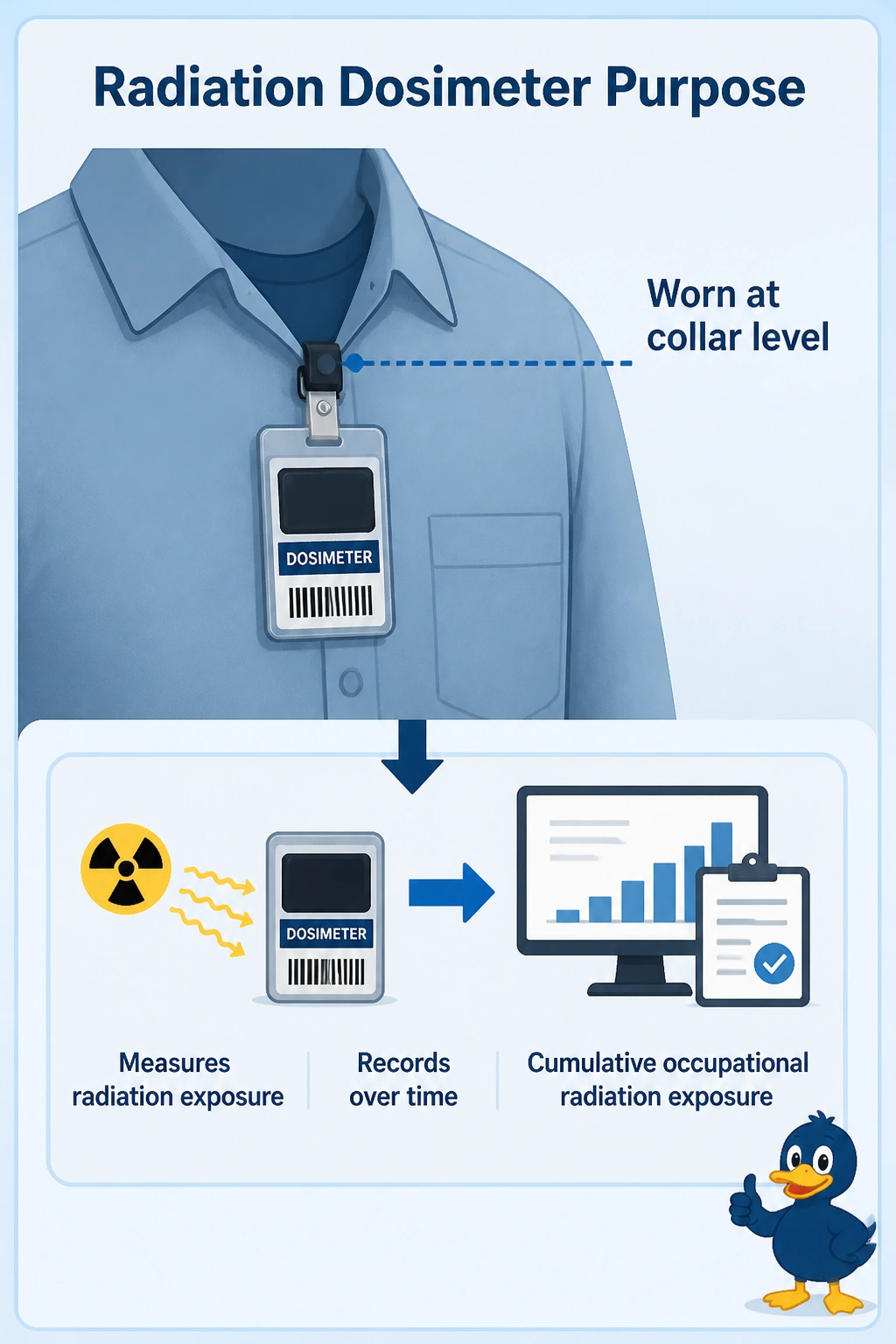
Think of a dosimeter badge like an odometer for your radiation shifts, not a shield or a siren. You wear it at collar level to measure and record cumulative occupational radiation exposure over time. The trap is assuming the little plastic badge physically blocks scatter or beeps when something goes wrong.
Full Explanation
A personal radiation dosimeter, such as an optically stimulated luminescence (OSL) or thermoluminescent dosimeter (TLD) badge, is a passive monitoring device worn by occupationally exposed personnel To measure and record cumulative occupational radiation exposure across a reporting period. Wearing it at collar level estimates dose to the head, neck, and lens of the eye, helping practices verify that staff exposures remain well below occupational limits. The badge is far too small and thin To absorb scattered X-ray photons before they reach the thyroid gland; physical shielding relies on distance, barriers, and protective aprons when indicated. Passive dosimeter badges also contain no speaker or real-time readout To trigger an audible alarm whenever a patient's exposure is too high. Likewise, a personal badge cannot function To verify that the X-ray tubehead kVp setting remains properly calibrated, which requires dedicated quality-assurance test equipment. As a caveat, leaving a badge on a dental apron inside an operatory or exposing it to high heat in a car can produce false readings. As an operational check, store your dosimeter in a designated radiation-free area outside the operatory at the end of every shift and submit it on schedule for processing.
Prefer to study offline? Printable PDF study book + test engine ($7.50, unofficial). These questions stay free here.