
A 5-year-old patient is unable to keep a digital bitewing holder steady in the mouth during an exposure, even after gentle coaching. Who should stabilize the sensor during the exposure, and with what precaution?
Select an answer to reveal the explanation.
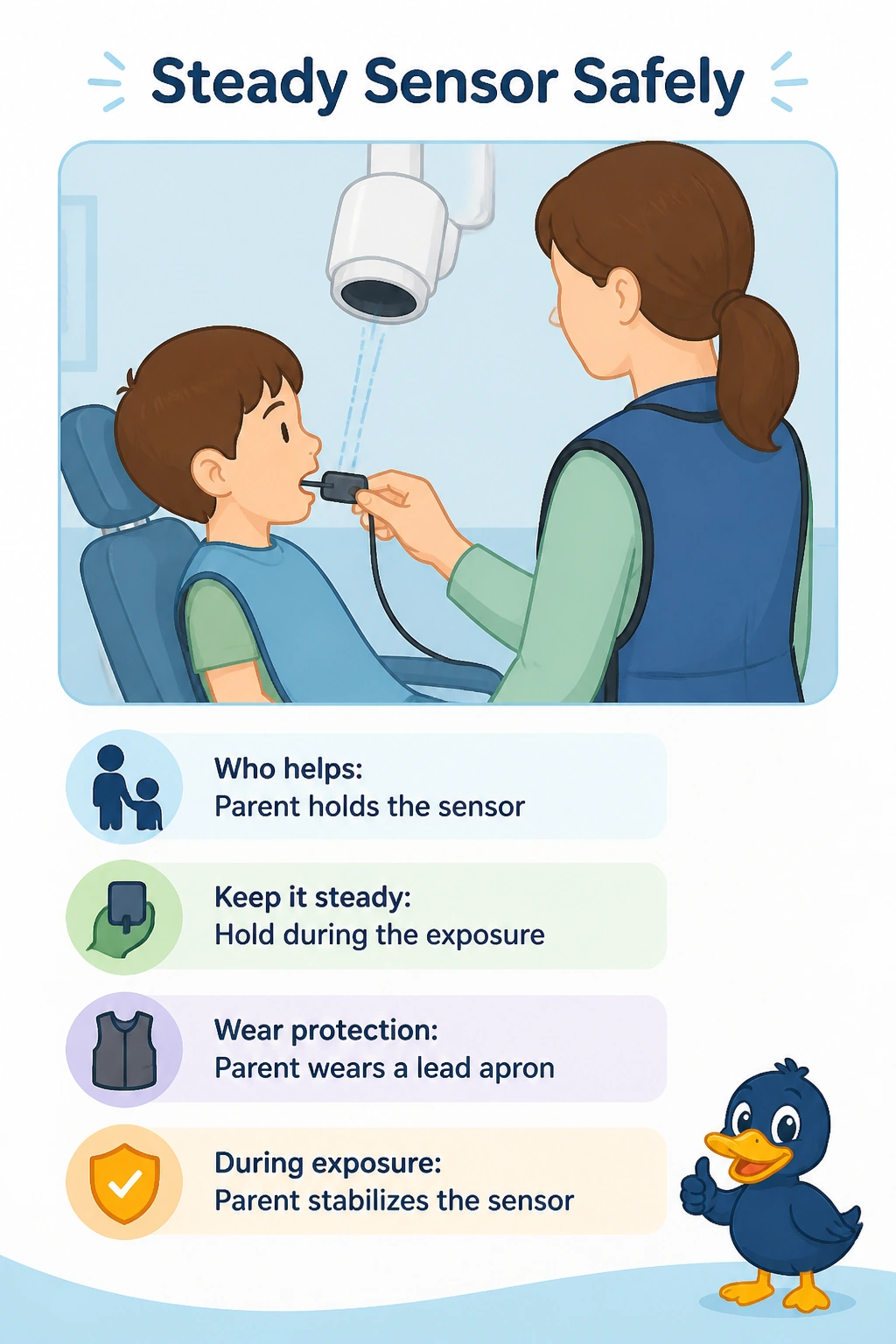
Short Explanation
When a young child cannot hold the sensor, your instinct to step in and steady it yourself is a classic radiation-safety trap. Dental staff must never hold receptors during exposure; let the parent step in with proper shielding.
Full Explanation
Under radiation protection standards, dental personnel must never hold the image receptor in a patient's mouth during an exposure; instead, Have the parent hold the sensor while wearing a lead apron (and thyroid collar) while the operator steps behind the barrier or outside the primary beam. This protects staff from unnecessary occupational exposure over a career. Choosing to Hold the sensor in place yourself while wearing a lead-lined protective glove is prohibited, because occupational exposure to the primary beam or scatter is unacceptable and lead gloves can attenuate automatic exposure or still allow scatter exposure to the body. Choosing to Increase the kVp setting so the X-ray exposure finishes more quickly alters image contrast and penetration rather than solving receptor movement, and kVp does not shorten the timer setting on its own. Similarly, choosing to Ask a coworker from the front desk to stabilize the sensor briefly merely shifts occupational radiation exposure onto another employee, which violates ALARA and workplace radiation safety rules. One caveat is to confirm that the parent or caregiver is not pregnant before asking them to remain in the room during exposure. As an operational check, position the parent's hand outside the path of the primary X-ray beam before pressing the exposure button.
Prefer to study offline? Printable PDF study book + test engine ($7.50, unofficial). These questions stay free here.