
During diagnostic dental X-ray exposures, most cellular injury occurs through an indirect biological mechanism rather than photons striking DNA directly. How does this indirect effect primarily damage human cells?
Select an answer to reveal the explanation.
Short Explanation
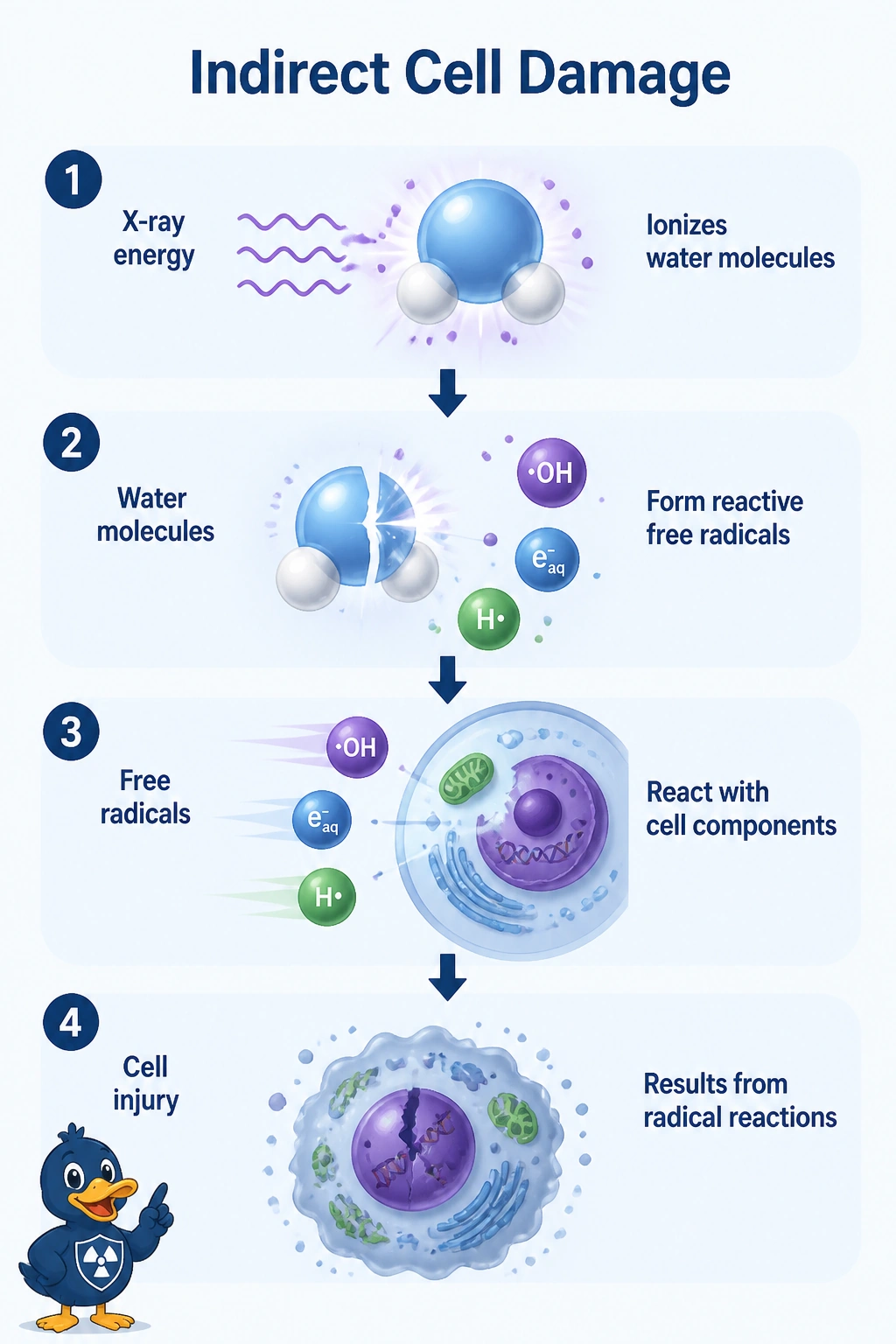
Because human cells are mostly water, X-ray photons are far more likely to hit water than to score a bullseye on DNA. You can remember the indirect effect as water splitting into unstable free radicals that chemically attack nearby molecules. The trap is thinking diagnostic X-rays cook tissue with heat or make bone radioactive.
Full Explanation
Because human soft tissue consists predominantly of water, ionizing X-ray photons interact with water molecules much more frequently than with critical macromolecules like DNA. This process, known as radiolysis of water, damages cells primarily By ionizing water molecules to form reactive free radicals such as hydroxyl and hydrogen radicals. These highly unstable chemical species diffuse short distances and react with cellular DNA or enzymes, causing strand breaks or molecular disruption. Diagnostic dental X-rays do not operate By heating intracellular proteins until cell membranes rupture, because diagnostic exposure energies produce negligible thermal rise in tissue. They also do not act By converting stable calcium in bone into radioactive isotopes, as dental X-ray energies are far below the threshold required to induce nuclear radioactivity in tissue. Similarly, injury does not occur primarily By knocking inner-shell electrons from DNA bases as the dominant interaction, because that describes the rarer direct effect, not the predominant indirect pathway. As a caveat, free radical reactions occur almost instantaneously, though any resulting biological expression may take years to appear. As an operational check, applying ALARA principles such as collimation and fast digital receptors directly lowers the total photon energy deposited in patient water molecules.
Prefer to study offline? Printable PDF study book + test engine ($7.50, unofficial). These questions stay free here.