
A dental assistant is setting up a full-mouth digital radiographic series and prepares to take periapical images of the maxillary central incisors and canines. How should the intraoral digital receptor be oriented for all anterior periapical exposures?
Select an answer to reveal the explanation.
Short Explanation
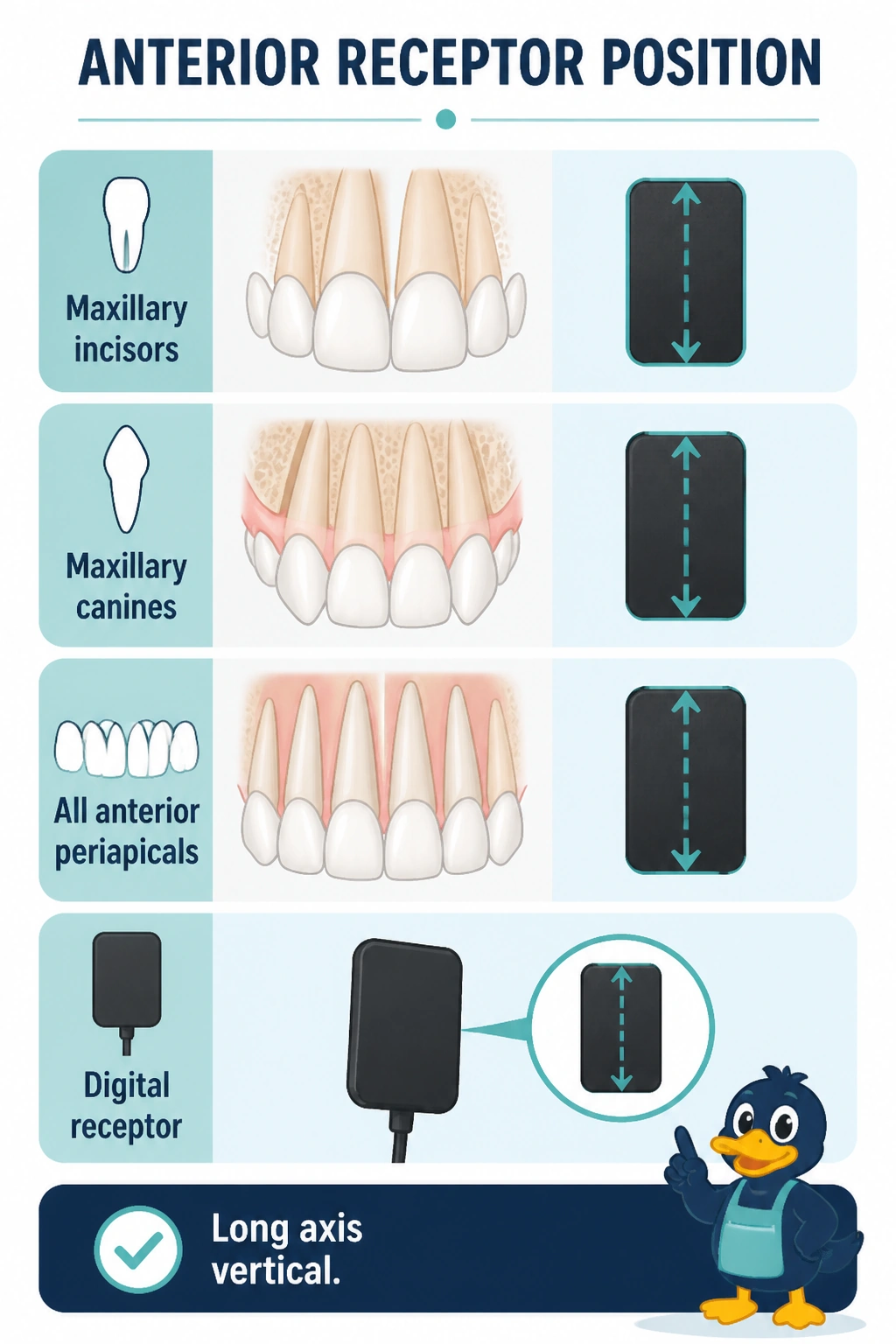
Think of taking a portrait photo of a tall building—you turn your camera upright so the roof and foundation both fit in the frame. Anterior teeth have long, narrow roots, so orienting the sensor vertically captures both the incisal edge and the apex. The trap is leaving the sensor horizontal as you do for molars, which clips the root tips.
Full Explanation
For all maxillary and mandibular anterior periapical radiographs, the receptor must be positioned With the long axis of the receptor oriented vertically. Because incisors and canines have long roots and narrow mesiodistal crowns, vertical orientation matches tooth anatomy, allows comfortable placement in the narrower anterior arch, and ensures adequate bone beyond the root apices is captured. Positioning the sensor With the long axis of the receptor oriented horizontally is standard for posterior periapical and horizontal bitewing projections, where wider mesiodistal coverage is needed; used anteriorly, it causes pain against the lingual mucosa and risks cutting off long canine or incisor apices. Placing the sensor With the receptor angled diagonally across the occlusal plane produces a slanted, distorted image that fails to keep the receptor parallel to the long axis of the tooth. Placing the sensor With the receptor placed flat between the occlusal surfaces describes an occlusal projection rather than a periapical radiograph and will foreshorten or miss the periapical bone if used with a standard periapical beam angle. As a caveat, patients with a narrow V-shaped arch may also require switching from a Size 2 to a narrower Size 1 receptor. As an operational check, verify the anterior aiming ring and bite block are assembled for vertical orientation before seating the sensor.
Prefer to study offline? Printable PDF study book + test engine ($7.50, unofficial). These questions stay free here.