
An 8-year-old patient in the mixed dentition stage presents for an orthodontic screening to evaluate the presence, position, and eruption paths of all unerupted permanent premolars and canines across both arches. Which radiographic projection provides the most comprehensive view for this assessment?
Select an answer to reveal the explanation.
Short Explanation
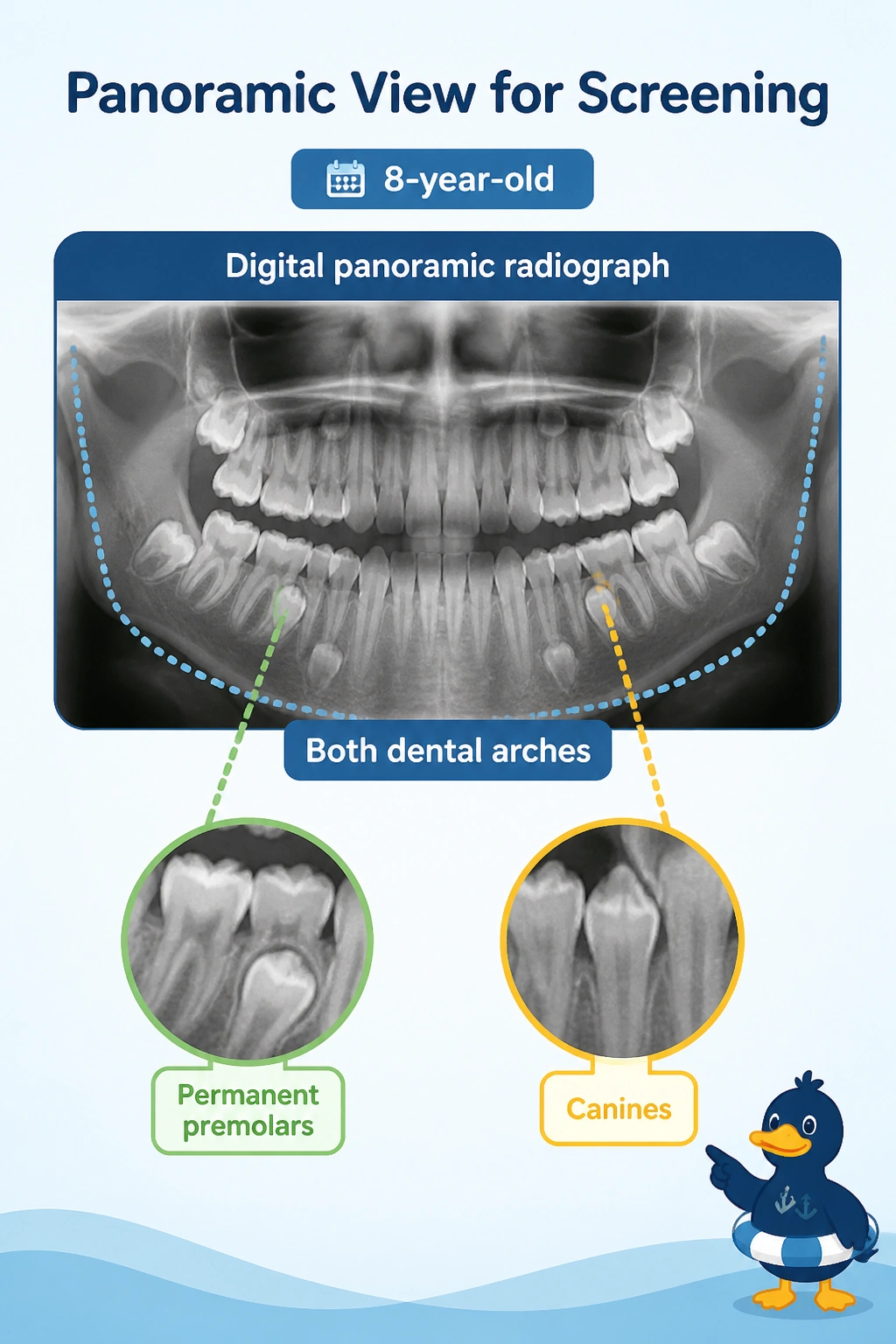
When you need a big-picture map of unerupted permanent teeth, posterior bitewings, a mandibular occlusal view, and anterior periapicals each leave parts of the assessment out. A panoramic image shows both arches at once, so you can assess them without crowding your child’s small mouth with multiple intraoral images.
Full Explanation
Evaluating mixed dentition development requires viewing the developing crowns, roots, positions, and eruption paths of unerupted permanent teeth across both arches. A digital panoramic radiograph covering both dental arches provides this broad, bilateral view in one image, making it the most comprehensive choice for this screening. A four-image posterior horizontal bitewing series primarily shows erupted posterior crowns and crestal bone, so it misses deeply positioned permanent canines and premolar crypts. A mandibular cross-sectional occlusal projection shows the mandibular floor of the mouth and buccolingual arch width, but covers only the mandible and does not show the maxilla or vertical eruption paths. A series of Size 0 anterior periapical images covers only the anterior segments and cannot survey posterior premolar development or overall arch symmetry without multiple intraoral placements. Exam caveat: panoramic images have inherent magnification and lower spatial resolution than intraoral sensors; if an ectopic canine or supernumerary tooth is identified, targeted periapical or limited-field CBCT imaging may still be needed. Practical check: select the pediatric panoramic exposure setting and carefully align the child’s Frankfort horizontal plane before starting the scan.
Prefer to study offline? Printable PDF study book + test engine ($7.50, unofficial). These questions stay free here.