
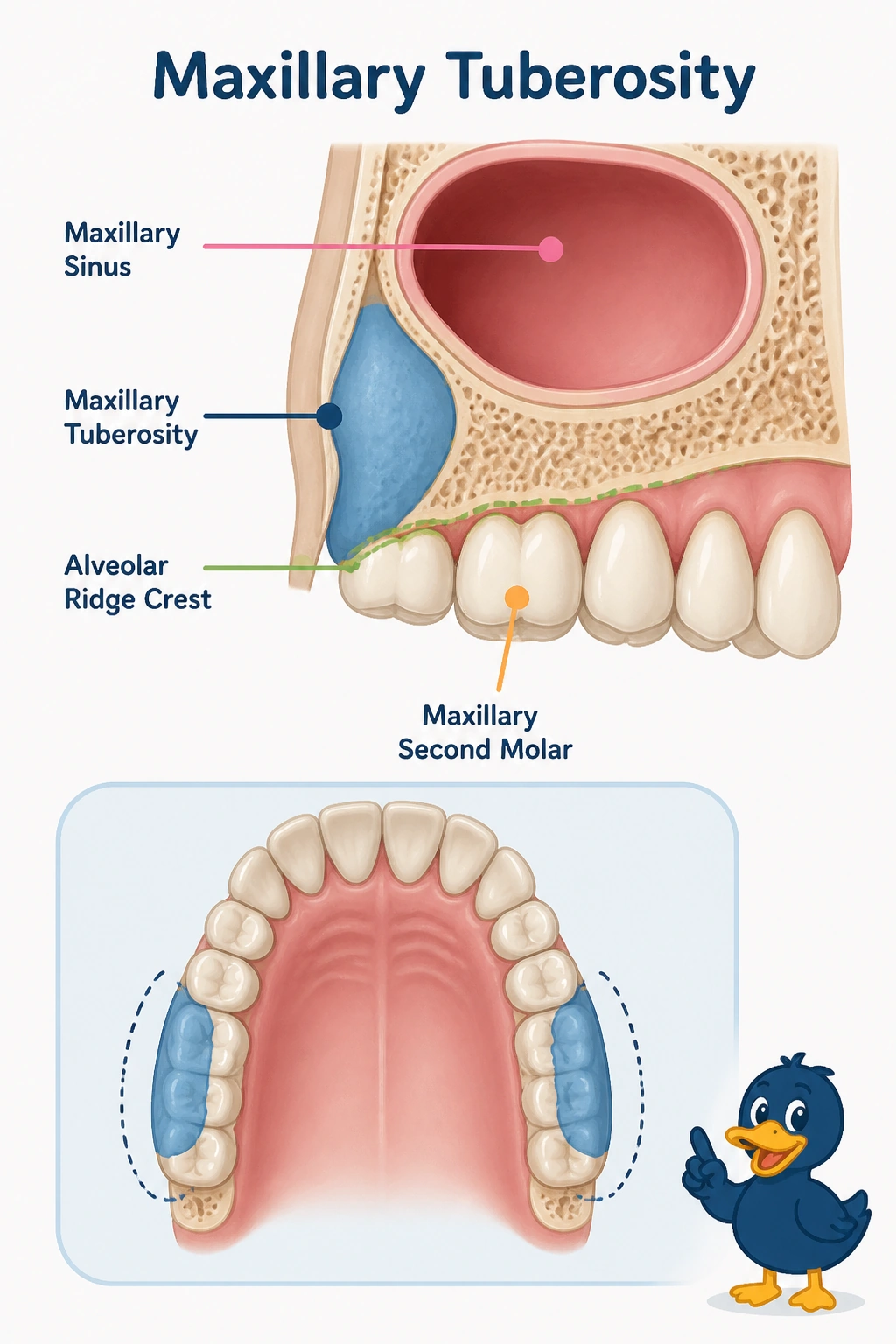
While reviewing a digital periapical radiograph of a maxillary second molar, a clinician observes a rounded, trabeculated radiopaque bony prominence extending posteriorly behind the molar, bordered superiorly by the maxillary sinus and inferiorly by the alveolar ridge crest. Which normal anatomical landmark does this structure represent?
Select an answer to reveal the explanation.
Short Explanation
You can recognize the rounded, trabeculated prominence behind your upper back molars as the maxillary tuberosity. It sits below the maxillary sinus and above the alveolar ridge crest, unlike the triangular coronoid process, the U- or J-shaped zygomatic process, or the small hook-shaped pterygoid hamulus.
Full Explanation
At the posterior end of the maxillary alveolar ridge, the maxillary tuberosity is a rounded, marrow-containing radiopaque prominence extending distally behind the most posterior molar, often just below the posterior border of the maxillary sinus. Its trabeculated appearance and location between the sinus and alveolar ridge crest identify it as the normal landmark described. The coronoid process of the mandible is a triangular radiopacity that projects upward and forward from the lower jaw; it typically overlaps the tuberosity or molar crowns from below when the patient opens wide. The zygomatic process of the maxilla forms a dense U-shaped or J-shaped radiopaque loop near the apices of the maxillary first and second molars, not behind the last molar. The pterygoid hamulus of the sphenoid bone is a small, distinct hook-like radiopaque projection extending downward just posterior and superior to the tuberosity. Caveat: an enlarged or fibrous tuberosity can resemble a bony exostosis or retained root fragment when trabecular patterns are dense, so trace its cortical border carefully. Practical check: position the digital sensor far enough posteriorly in the molar periapical view to capture the full distal surface of the last molar and the adjacent tuberosity.
Prefer to study offline? Printable PDF study book + test engine ($7.50, unofficial). These questions stay free here.