
After exposing a series of photostimulable phosphor (PSP) plates, a dental assistant removes the plates from their barrier envelopes on a brightly lit operatory counter and leaves them uncovered for several minutes before scanning. How will this delay most likely affect the resulting digital images?
Select an answer to reveal the explanation.
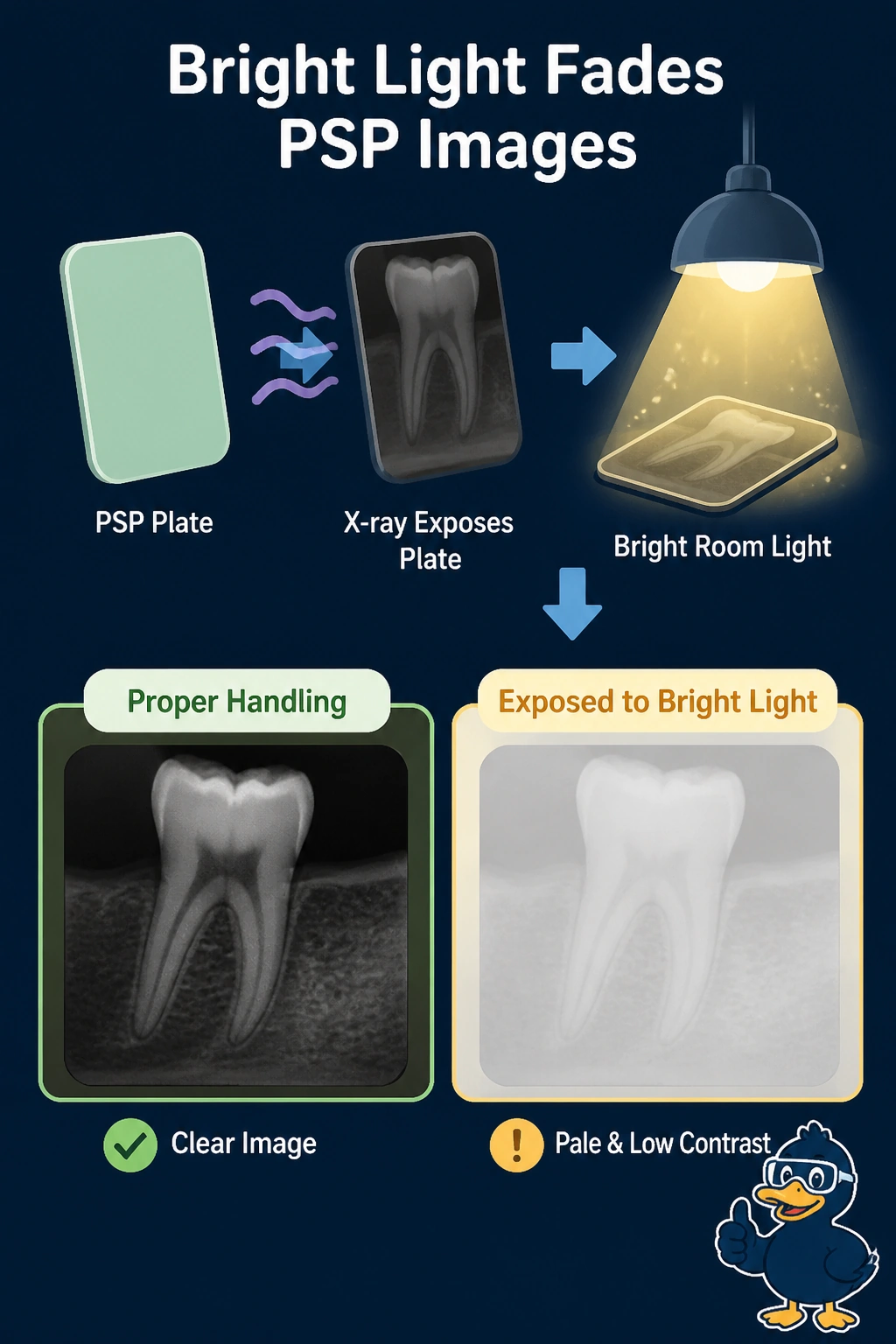
Short Explanation
You can think of a PSP plate’s stored image like glow-in-the-dark paint: bright operatory light makes the signal fade before the scanner reads it. That leaves you with pale, low-contrast images—not extra darkness, a double exposure, or stretched crowns.
Full Explanation
Photostimulable phosphor (PSP) plates store X-ray energy in a crystalline phosphor layer as a latent image until a scanning laser stimulates trapped electrons to release light. Bright ambient room light can prematurely release those electrons, so leaving unwrapped plates on a brightly lit counter causes signal loss: the images appear pale and low in contrast because the stored signal has been partially erased. Room light does not add exposure to the phosphor, so it cannot make images uniformly too dark; it depletes the trapped signal instead. Two superimposed sets of teeth would result from a double-exposure error, such as skipping the erase cycle, not from fading of a single exposure. Severe localized stretching of tooth crowns describes geometric distortion from bending a plate in the patient’s mouth, not signal loss from ambient light. As an exam caveat, even brief exposure to intense operatory task lighting can degrade subtle incipient caries contrast. As a practical check, handle unwrapped PSP plates in subdued lighting and feed them into the scanner immediately after barrier removal.
Prefer to study offline? Printable PDF study book + test engine ($7.50, unofficial). These questions stay free here.