
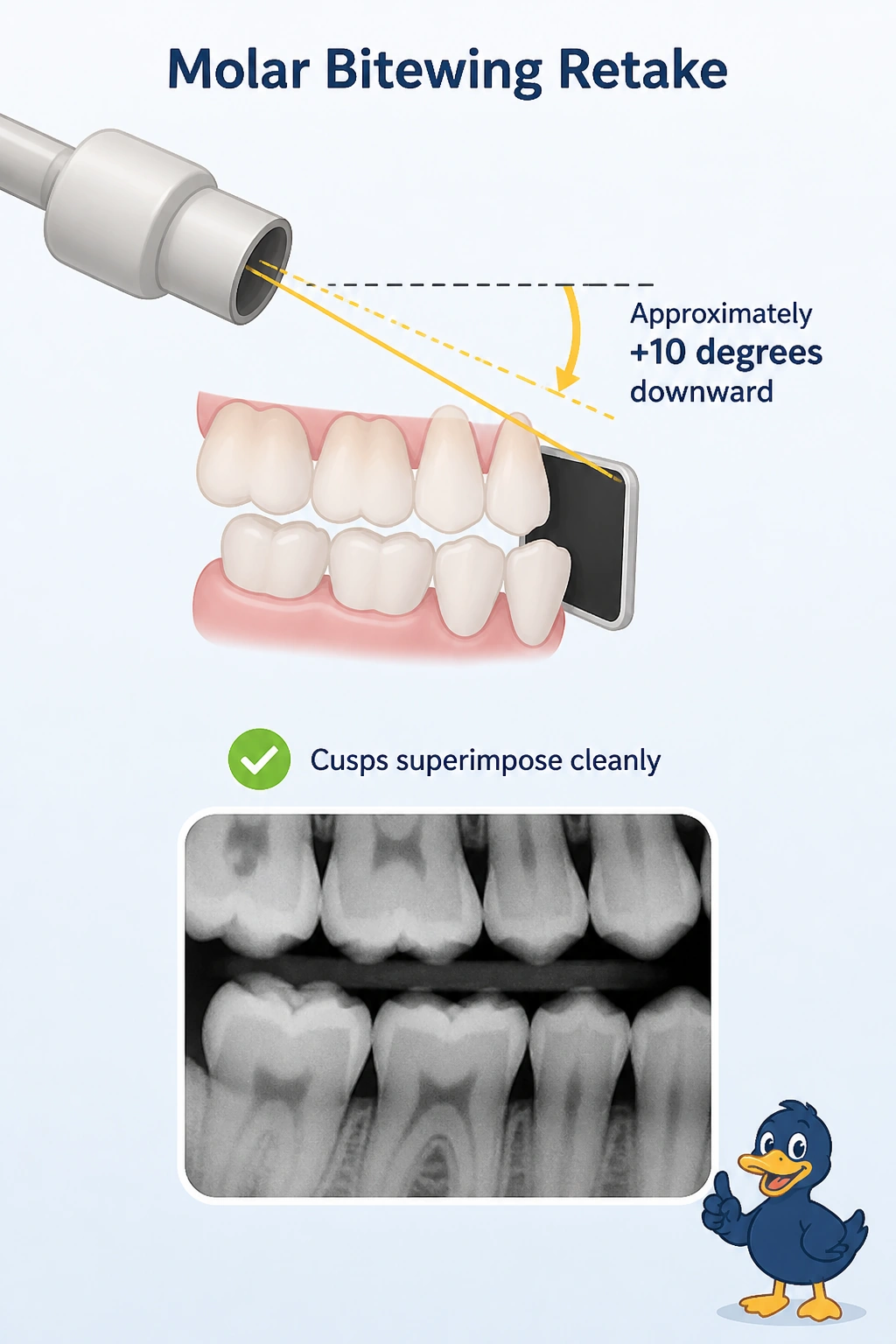
While evaluating a horizontal digital molar bitewing radiograph, you notice that the buccal and lingual cusps of the maxillary and mandibular molars are widely separated vertically, obscuring the occlusal enamel and crestal bone height. How should you adjust the setup for the retake?
Select an answer to reveal the explanation.
Short Explanation
Think of a bitewing like looking straight down a hallway—if you tilt your head too steeply up or down, the ceiling and floor overlap the view. The trap is blaming horizontal angulation or receptor placement when the real culprit is vertical tilt separating the buccal and lingual cusps.
Full Explanation
In posterior horizontal bitewing radiography, the maxillary teeth tilt slightly buccally, so directing the central X-ray beam at roughly +10 degrees downward places it perpendicular to the mean plane of the crowns and receptor, superimposing the buccal and lingual cusps. When excessive or negative vertical angulation separates the cusps vertically, you must Set the vertical angulation to approximately +10 degrees downward so the cusps superimpose cleanly. Choosing Shift the horizontal angulation mesially or distally so the central X-ray beam passes directly between the proximal contacts corrects interproximal horizontal overlap, not vertical cusp separation. Choosing Move the receptor farther posteriorly in the arch to capture the distal surface of the second molar fixes posterior anatomical cropping rather than vertical distortion. Choosing Rotate the bitewing receptor vertically so its long axis runs parallel to the long axes of the molar roots is used to visualize moderate-to-severe periodontal bone loss, not to correct vertical angulation errors. As a caveat, even with an aiming ring, improper bite-tab seating can tilt the sensor and mimic a vertical angulation error. As an operational check, have the patient bite firmly on the tab while keeping the occlusal plane parallel to the floor and verify +10 degrees on the tubehead dial.
Prefer to study offline? Printable PDF study book + test engine ($7.50, unofficial). These questions stay free here.