
A patient presents with severe trismus and facial swelling from a suspected odontogenic infection and cannot open their mouth more than a few millimeters. Which radiographic approach is most appropriate to evaluate the jaws without forcing the mouth open?
Select an answer to reveal the explanation.
Short Explanation
When a patient's jaw is locked shut by swelling and trismus, forcing a rigid sensor inside the mouth only causes pain and a nondiagnostic retake. Stepping outside the mouth with a panoramic unit gives you the overview safely.
Full Explanation
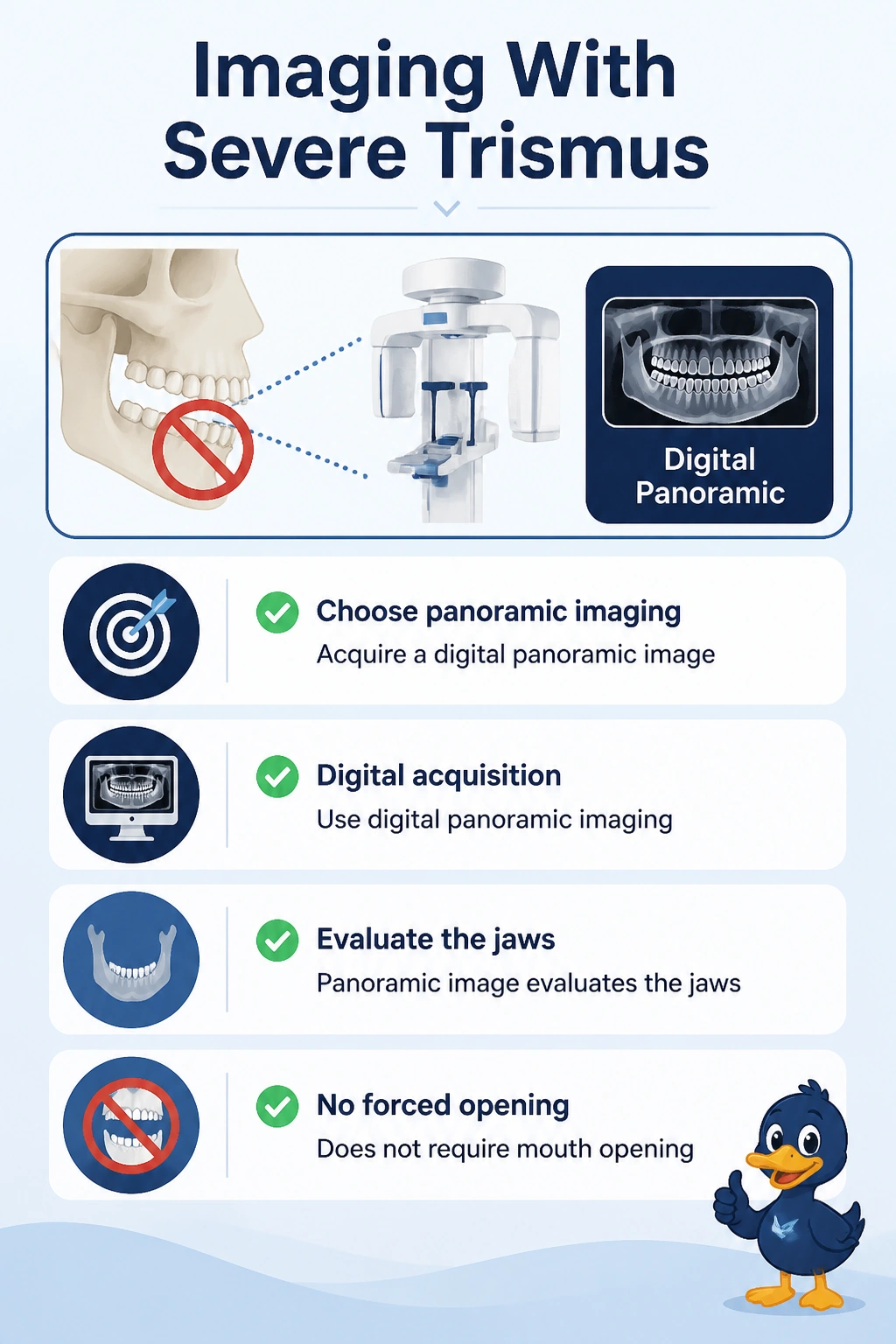
Acquire a digital panoramic image because extraoral radiography keeps the image receptor and X-ray source outside the oral cavity, allowing evaluation of impacted teeth, jawbone pathology, and infection extent when severe trismus prevents intraoral access. Use a Size 2 periapical bite block requires opening the mouth wide enough to insert a rigid sensor and aiming holder vertically against the palate or floor of the mouth, which is impossible or painful with severe trismus. Take a maxillary topographic occlusal still requires inserting a wide intraoral receptor between the occlusal surfaces of the teeth, which cannot be seated properly when opening is restricted to a few millimeters. Expose four horizontal molar bitewings also depends on intraoral sensor placement and biting onto a tab or holder, making it unsuitable for a patient who cannot open. As a clinical caveat, if the patient cannot bite onto the panoramic bite-stick notch because of swelling, use an edentulous chin rest or cotton-roll stabilization as directed by the unit manufacturer. For an operational check, remove any metallic jewelry or eyeglasses, verify the patient can remain still for the rotation, and confirm the affected jaw region is fully visible.
Prefer to study offline? Printable PDF study book + test engine ($7.50, unofficial). These questions stay free here.