
While reviewing a digital periapical radiograph of asymptomatic maxillary central incisors, a clinician notices a thin, vertical radiolucent line extending superiorly from the alveolar crest between the roots. Which structure or finding does this most likely represent?
Select an answer to reveal the explanation.
Short Explanation
That thin dark line running straight up between the upper front teeth can give you a scare if it looks like a split bone. The trap is mistaking normal anatomy for trauma when the patient has no pain or history of injury. Checking the smooth, continuous borders of the suture keeps you from calling a false alarm.
Full Explanation
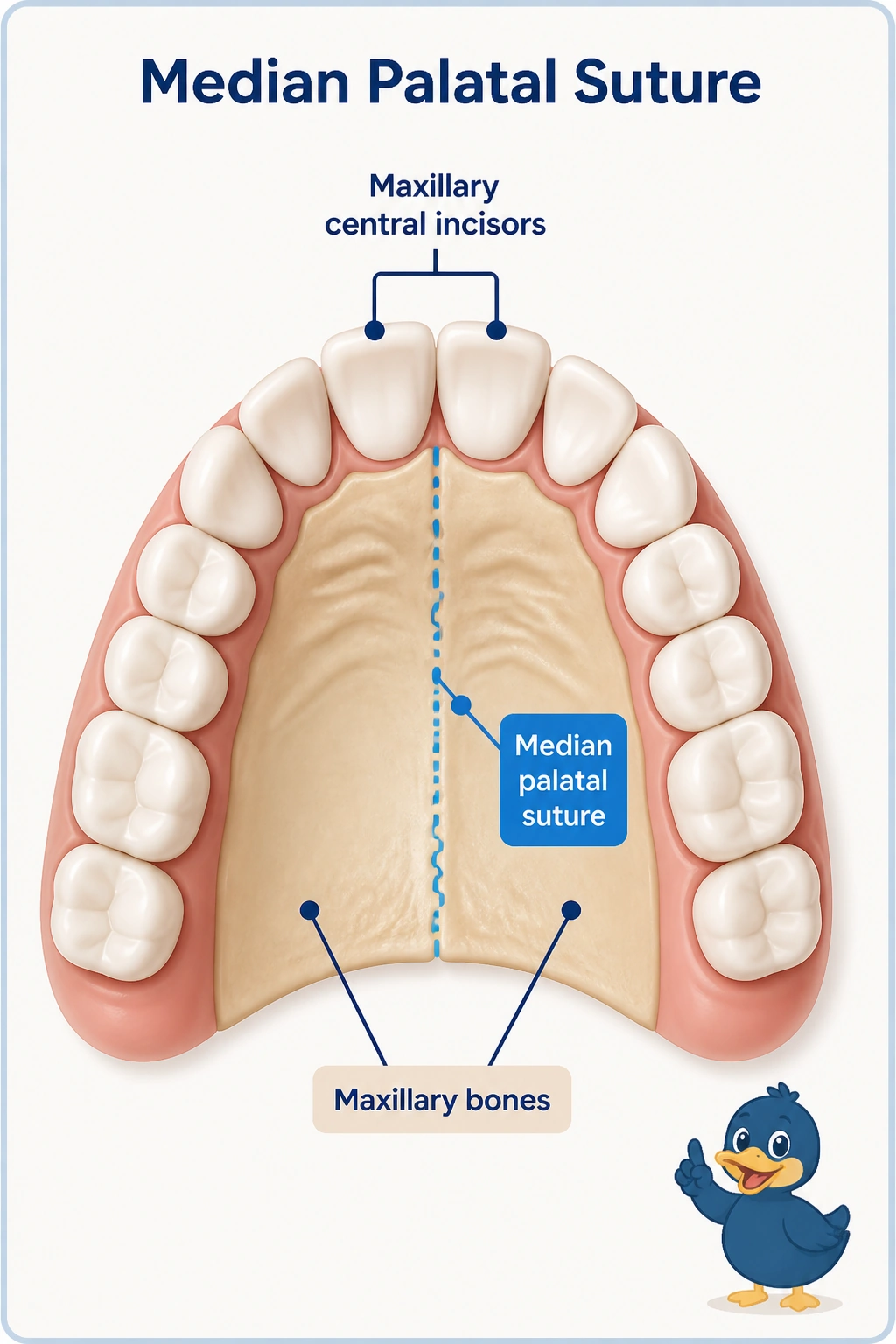
On a maxillary central incisor periapical radiograph, the X-ray beam passes directly through the intermaxillary articulation, which contains thin connective tissue rather than dense cortical bone. The median palatal suture, a normal anatomical junction between the maxillary bones therefore appears as a thin, vertical radiolucent line extending upward from the alveolar crest between the central incisor roots, bordered by smooth cortical margins. The incisive foramen, an oval opening near the central incisor apices is incorrect because that landmark presents as a round or oval radiolucency centered between and slightly above the root tips rather than a narrow vertical line starting at the crest. The anterior nasal spine, a dense projection at the base of the septum is incorrect because it appears as a V-shaped radiopacity superior to the apices rather than a dark radiolucent line. A vertical midline alveolar fracture requiring immediate splinting is incorrect in an asymptomatic patient because a true fracture typically disrupts the lamina dura or cortical plate and correlates with clinical trauma, swelling, or tooth mobility. As a clinical caveat, this suture can be wider and more radiolucent in younger patients whose palatal bones have not yet fully fused. Before documenting pathology, correlate any midline radiolucency with clinical percussion, mobility testing, and the patient's trauma history.
Prefer to study offline? Printable PDF study book + test engine ($7.50, unofficial). These questions stay free here.