
When positioning the tubehead for a posterior horizontal digital bitewing radiograph without an aiming ring, why should the dental assistant direct the central X-ray beam at approximately +10 degrees downward?
Select an answer to reveal the explanation.
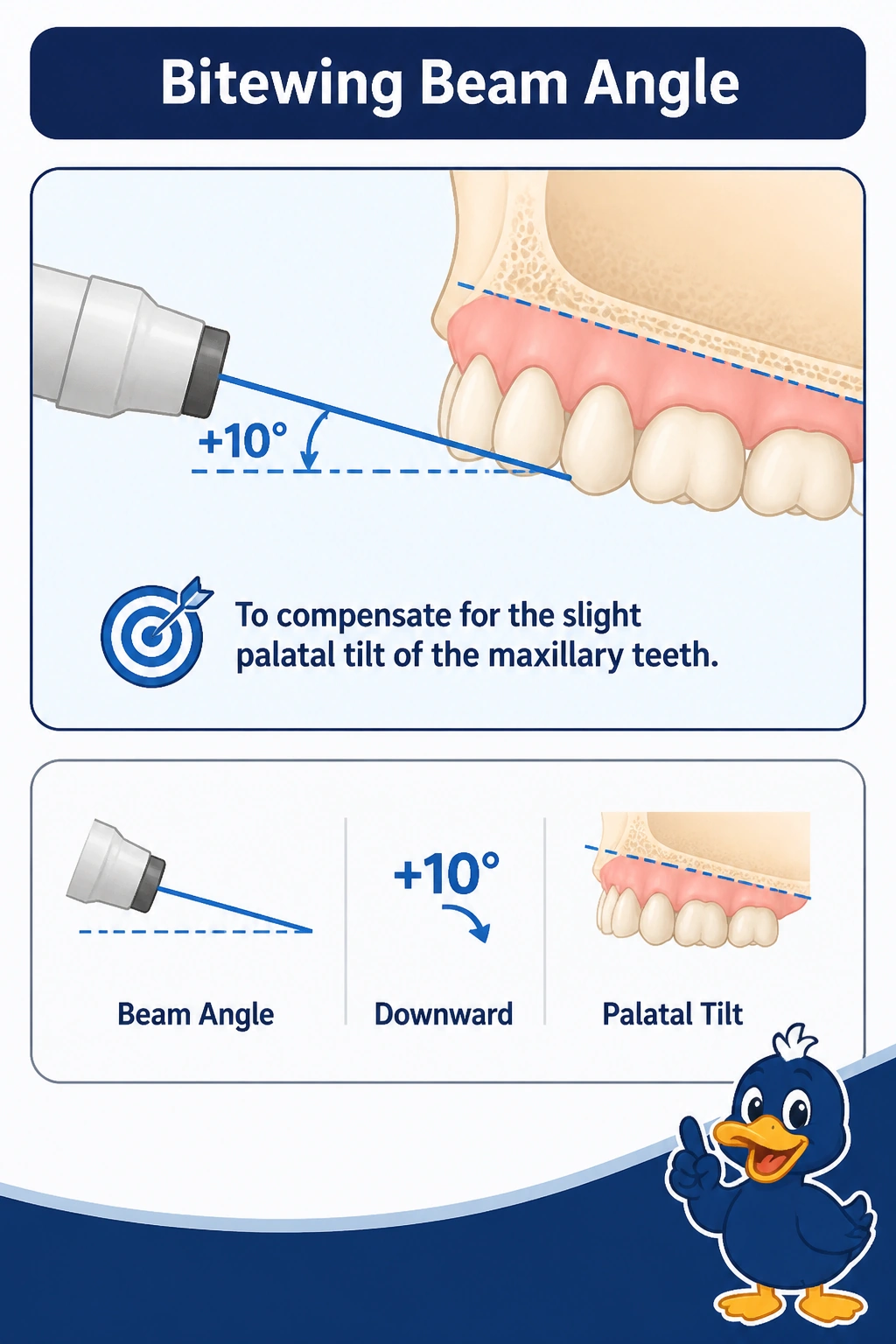
Short Explanation
Think of a slight +10-degree downward nod as matching the natural inward lean of your upper back teeth. The trap is thinking vertical angulation opens side-to-side contacts, when horizontal angulation actually handles that job.
Full Explanation
Maxillary posterior crowns tilt slightly buccally while their roots incline palatally, and the occlusal curve slopes gently upward, so a +10-degree downward beam keeps the central ray perpendicular to the receptor's average plane, making To compensate for the slight palatal tilt of the maxillary teeth correct. By contrast, To open the interproximal contacts between adjacent premolar crowns depends on horizontal angulation—directing the beam straight through the contact areas—not vertical angulation. Selecting To project the zygomatic process superiorly above the molar apices applies to maxillary periapical technique adjustments rather than bitewing imaging, which does not include root apices. Likewise, To eliminate cone-cutting along the distal edge of the digital sensor is achieved by centering the position-indicating device over the receptor rather than tilting it vertically. As a technique caveat, using an excessive positive vertical angle beyond +10 degrees distorts the occlusal surfaces and can clip the mandibular alveolar crest. For an operational check, confirm on the finished bitewing that both maxillary and mandibular crowns and alveolar crests appear symmetrically without vertical overlap.
Prefer to study offline? Printable PDF study book + test engine ($7.50, unofficial). These questions stay free here.